
KINGSTON, R.I. – Sept. 8, 2023 – Dun dun ….
One of the more unique lecture series in Rhode Island marks a milestone this fall — certainly worthy of a Law and Order-style dramatic pause — when the University of Rhode Island Forensic Science Seminar Series celebrates its 25th year. It’s a long-running successful series, too.
The annual series takes place in the University of Rhode Island’s Beaupre Center on Friday afternoons. During its run, the series has hosted the likes of Henry Lee, the renowned forensic scientist who worked on the O.J. Simpson criminal case; the late URI faculty member, Robert Leuci, who exposed corruption in the New York Police Department; Mary Jane Behrends Clark ’76, a former CBS News producer and best-selling suspense novelist; Anthony Amore ’89, chief of security at the Isabella Stewart Gardner Museum in Boston; and Kirk Yeager, the FBI’s chief explosives scientist. Visiting speakers have discussed everything from blood spatter and hair analysis to Sherlock Holmes and terrorism, coming to URI from the Naval Criminal Investigative Service , the U.S. Secret Service, Israeli Police, and more.
Pretty exciting for a Friday afternoon on a bucolic college campus.
Series started in 1999
Forensic anthropologist Douglas Ubelaker, senior scientist at the Smithsonian, was one of the first speakers in the series’ first year. The intervening years have witnessed remarkable advances in forensic sciences, he says. Much relates to modern technology, but also thoughtful research and greater awareness of issues inherent in case applications. Today’s forensic scientists employ scientific methods with a keen awareness of the probabilities and errors involved, so careful execution of methods employed is key, as well the need to properly express them in qualified reports and testimony.
“Recent attention to potential cognitive bias has contributed to more rigorous laboratory procedures,” Ubelaker says.
Much of the field’s progress has been fueled by the growing numbers of intelligent, motivated students attracted to forensic sciences, he says: “The field continues to offer opportunities for those trained in science to apply their knowledge and skills to key forensic issues in contemporary society. Seminar series and courses, such as those offered for the past 25 years at URI, expose students to this dynamic and rapidly changing field.”
Dennis Hilliard, director of the Rhode Island State Crime Laboratory at URI and adjunct professor of pharmacy; Chemistry Professor Jimmie Oxley, world renowned explosives and energetic materials expert and co-director of URI’s Center of Excellence in Explosives, Detection, Mitigation, and Response; and Everett Crisman, research professor emeritus in chemical engineering, launched the series. The application of forensic science, and the offerings at URI, have grown over the years, and now URI offers a bachelor’s degree in forensic chemistry, a cyber forensics program, and a bachelor’s degree in criminology and criminal justice.
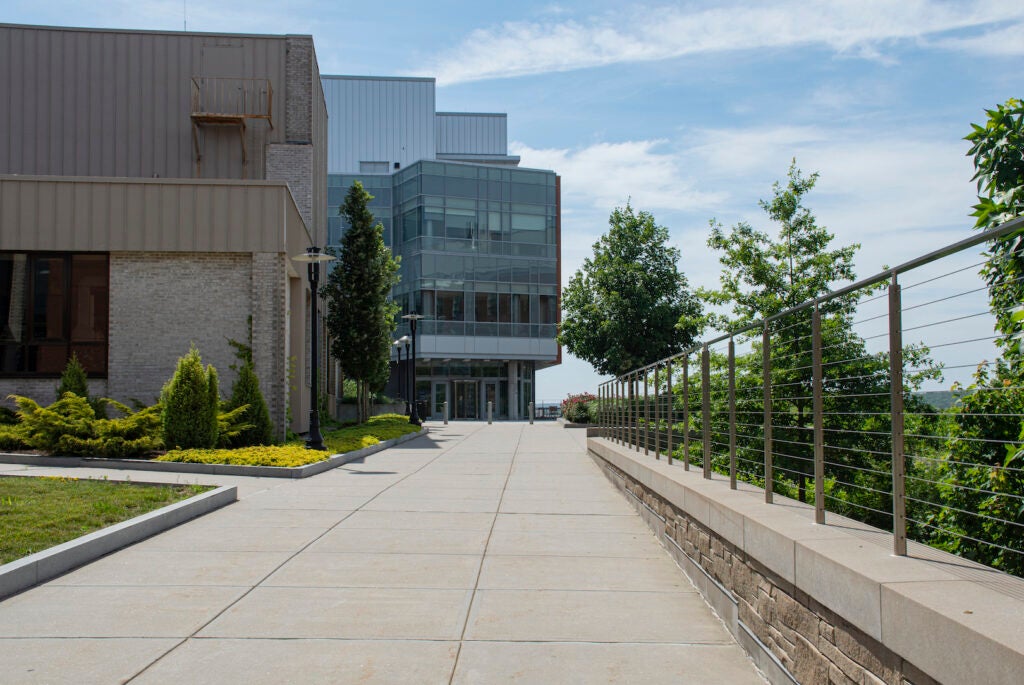
URI’s Forensic Science Seminar Series begins Sept. 15 this year. The series brings together researchers from across campus, with visiting guests, and is open to the public. (URI photo/Nora Lewis)
Crime Fridays
On Sept. 15, the series begins its 25th year inviting experts to URI to speak on topics in the field.
URI students attend the series for credit, but the lectures are open to the public at no cost.
The lectures are offered Friday afternoons, Sept. 15 through Dec. 8, in the Beaupre Center for Chemical and Forensic Sciences (Room 100) on URI’s Kingston Campus, 3:30 to 5 p.m.
The public is welcome to attend at no charge and can park in Lot 13 behind the Beaupre Center, which is open for general parking at 3 p.m. on seminar Fridays. High school students interested in forensics are welcome as well. Those who cannot attend in person may view the lectures live online or at a later date by visiting https://www.chm.uri.edu/forensics/seminars.php and clicking on the topic links.
This fall’s speakers and topics are:
Sept. 15 – “Crime Scene Processing,” James Clift, Providence Police Department. Clift will discuss his role as a crime scene investigator for the Providence Police Department, describing actual scenes processed in his 23-year career.
Sept. 22 – “Rhode Island State Health Labs Support of Law Enforcement,” Glen Gallagher, Rhode Island Health Department. Gallagher is director of the State Health Laboratory.
Sept. 29 – “Impaired Driving,” Anthony Silva, Rhode Island Police Chiefs Association. The Police Chiefs Association represents nearly 50 agencies serving more than 1 million Rhode Islanders.
Oct. 6 – “Ships Don’t Leave Skid Marks,” Dennis Nixon, URI. Nixon is professor emeritus of marine affairs at URI and the former director of Rhode Island Sea Grant. A marine lawyer by training, he has lectured on marine law topics in 27 states and 26 countries on 6 continents.
Oct. 13 – “Human Trafficking,” Michael Camal ’18, Department of Homeland Security, Washington, D.C. Camal manages the agency’s efforts to counter human trafficking. He credits his path to advocacy work with the start he received at URI, where he attended the lecture series as a student.
Oct. 20 – “Rhode Island Forensic Lab,” Cara Lupino, Rhode Island Health Department. Lupino (M.S. ’04) is the supervisor of forensic biology at the Rhode Island Department of Health, Center for Forensic Sciences. She has testified numerous times as an expert witness on the topics of forensic biology and forensic DNA.
Oct. 27 – “Blood Splatter / Reconstruction,” Peter Valentin, University of New Haven. A noted educator and crime scene investigator, Valentin is a member of the federal disaster forensic team responsible for human remains identification during terrorist events or disasters.
Nov. 3 – “Hoarding Animals,” Virginia Maxwell, University of New Haven. An expert in animal cruelty investigation, Maxwell uses data to predict hot spots for crimes against animals, such as dogfighting, and has studied abuse in horse racing.
Nov. 10 – “Prosecution Cases, Thanks to Forensics,” Jack McMahon, attorney and consultant. McMahon retired from the Rhode Island Office of the Attorney General in 2005 as an assistant attorney general, after 26 years of service.
Nov. 17 – “Toxicology,” Alexis Donaway, Rhode Island Department of Health. Donaway will discuss the use of toxicology to aid investigations.
Nov. 24 – No lecture, Thanksgiving recess
Dec. 1 – “Artificial Intelligence and the Law,” Michael DiLauro, attorney. DiLauro is a career public defender and advocate for criminal justice reform in Rhode Island.
Dec. 8 – “Junk Science and the American Criminal Justice System,” M. Chris Fabricant, Innocence Project. Fabricant leads the Innocence Project’s Strategic Litigation Department, addressing the causes of wrongful conviction. His writing and speaking focus on the intersection of science, law reform, and social justice.
(Schedule subject to change; join email list for updates)
Links to talks by prior speakers can be viewed here.
To learn more about the URI Forensic Seminar Series and be added to the series’ email list, email Dennis Hilliard, M.S. ’80, Rhode Island State Crime Laboratory, at dhilliard@uri.edu, or call 401-874-5056.