
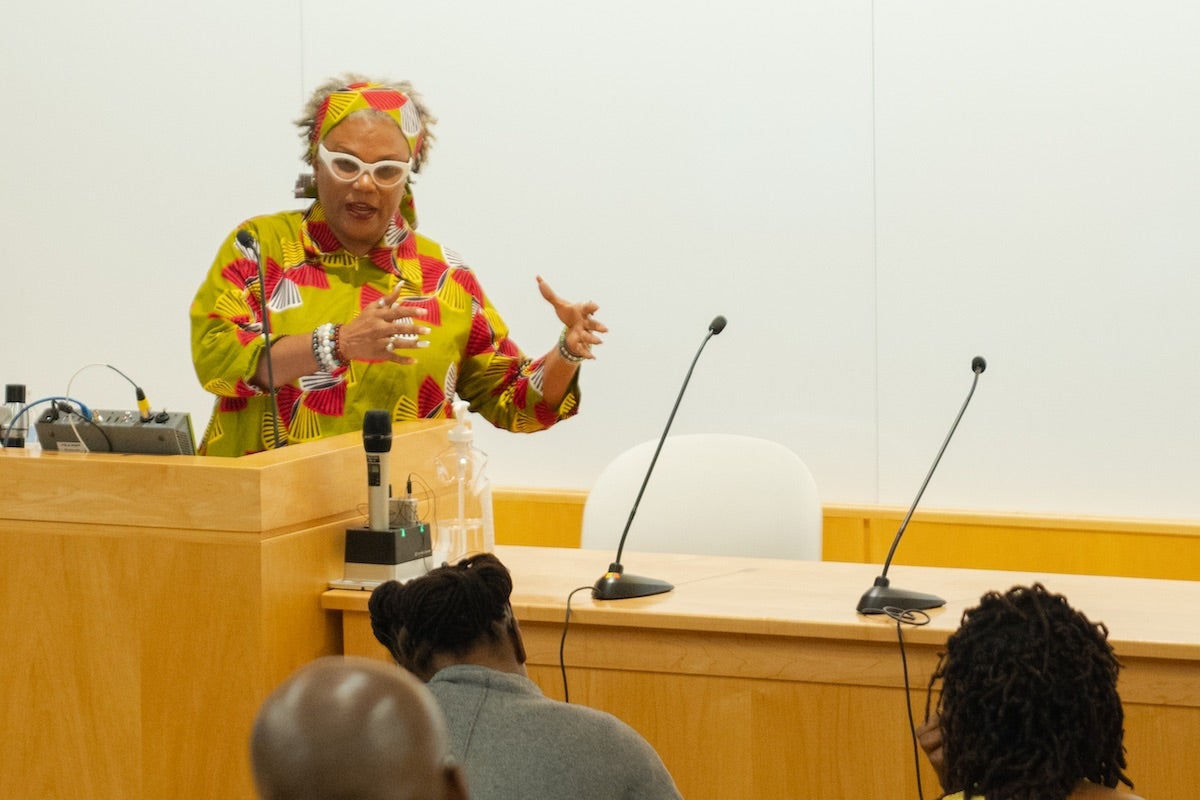
KINGSTON, R.I. – Feb. 17, 2023 – When Taitu Heron was an undergraduate student, before she went on to become an international development specialist focusing on women’s issues, she had an experience that continues to shape her view of feminist activism today.
As a volunteer for a nongovernmental organization called Women’s Media Watch, Heron attended a training session on domestic violence issues, aimed at helping women in an underserved community in her home country of Jamaica. In the back of the room, where food was being served, Heron struck up a conversation with an attendee. As Heron drew on feminist theory to lament the rigid gender roles and constructs that made things difficult for women, the woman she spoke with seemed exasperated.
“She paused and said … ‘You can’t carry feminism to the supermarket,’” Heron recalled the woman saying as she packed food into containers for her children. “Neither I nor feminism was of any concern to her. She came for the food.”
For Heron, the conversation was a reminder that while the theoretical foundations of feminism are useful in analyzing gender-related issues, they don’t always resonate in the everyday lives of women around the world. During a lecture and roundtable discussion held Wednesday, Feb. 15, on URI’s Kingston Campus, Heron suggested that it may be time to expand feminism’s traditional framework.
“We have a lot to think through,” Heron said. “We’re in a new juncture … as activists, academics, and so on where feminism is concerned. The epistemological foundation [of feminism] is still problematic and I think there’s a need for us to move beyond that.”
A Caribbean scholar, activist, and poet, Heron is currently head of the Women and Development Unit at the University of the West Indies, Open Campus. She spoke as part of the College of Arts and Sciences’ annual lecture series on African Americans, Black Diaspora and Global Black Lives. The talk was also part of the African-Caribbean Intersectional Engagement Series, a collaboration between the University’s departments of Africana Studies and Gender and Women’s Studies.
In her talk, “What Are We Fighting For? Feminist Challenges and the Search for Dignity In Gender Equality Work in the Caribbean,” Heron warned of a self-serving form of feminism she’s seen in her time working in development, academia and nongovernmental organizations. She terms it “fe’me’nism.”
“As feminism has gone mainstream, the imperative of feminist discontent seems to have been displaced by the lure of respectability, status, and the rewards of inclusion,” she said. This type of feminism, she added, has elsewhere been referred to as “feminism for the 1%.”
Too often, Heron said, this type of feminism focuses on women as victims of their circumstances rather than victors over them. She cited the example of a young woman she had worked with who had been abused as a child, but had written a self-published book about her healing process afterward. The woman was given a chance to tell her story at a conference hosted by a large nongovernmental organization. But the organization was particular about how they wanted the woman to tell her story.
“They wanted her to speak,” Heron said. “But they did not want her to spend time on the victory path of her life. They wanted her to focus on the part of her life when she was raped and what happened after that. They didn’t want her to focus on what tools she managed to find to become a victor.”
The woman ultimately chose not to speak.
This attitude toward victimhood is reflected in the structure of aid programs around the world, Heron said. Funding from nongovernmental organizations often doesn’t provide for things like legal support for women who want to go to court, jobs and skills training, and trauma therapy.
“These are the things that would move women from victim to victor,” Heron said. Yet they’re often left out of funding packages.
“It got me to think, if there were no more victims, and rather women moving from victimhood to thriving and surviving, what would feminists be doing?” Heron asked. “Is it that feminism needs victims in the same way that the International Monetary Fund needs countries to be indebted?”
However, Heron said, now is the time to think about expanding the traditional foundations of feminism in a way that can transform more people’s lives. The path forward to doing that, Heron suggested, is by looking beyond Western constructions of feminism.
“We need to spend more time and energy on building our own lives and on empowering ourselves,” she concluded. “We need to spend more time lifting up patterns in our history that have been repressed because of patriarchy—the ancient wisdom of women, the ancient wisdom of indigenous cultures, the ancient wisdom of civilizations of India and countries in Africa.”