
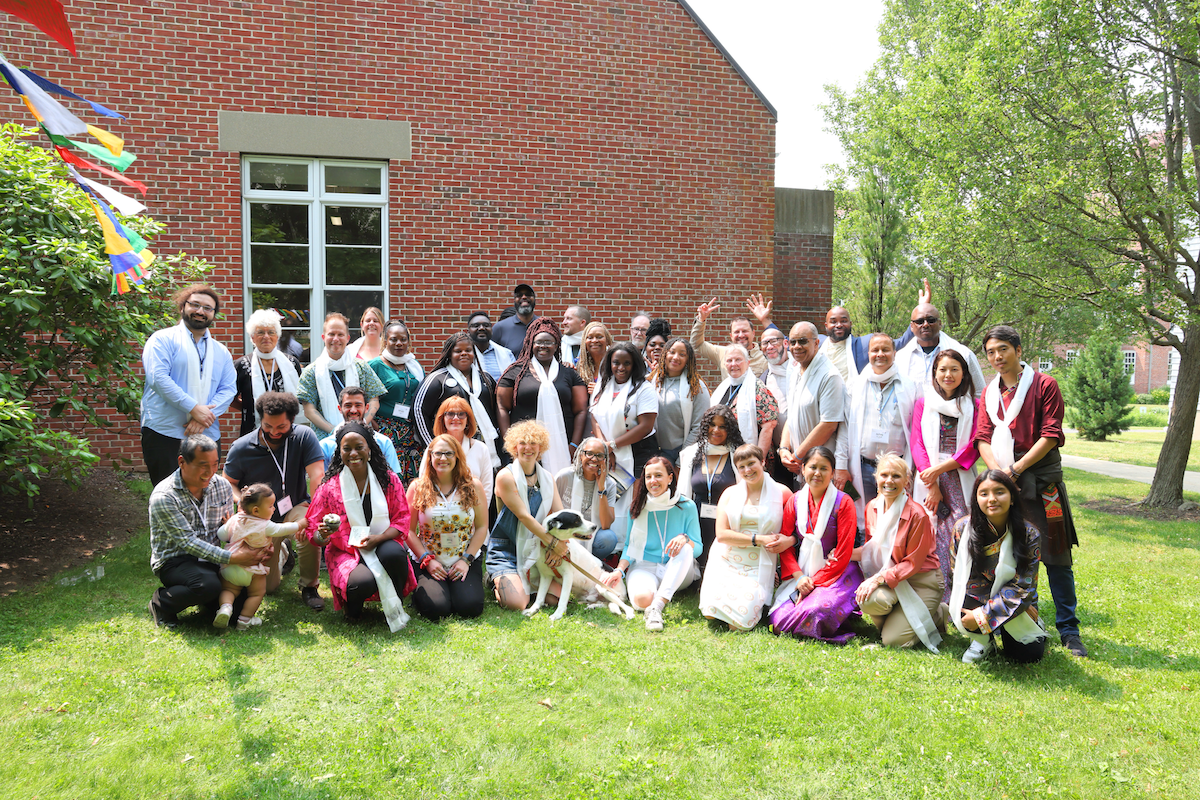
KINGSTON, RI. – June 27, 2023 – Graduates of the International Nonviolence Summer Institute at the University of Rhode Island have gone on to lead peace and nonviolence training efforts everywhere from Boston to Bangladesh. The institute recently celebrated its 24th graduating class, awarding nonviolence certification to 33 people representing 12 U.S. states and 7 countries.
The Nonviolence Summer Institute teaches a set of nonviolence principles derived from the philosophy and strategies of Dr. Martin Luther King Jr., including how to organize and mobilize to peacefully address violence and social justice issues. Graduates are equipped to implement these principles in their communities and teach them to others.
At a ceremony held June 16, Skip Mark, an assistant professor of political science at URI and director of the Center for Nonviolence and Peace Studies, encouraged the new graduates to take what they’ve learned to make positive change in the world.
“To each and every one of you who has completed the rigorous nonviolence training program, I extend my deepest congratulations,” Mark said. “Your commitment to personal growth, understanding, and compassion has set you apart as ambassadors of peace and agents of change. By embracing the principles of nonviolence, you have taken an active role in shaping a world that is free from the chains of hatred, discrimination, and injustice.”
The principles of Kingian nonviolence are outlined in King’s essay “A Pilgrimage to Nonviolence.” They include nonviolence as a form of courage, community and relationships as a means to head off violence, and ways of attacking systems that perpetuate injustice rather than people.
Since its founding in 1999, the URI Summer Institute has certified more than 1,000 people in Kingian nonviolence. This year’s graduates included educators and activists from Australia, India, Liberia, Tibet and elsewhere around the world. U.S. participants included a team of Peace Warriors from North Lawndale College Prep School in Chicago, faculty from universities in Wisconsin and Texas, as well as staff from URI.
“The program was really helpful as a model of how to form the ‘beloved community’ that King wrote about,” said Brian Scannell, a teacher at the Hawthorne Waldorf School in Ghent, New York. “I loved that the training was interactive and experiential and that the trainers took time to get to know the students.”
Jean Nsabumuremyi, director of the Multicultural Student Services Center at URI who received his level 1 certification, said the instruction will help greatly in his work.
“It allows me to see that we have a better alternative to respond to hate and violence,” he said. “The Kingian principles I learned in the program can support how we teach and educate our students to respond to injustices on campus, in the country, and around the world.”
Thupten Tendhar, a certified nonviolence trainer who works at the Center for Nonviolence and Peace Studies, said that the Summer Institute’s global reach makes it one of the leading Kingian nonviolence training programs in the world.
“URI-trained peacebuilders are actively training in Nonviolence and Peace in Afghanistan, Pakistan, Bangladesh, Brazil, Colombia, Nepal, Nigeria, India, Liberia, Haiti, the UK, Italy, Senegal, and many more countries around the globe,” Tendhar said.
Mark said he’s confident that this year’s class of trainers will continue that tradition.
“The journey towards peace is not an easy one,” he told the graduates. “It requires courage, resilience, and an unwavering belief in the power of nonviolence. But through your dedication and determination, you are driving meaningful change in your communities, inspiring others to follow in your footsteps and become catalysts for transformation.”