
KINGSTON, R.I. – Feb. 22, 2022 – From classic to contemporary music, from jazz big band to the symphony orchestra and concert band, the University of Rhode Island Music Department will present dozens of concerts this spring.
The one thing they have in common is most will be held in the Concert Hall in the Fine Arts Center, 105 Upper College Road, on the Kingston Campus. Many of the concerts are free and open to the public. All concert-goers are required to wear masks inside all URI buildings.
Here is a list of some of the performances that will be presented early in the spring semester. For more information, go to the Music Department’s events website.
On Saturday, Feb. 26, the Symphony Orchestra, directed by Ann Danis, will perform an evening of music including works by Mozart and Ellington. The orchestra is made up of URI music students and members of the South County community. The concert starts at 8 p.m. in the Concert Hall. For tickets, click here.
The orchestra’s repertoire will include “Overture to the Wasps” by Vaughn Williams, Mozart’s “Ave Verum Corpus,” Alex Rowley’s “Admiral’s Hornpipe,” and a Duke Ellington medley.
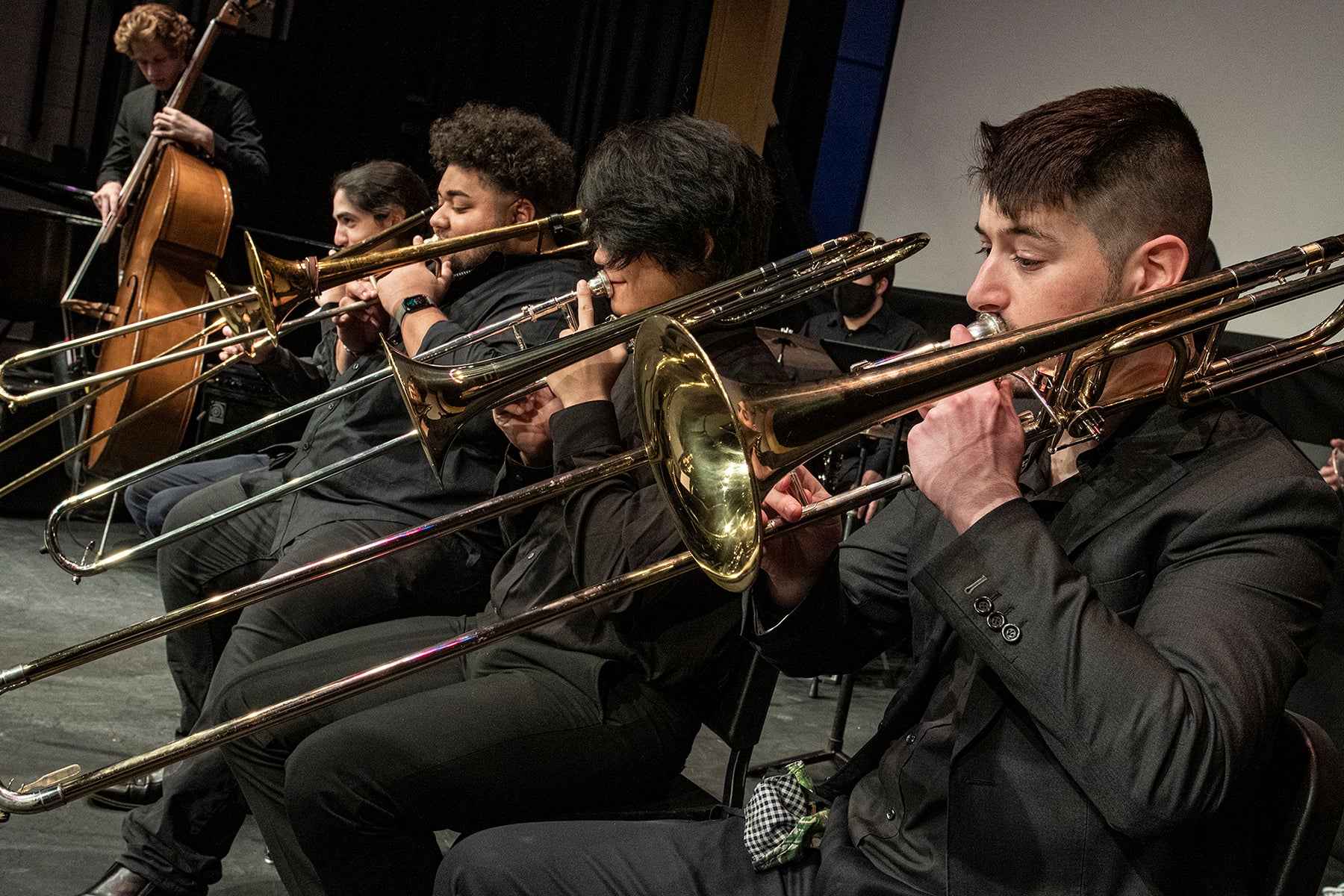
On Thursday, March 3, the Jazz Big Band will perform a University Artists Series: “Concert for a Cause, in support of Breast Cancer,” coordinated by director Emmett Goods. The concert starts at 8 p.m. in the Concert Hall. For tickets, click here.
“In May of 2020, I lost my wife, Keisha Goods, to breast cancer. She had a long hard battle for 18 months,” Goods said. “This concert is to help an organization [My Beauty for Ashes] that I think really aligns with her values.”
The concert will focus on the work of Mary Lou Williams, who wrote and arranged for such band leaders as Duke Ellington and Benny Goodman, and compositions by other female jazz composers. Goods said he wanted to focus on women in jazz, outside the role of singer.
“Mary Lou Williams is a hometown hero of mine. She grew up in my neighborhood,” said Goods, who grew up in Pittsburgh. “Our families knew each other. And her story is one of the best ever in jazz. She was a child prodigy who began working professionally as a middle schooler. She was equally talented both as a performer and an arranger.”
Williams’ work started in the early jazz era and continued through modal jazz, Goods said, presenting a wide range of styles for the Big Band to master. Some of the pieces will be familiar to the audience, such as “Walkin’ & Swingin’” and “Messa Stomp.”
On Friday, April 1, the Concert Band, directed by Brian Cardany, will honor the memory of alumnus Zachary Friedland ‘13, who died in October, by performing his composition “Someday” as part of the night’s concert.
Friedland, 31, who was born with a rare heart defect, was a prolific composer, writing music for band, wind ensembles, chamber, and vocal music. Among his works were “On Greens of White and Blue,” which he composed for URI’s 125th anniversary, along with compositions for a URI commencement and for the 30th anniversary of the Kingston Chamber Music Festival. Friedland, who held a doctorate in music from The Ohio State University and a master’s degree from the Longy School of Music at Bard College, also founded the Rhode Island Recording Ensemble to advocate for the work of young and emerging composers.
“Zachary was a very active member of the URI Music Department and the Rhode Island music community throughout his adult life,” said Cardany. “His passion for supporting young composers was embodied in the Rhode Island Recording Ensemble project, which involved the recording of new music by developing composers. He is one of two Music alumni who have been honored with a mural photograph on a wall in the Fine Arts Center.”
The Concert Band will also perform “Emperata Overture” by Claude T. Smith, “Twilight in the Wilderness” by Christopher Tucker, “Sòlas Ané” by Samuel Hazo, “Sun Dance” by Frank Ticheli and “Circus Days” by Karl King. The concert begins at 8 p.m. in the Concert Hall. (Because of possible scheduling conflicts, the date of this concert may change. To confirm the date, please check out the Music events schedule.)
The Symphonic Wind Ensemble, directed by Gene Pollart, will perform Sunday, March 6, at 7 p.m. in the Concert Hall. For tickets, click here.
During the spring, the department will also present concerts by jazz combos performing a wide range of jazz styles; weekly music convocation shows featuring performances by students and faculty, and student and faculty recitals. Many of these performances are free. For dates and times, go to the full schedule.
Gianna Cardarelli, a senior public relations major and intern in the URI Department of Marketing and Communications, wrote this press release.