
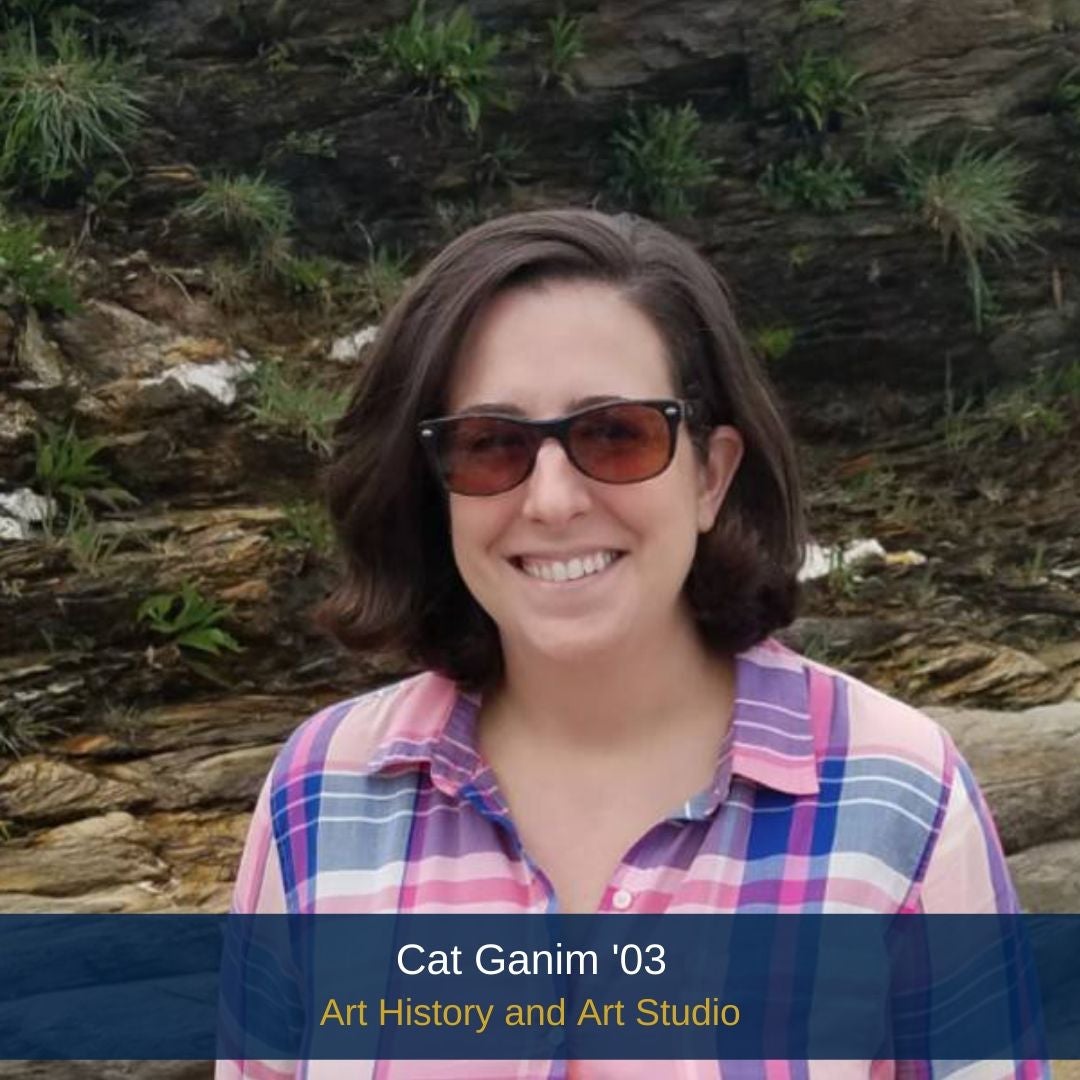
As the famed abstraction artist Pablo Picasso once said, “Every child is an artist. The only problem is how to remain an artist once we grow up.” Many would fervently argue the validity of this statement, as across the decades and over a vast stretch of ocean, Cat Ganim was one of those children who held the spark of divine artistic prowess. Growing up in her hometown of East Greenwich, RI, Ganim recalls an early life spent painting and drawing, taking inspiration from her grandmother, an oil painter. She carried this passion with her throughout her adolescence, stating, “I always enjoyed it, and I felt in the back of my head that if I majored in the arts then I wouldn’t have to sit behind a desk all day. I wanted to be creative and have the freedom to create.” With a healthy dose of encouragement from her parents, and tuition assistance from a hefty scholarship, Ganim decided that URI would be the best option for her and her future in the arts.
While enrolled at URI, Ganim became completely immersed in the world of art, coming into her own as an art boeuf along the way. “I realized I was way more interested in history while taking art classes,” she states, “History creates a narrative that details the human journey. I loved creating, but I loved history even more.” Having declared an art studio major already, Ganim took another discipline under her wing in the form of art history. “Education in art history helps you add context to any historical event,” Ganim says. “It can also help frame current events.” She notes that she found enjoyment in working as a docent at the URI art studio, where she got to see visitors currently working as artists, as well as finding joy in the critique parts of her studio classes. “It helped me articulate my thoughts in more meaningful ways,” she says. “It also helped me put stories behind my own artwork and question the choices made by other artists.”

After graduating in 2003 with a double major in art studio and art history, Ganim found a way to use her art degrees in a new professional field: the fast-paced world of business. She now works as a product manager, utilizing design in a field which she describes as “the nexus of where business, design, and technology intersect.” Her work involves understanding the business side of technology and vice versa, in addition to designing solutions to customers’ problems. Working collaboratively with members of her team, Ganim helps successfully build digital products. One of her latest achievements is co-founding OysterTracker, an app that assists shellfish farmers by keeping them up to date on their shellfish yield, as well as advising changes in farming techniques. With her career fully realized, Ganim has found the art in business and technology, and to those who wish to follow suit she has this to say: “Don’t be afraid of not being able to thrive in today’s workforce with an arts education. The skills you learn can work in various businesses and industries. Ask around to see how others are using their education because you don’t, for example, need an engineering degree to become a developer. You can definitely learn from those out in the workforce.”
~Written by Chase Hoffman