
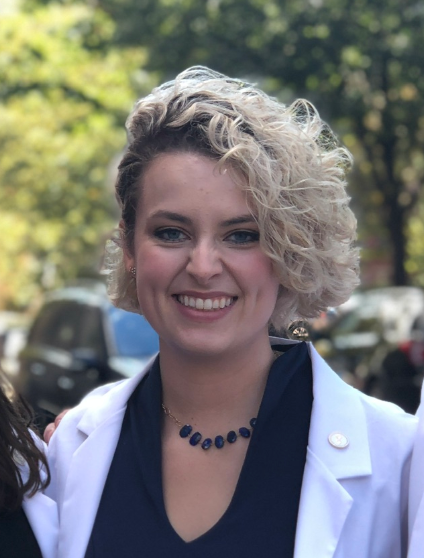
Tori Zeyl of South Kingstown, RI, entered URI as a kinesiology major with hopes of becoming a physical therapist. She learned quickly that many choices should not be set in stone. “Not to say anything bad about kinesiology,” Zeyl says, “but it wasn’t really my thing. I wasn’t getting a lot of good things by learning just facts and not thinking about literature and stuff like that.” She soon made the switch to the College of Arts and Sciences, declaring a Spanish major. With the flexibility her new major provided, she followed a simple yet effective philosophy: take classes you like. “I knew I wanted to do a postgrad degree,” she says, “so, for me, undergrad was about making myself a more well-rounded person. A major way to understand other cultures is to communicate with others better, and it was great learning a language that the majority of the country speaks.” The change also meant that the minimal amount of required courses for the Spanish major left more time for Zeyl to focus on taking her prerequisites for medical school, as well as the coursework needed for her two minors.
During her time at URI, Zeyl used her liberal arts education to help advance her abilities as a writer, Spanish-speaker, and critical thinker. She graduated in August 2018 pre-med with a B.A. in Spanish and with minors in art history and psychology. It was then that the next stage of her educational career began: she was accepted into graduate school. But not just any graduate school, the Warren Alpert Medical School of Brown University. “A lot of people are scared to do a liberal arts degree when they’re considering medical school,” she says, “but, from the people I’ve talked to, medical schools want people to have prior experiences with communicating and getting different perspectives on the world.” She further emphasizes the importance of the liberal arts by stating: “When you’re interacting with patients, it’s not the science but the communication part that gets through to them because people want to be taken care of by a human. When you have the time to work on the humanity in yourself, it helps further you professionally. The human part is expected of you in medical school; the science you learn later.”

Now, Zeyl dreams of becoming a plastic surgeon after graduation from Brown. In the meantime, however, she notes that the skills she learned at URI come into play every day in medical school, particularly her Spanish fluency. Working with patients, she’s able to practice with native Spanish speakers, allowing for a more comforting environment. As for advice to incoming and current Arts and Sciences students, she says with a laugh, “It’s kind of corny, but my biggest piece of advice is to do what makes your heart sing. Do whatever makes the time pass for you in an instant because, at the end of the day, people especially now are scared to major in an Arts and Sciences degree, but it’s worth investing in things that make you happy. The people who are most content with who they are in life aren’t the ones making the most money. You have so much time to be unhappy in life. And enjoy the party life, too. There’s lots of pressure to be performing at a high level, but you’re paying to have a good time, so have a good time.”
~Written by Chase Hoffman, Writing & Rhetoric and Anthropology Double Major, URI Class of 2021