

The Philosophy of Comedy
Think about it. On close inspection, philosophy and comedy are the odd couple: seeming opposites who, really, have the important stuff in common. URI alums, students, professors, and practitioners see the two as approaches to the same goal: To get to the central truths of what it is to be human.
To explore the many intersections between comedy and philosophy, let’s start with improv, a form of on-the-spot comedy that often involves competition. One such contest is The Hat Game, in which a maestro will set the scene—perhaps a train station waiting room—and assign a character to each actor. The actors then face off, trying to remove each other’s hats while staying in character. Lose your hat, and you’re out. Sound simple? It’s anything but.
The Hat Game, in fact, is one helluva hat trick—in philosophical terms, it’s an act of metacognition, or thinking about thinking. The winner must be both in the moment, playing out the scene, and strategizing for the future: the taking of an opponent’s hat. All the while being funny, of course. And, remember, improv is an act of invention. There is no script. In essence, players must manage multiple trains of thought simultaneously.
Improv actor and philosophy major Charlie Santos ’18 brings up The Hat Game as he considers the question of what connection there might be between comedy and philosophy. In classic improv fashion, his musings take the form of a story: A year ago, he found himself sitting in a darkened theater watching three fellow improv actors play The Hat Game. There were three finalists in the competition: two tallish local actors and an out-of-towner, a petite woman named Haniko. Her lack of height put her at a distinct disadvantage. Or so it would seem.
“And she takes one of their hats and the crowd is like, ‘Whoa, the underdog!’ All of a sudden the audience is embracing the newcomer who has emasculated a seasoned performer,” Santos recalls.


Improv actor and philosophy major Charlie Santos ’18 received a 2015 Metcalf Award from the Rhode Island Foundation to study improv at the Loose Moose Theatre in Calgary, Alberta.
As the final showdown approached, the ousted actor unabashedly rallied support for his fellow local boy. The scene felt raucous, more boxing match than theatrical competition. Then the director upped the ante, placing Haniko and the remaining man in a hula-hoop.
“The scene begins, she takes the other guy’s hat, and the entire roomful of people stands and cheers!” Santos says, grinning broadly at the memory.
To a philosopher and comedic actor, this is a superhero’s power. The difference between philosophy and comedy? Santos closes with a joke: “Well, I definitely see the ways in which philosophy inhibits me.”
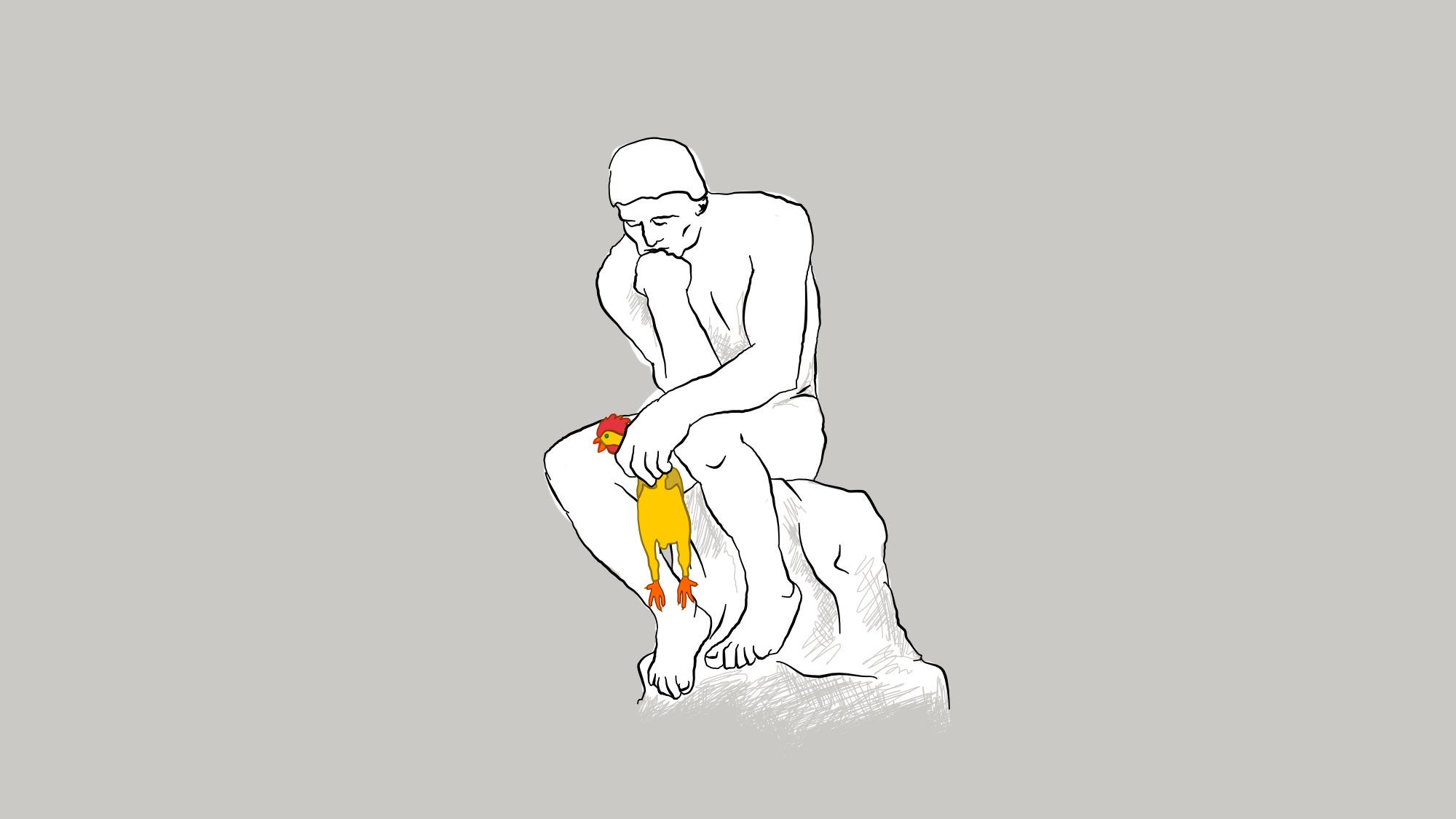
Act I
‘I think; therefore, I am single’
Hannah Travaglini ’13 believes great comedy comes of finding common ground with the audience. She performs her stand-up in Philadelphia under the stage name Hannah Trav. “I write about my life—what’s funny and relatable. I write about relationships. I’ve done stand-up long enough that I have multiple ex-boyfriends that I can talk about. It’s ‘I think; therefore, I am single.’ That type of thing,” she says.
A recent bit recounted Trav being ghosted by a guy with whom she had a romantic fling. “Comedy, for me, feels like a new relationship,” Travaglini quips. “Because I’m always killing it.”
Her interest in comedy came before philosophy, Travaglini says; though to hear her tell it is to think it’s almost a chicken-or-the-egg type thing. She describes herself as an “old soul philosopher type of kid” who studied improv. She gravitated to sad stories, in part because they led to wry observations. “Dark things led me to comedy,” she observes.


“The Way I Remember It,” a show by Hannah Travaglini ’13, played at the Philly Improv Theater in Philadelphia this winter.
Philosophy and comedy are alike in that they both involve premises, she posits. “Punch lines are like conclusions,” she says, “although, conclusions are not as satisfying as a big laugh.” A double major in art and philosophy who graduated summa cum laude, she is considering offers of admission to Temple and Villanova universities’ law schools. Philosopher-turned-comic-turned-lawyer—it’s quite a path.

“All three disciplines involve solving problems using logic,” she says. “And I’m a problem-solver; that’s my strength.”
Act II
Thrown to the wolves
Bill Horrigan ’08 left URI with a B.A. in philosophy and the title of America’s funniest college student. In his senior year, he’d won the American Eagle Campus Comedy Challenge, beating out aspiring comics from 12 other campuses across the Northeast. At the time of his coronation, the king of campus comedy had been on stage only twice: to audition and to win the competition. It would’ve been a happy ending had it ended there.
Horrigan’s prize was to open for a professional stand-up comic at a spring break event in Mexico hosted by American Eagle. The problem was the comedy show followed a rowdy wet T-shirt contest. Horrigan’s jokes failed.
“I was thrown to the wolves! The pain of the situation: I carry that with me every day. Everything else in life is relative to that moment,” Horrigan says. “I can laugh about it now. I can look back and say, ‘God, that was bad.’”
Horrigan’s story highlights another point at which philosophy and comedy converge: pain. Comedy delves into the uncomfortable; it tackles taboos, Horrigan points out. There’s a burden and a heaviness that can come of abstract thought, and comedy alleviates those feelings.
In other words, acute perception can hurt acutely—and be funny.

After his early success as a comedian, Bill Horrigan ’08 went on to get a law degree.
A lawyer who works as a contract manager in federal acquisitions for the United States Air Force, Horrigan, too, sees the connections between disciplines. There’s a structure to a case, and there’s a structure to a joke, he says. The end game is the same: “It’s knowing the reaction you’re supposed to get, and crafting your argument and answer to elicit it.”
Just over a year ago, Horrigan returned to the stage, doing a bit of improv at a local bar. He plans to do it again. Like Travaglini, Horrigan draws upon general human experience—“the problems of being a person”—to connect with an audience, whether that audience is a living room full of friends or a bar full of strangers.
“Humor and deep thinking are doing the same thing: observing, analyzing, and coming up with answers,” he says. “My best memories of law school are not about getting the answer right. My greatest accomplishment was making the entire lecture hall laugh for a minute.”
Act III
‘What it is to be human’
Douglass Reed ’04, assistant professor in the Department of Philosophy, studied humor and philosophy for his senior project. It was then, he says, that he realized that the skills honed in philosophy could be applied to humor. If psychology seeks to explain what makes people laugh, philosophy addresses a more fundamental question: What is humor?
While an undergraduate, Reed and a friend hosted a radio show on WRIU called “The Saturday Morning Show.” It started at noon and ran till 2 p.m. The format: skits, music, and humor. They were just doing what they’d be doing if they were hanging out, Reed says. At the time, he imagined being a television comedy writer. A year after leaving school, though, Reed missed doing philosophy and returned to earn a master’s and a Ph.D.
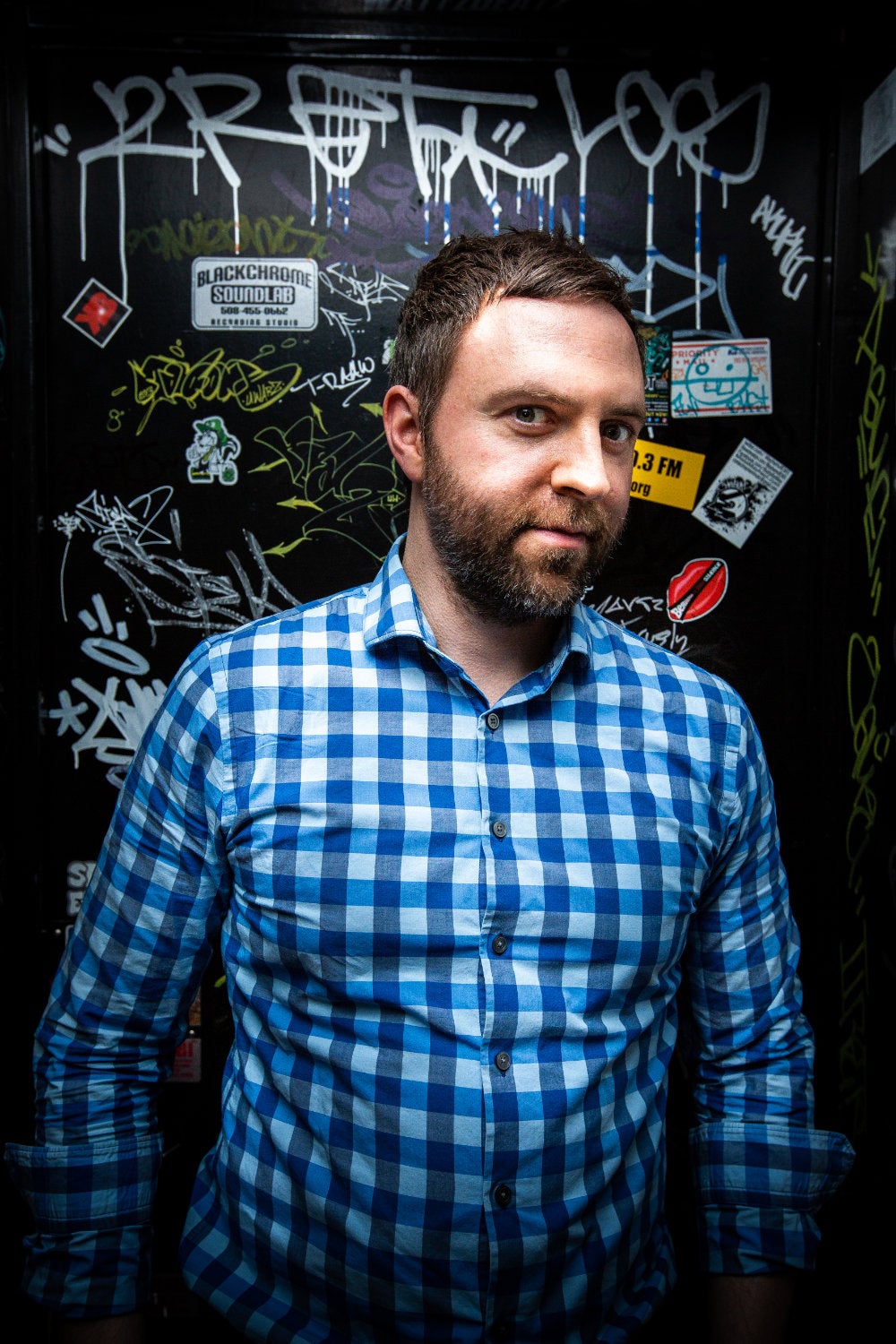

Which classical philosopher would Douglass Reed ’04, assistant professor of philosophy, have a beer with? It’s a risky proposition, he said. Socrates was likely a Rachel Maddow type; Aristotle, more a Mitt Romney. “I’d have to say Plato. At certain points in his career, he was almost playful,” Reed said. “He’d be the Steve Martin of the group.”
Now he teaches ethics and ancient philosophy and is partial to Aristotle’s theory of humor: “Humor is to be found in the unexpected comparison.” In other words, Reed says, one way in which philosophically minded people explore the world is by bringing disparate things together—and in these juxtapositions, humor often lies. To Aristotle’s way of thinking, “The true test of intelligence was the ability to make people laugh.”
What underlies all this, Reed says, “is a deep curiosity about what it is to be human.”

Act IV
The particle physics of performing
Rachel Walshe ’00, a lecturer in honors and theater and member of the philosophy department, argues that stand-up’s qualities—it’s difficult, direct, subversive and truthful—make it akin to the “particle physics of performing.” Those are qualities she wants to pass on to her students, so she uses stand-up in her ethics classes.
“It’s the most progressive art form of the 21st century,” she says. “The audience has the experience of wanting to be provoked, secretly loving that someone will do that. Oscar Wilde wrote dark, hysterical comedies that poked fun at the people watching his plays. And what does a Ricky Gervais do? He dresses down and eviscerates the celebrity class as he’s performing for them. With a great stand-up comedian, you’re under fire.”

Rachel Walshe ’00 majored in the philosophy of religions, a self-designed course of study, before heading to Oxford University to study dramatic literature and theater history as URI’s first Rhodes Scholar.
This winter, Walshe directed the theatre department’s production of William Shakespeare’s “Measure For Measure,” alternatively called a comedy, a tragedy, a tragicomedy, a satire, and an allegory by critics. Like the 2017 Oscar Award-winning movie “Get Out,” it defies easy categorization as it simultaneously exposes hypocrisy and raises questions about morality—while being darkly funny.
And in a culture held hostage to political correctness and fake news, comedy that provokes is essential, Walshe says. It removes the gauzy-lensed filter through which we would prefer to view life and forces us to confront truth.
“Comedy cracks open—with a sledgehammer—our pearl-clutching response to the world,” Walshe says.
Mic drop.