
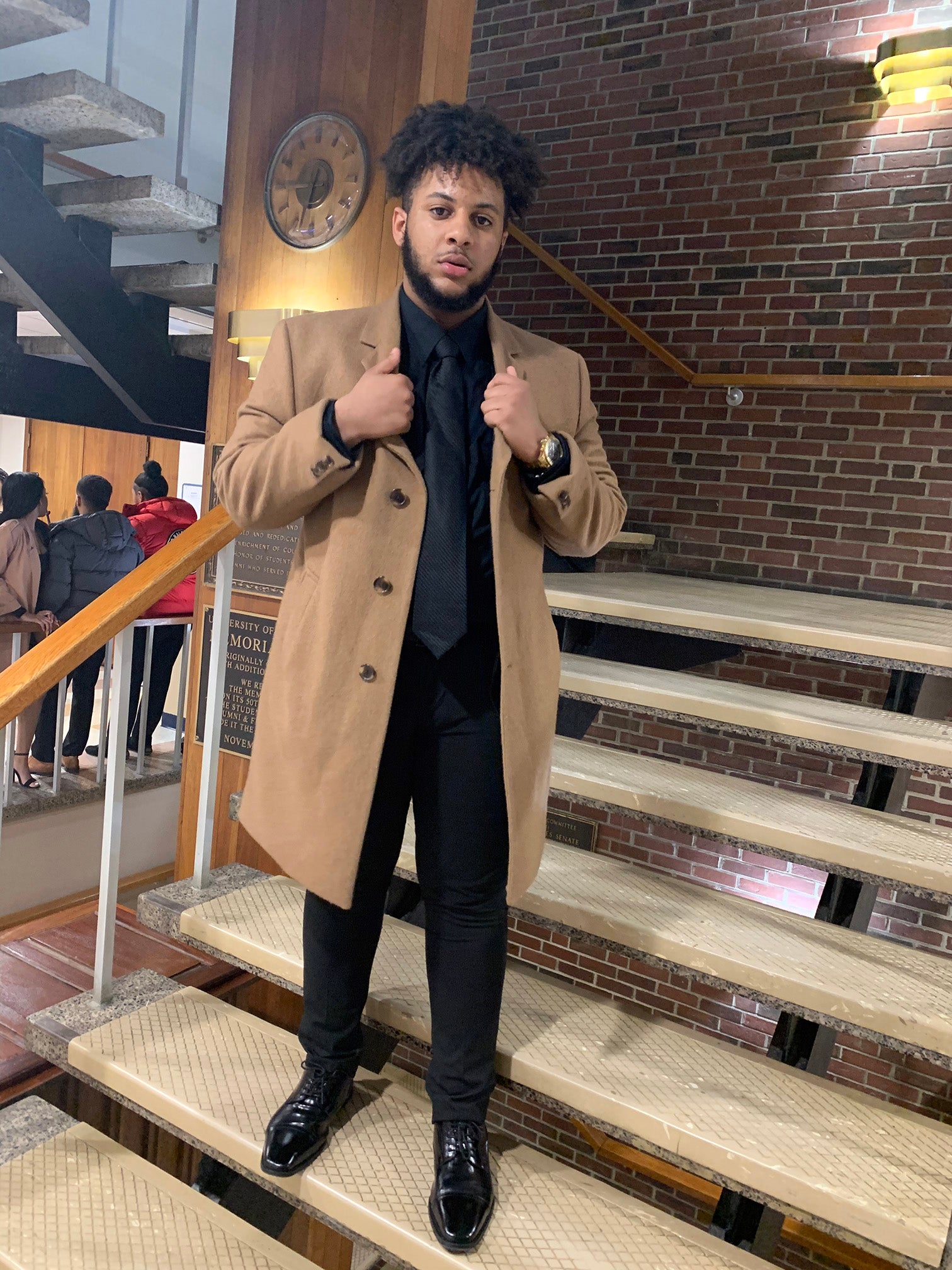
KINGSTON, R.I. – June 23, 2021 – Two rising juniors at the University of Rhode Island have been selected as fellows by the national nonprofit Management Leadership for Tomorrow (MLT) to participate in the organization’s MLT Career Prep Program, which aims to support and empower talented students from underrepresented communities. As Career Prep Fellows, Warith Balogun and Markeem Rodrigues, both URI Honors Program students and graduates of Providence’s E3 (E-Cubed) Academy, will receive 18 months of one-on-one coaching, mentorship, and in-person workshops as well as access to a growing network of program alumni and allies across more than 120 partner organizations representing all sectors.
Warith Balogun, who moved to Providence about six years ago from Brooklyn, is a computer science major with a creative streak that has helped to shape his interest in poetry, fashion, photography and graphic design, as well as his chosen major. As a resident assistant, membership chair for URI’s chapter of the National Society of Black Engineers and as treasurer of the Black Student Union, Balogun has already begun to develop strong leadership skills. But while researching MLT, he was drawn to the support, coaching and honing of technical skills that the Career Prep Program could provide and help take him further in his career. He also saw it as an opportunity that would open doors to top companies doing creative work in the area of software engineering.

In addition to the one-on-one time with his coach who has had a long career in computer science, Balogun appreciates how the program’s exercises and assignments have helped him gain a better understanding of his own values and interests when it comes to choosing a career and employer. He spoke animatedly about his research into employers and is particularly interested in the work happening at Adobe and Google, as well as top consulting firms like Accenture, Deloitte and Ernst & Young.
“Anything I am interested in, I research,” said Balogun. “And the program has helped me to figure out what matters to me and how important it is for me to find a company that will help me grow as a person and to make a change in the world.”
Balogun looks forward to an internship at Microsoft this summer, as well as the year ahead in the program, and is excited about the path that he is on with computer science. He sees an opportunity to combine his creative interests with his career choice and eventually choose consulting or to work for himself.
“I am passionate and I put a lot of work in to get myself where I want to be,” he says. “I like computer science because it gives me the basic tools to build what I want, go where I want to career-wise and it empowers me to express who I am. I want to be able to use my art and my skills to contribute and to help others do the same.”
Markeem Rodrigues, who grew up in Providence and Pawtucket, is also intent on making a difference. The computer science, film/media and textiles, fashion, merchandising and design triple major is a member of Brothers on a New Direction, a multicultural service-based brotherhood, and will be serving as its president during the upcoming school year. He is also a member of the Student Entertainment Committee and will serve as its chair this fall. He is a member of URI’s chapter of the National Society of Black Engineers, just finished a term as public relations chair for the Black Student Union and is also a resident assistant.
“I like to keep busy; I don’t like having a lot of down time,” he says. “I like to have a reason and a purpose. There are lots of things that need to be done and I think joining organizations and working alongside like-minded individuals helps me to accomplish that. I also view my involvement as a way to gain experience for any future workplace.”
Given that MLT offers computer science and business-focused tracks as part of the Career Prep Program, Rodrigues thought it sounded like a great fit for him. In addition to the assignments and exercises designed to help students hone their job search skills and tailor their searches to match their values and interests, Rodrigues also appreciates the opportunity to brush up on technical, career-related skills. For instance, so far this summer Rodrigues took part in a bootcamp that enabled him to learn the iOS operating system – a whole new computer language.
“It’s been amazing so far and the great thing about MLT is that they have a lot of partners like Nike and Netflix and Apple,” said Rodrigues, which he sees as an opportunity to link his interests in fashion, film and media and computer science, something he began on his own about two years ago with the launch of a multimedia creative platform, AUXILIARY, aimed toward amplifying Black voices and promoting cultural expression of the Black identity – something he hopes to continue into the future. “As someone who wants the betterment of underrepresented people, who has been proving people wrong for a long time, the biggest thing for me is helping others. I’m glad to be here, to be part of MLT, to be part of URI, to set a precedent and be the change I want to see.”
Both students credit Kathleen Maher, director of URI’s Office of National Fellowships and Academic Opportunities, for bringing the MLT Career Prep Program to their attention and for supporting them through the application process.
Management Leadership for Tomorrow was launched in 2002 by John Rice, to fight racial and economic disparities by empowering a new generation of diverse leaders. MLT equips and emboldens high-achieving women and men from underrepresented communities—African American, Latinx, and Native American—to realize their full potential, make a mark, and make a difference. Fellows gain career-accelerating skills not taught in classrooms, cultivate personal clarity, and connect with top employers for potential internships and full-time roles across a variety of industries.
URI students interested in learning more about the MLT Career Prep Program or other opportunities should contact the URI Office of National Fellowships and Academic Opportunities for guidance and institutional endorsement.