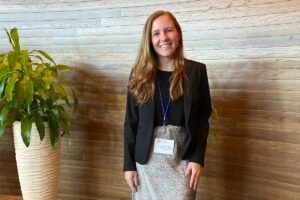
Leslie Mahler, PhD, CCC-SLP, is an assistant professor in the Department of Communicative Disorders. Leslie received a dual doctorate in Speech, Language and Hearing Sciences and Neuroscience at the University of Colorado-
Boulder in December, 2006. She holds two additional graduate degrees; an MA in Speech and Hearing Science from the University of the Pacific in Stockton, CA in 1977, and an MBA from Drake University in Des Moines, IA in 1987. Dr. Mahler has over 30 years of clinical experience working primarily in a hospital setting treating adults with neurological and voice disorders. She was on the clinical faculty at the University of Colorado-Boulder teaching courses in motor speech aspects of communication, language disorders, and voice disorders and providing student clinical supervision prior to pursuing a doctoral degree in 2000. Dr. Mahler’s teaching responsibilities include training undergraduate and graduate students in normal communication processes as a foundation for understanding communication disorders. The goal for the preparation of graduate students is to develop their clinical skills for evaluation, diagnosis, and treatment of communication disorders as they prepare for careers in speech-language pathology. Her areas of expertise include motor speech disorders, voice disorders, swallowing disorders, acquired cognitive disorders, and medical speech-language pathology. She provides required courses in Phonetics (CMD 273), Dysphagia (CMD 581), Voice (CMD 560), Acquired Cognitive Disorders (CMD 583), Clinical Pre-Practicum (CMD 565), and an elective in Medical Speech-Language Pathology (CMD 571). Dr. Mahler is also the co-coordinator of NEU 501, Introduction to the Neurosciences, a core course in the Interdisciplinary Neuroscience Program.
Dr. Mahler’s classes integrate the basic science of communication with current research to develop clinical skills for evaluation, diagnosis and treatment of clinical cases, and require students to synthesize information from multiple sources. Her involvement in the University of Rhode Island Speech and Hearing Clinic provides students with clinical opportunities to develop expertise in the treatment of neuromotor speech disorders and gives them an opportunity to participate in experiential learning opportunities and potentially be involved in clinical research.Dr. Mahler’s research interests and publications are directed toward describing and treating motor speech disorders/dysarthria to improve the quality of life for people with neurological diagnoses. Specifically, my research focuses on how principles of neuroplasticity can be applied to the treatment of individuals with dysarthria secondary to neurological diagnoses such as stroke, Parkinson’s disease, head injury, Down syndrome and cerebral palsy. Investigations of how well-defined behavioral interventions affect communication behaviors and whether there is a positive impact on communication effectiveness and efficiency are the first of their kind to be published in the area of Down syndrome. These data can be used to influence public policy and insurance reimbursement practices in the future.
Personal Statement:
My instructional aims since joining the URI faculty in January 2007 have been to combine academic teaching with research and experiential learning in a clinical setting, building on my extensive clinical experience in hospital settings combined with expertise in treatment efficacy research. Toward this end, I have taken on clinical responsibilities in the areas of evaluation, diagnosis and treatment of adults with neurological disorders in the clinic and conduct ongoing treatment research. I am responsible for a communication group for people with Parkinson disease, the LOUD Crowd, and an interdisciplinary group for adults with acquired brain injury, the Gateway Cafe and Wellness Center. My expertise in the area of motor speech disorders has been recognized outside of the University of Rhode Island community. I have been invited to give national and international lectures on translating principles of neural plasticity to the treatment of motor speech disorders nationally and internationally. I am pleased to be able to share this expertise with URI students.
Courses taught:
Service:
Faculty Senate 2008-2012
Experiential Learning Task Force 2011
Selected Publications:
Mahler, L., Ciucci, M., Ramig, L., & Fox, C. (2007). Swallowing problems in Parkinson's disease. In Trail, M., Protos, E., & Lai, E. (Eds). Neurorehabilitation in Parkinson's disease: An evidence based treatment model. SLACK Inc. Professional Book Division, Thorofare, NJ.
Mahler, L., Ciucci, M., Ramig, L., & Fox, C. (2008). Swallowing problems in Parkinson's disease. In Trail, M., Protos, E., & Lai, E. (Eds). Neurorehabilitation in Parkinson's disease: An evidence based treatment model. SLACK Inc. Professional Book Division, Thorofare, NJ.
Fox, C., Ramig, L., Sapir, S., Halpern, A., Petska, J., & Mahler, L., Farley, B. (2008). Voice and speech disorders in Parkinson's disease and their treatment. In Trail, M., Protos, E., & Lai, E. (Eds). Neurorehabilitation in Parkinson's disease: An evidence based treatment model. SLACK Inc. Professional Book Division, Thorofare, NJ.
Fox, C., Ramig, L., Halpern, A., Cable, J., & Mahler, L. (2008). Speech therapy tips for patients with Parkinson's disease. In Trail, M., Protos, E., & Lai, E. (Eds). Neurorehabilitation in Parkinson's disease: An evidence based treatment model. SLACK Inc. Professional Book Division, Thorofare, NJ.
Mahler, L., Ramig, L.O., Fox, C. (2009). Intensive voice treatment (LSVTĀ® LOUD) for dysarthria secondary to stroke. Journal of Medical Speech-Language Pathology, 17,(4).
Spielman, J., Mahler, L., Halpern, A., Gilley, P., Klepitskaya, O., and Ramig. L. (2011).
Intensive Voice Treatment (LSVT®LOUD) for Parkinson's disease following Deep Brain
Stimulation of the Subthalamic Nucleus. Journal of Communication Disorders, 44, 688-700.
Mahler, L. & Jones, H.N. (2012). Intensive treatment of dysarthria in two adults with
Down syndrome. Developmental Neurorehabilitation, 15, 44-53.
Mahler, L. & Ramig, L.O. (2012). Intensive voice treatment of dysarthria
secondary to stroke. Journal of Clinical Linguistics and Phonetics, 26, 681-694.
Book Chapters:
Ciucci, M., Mahler, L., & McFarland, D. (2011). Swallowing disorders in Parkinson’s disease. In Theodoros, D. & Ramig, L. (Eds), Communication and swallowing in Parkinson disease (pp. 199-223). Oxford, England: Plural Publishing.
Congratulations to our May 2013 B.S. and M.S. graduates! Your hard work has paid off!
NSSLHA NEWS:
Here are our URISSLHA officers (Left to Right below): Mary Loveley, secretary; Kristen Troy, historian; Jaclyn Schiemer, president; Lexi Caruso, treasurer; and Kristy Wallace, vice-president. We thank our outgoing board members: Shannon Witter, Meredith Fitzgibbon, Heidee Pottker and Jess Lally for all of their hard work. Shannon and Meredith are graduating in May, Heidee will be a second-year graduate student, and Jess is heading off to graduate school! Look for information about our first fall 2014 meeting here on the CMD web site.
Message from URISSLHA President
***SCHOLARSHIPS AVAILABLE THROUGH THE ASHA FOUNDATION***
See the following web site for information: www.ashfoundation.org/grants/GraduateScholarships/
Check out our updated table of graduate student student outcomes: PRAXIS examination, graduation, and employment rates by linking to:
Why CMD at URI? - Communicative Disorders - University of Rhode Island
PROGRAM HIGHLIGHTS