The
University of Rhode Island offers a two-year program leading to
the Master of Science degree in Human Development and Family
Studies with a specialization in Marriage and Family Therapy. This
program is accredited by the Commission on Accreditation for
Marriage and Family Therapy Education (COAMFTE). The objectives of the
program are:
- To train marital and family
therapists to a high level of expertise in this specialty area
so they can competently treat diverse families and couples in
crisis as well as during normative and developmental
transitions.
- To prepare graduate students to
meet the standards for associate membership in American
Association for Marriage and Family Therapy (AAMFT).
- To promote viable research in
marital and family therapy in order to enhance students’
research competency.
- To provide a community resource
in a vital area of mental health to meet the service needs of
the university and community.
- To promote a systems approach
to therapy.
- To become a state and regional
voice for the promotion of marital and family therapy.
- To provide a resource for
mental health professionals in the state and region who seek
additional training.
Graduates of the program are now
employed in various parts of the country in mental health
agencies, family services agencies, and state departments of
children and families.
The
Program
The Marriage and Family Therapy
program provides students with an intensive, specialized training
which serves as a firm theoretical and practical base for
becoming competent family and individual therapists. The family
therapist must possess an understanding and ability to treat
individuals and families from a systems perspective. The therapist
must also know how to deal with the societal, cultural, and
government forces that influence family relationships.
The program consists of:
1)
Conceptual instruction in family systems, family development,
research methods, and therapy;
2) Supervised clinical experience
with individuals, couples, and families having a wide range of
problems;
3) Contextual learning in a professional setting that
includes family therapy and family-based evaluation and
preventative work.
Students seeking the marriage and
family therapy specialization take between 54 and 60 credit hours
exclusive of prerequisites. The number of graduate hours required
will depend on previous graduate coursework in related fields, but
usually averages about 60 hours. It takes a minimum of two years
of full-time study to complete the program.
Clinical Experience
Clinical
training and experience begins in the first semester and continues
throughout the program. A one-year off-site practicum in marriage
and family therapy begins in the summer. Supervised off-site
placements (internships) are completed at various community
settings, including the department’s on-campus Family Therapy
Clinic. AAMFT standards require 500 hours of clinical practice and
100 hours of supervision during the program. Several supervision
techniques are employed, including live supervision using a
one-way mirror, telephone call-ins, and co-therapy. Videotaping of
sessions is required.
Sample Program of Study for the
M.S. Degree with an Option in Marriage and Family Therapy:
In addition to the required courses
listed below, students must take one elective course in the semester
of their choice.
Semester I - Fall
- HDF 500 Human Development
Seminar
- HDF 535 Families Under Stress:
Coping and Adaptation OR HDF 578 Ethical, Legal &
Professional Issues in MFT
- HDF 563 Marital and Family
Therapy I
- HDF 565 Family Therapy
Practicum
Semester II - Spring
- HDF 559 Gender Issues in
Therapy OR HDF 505
- HDF 564 Marital and Family
Therapy II
- HDF 565 Family Therapy
Practicum
- HDF 569 Assessment in Family
Therapy
- HDF 570 Research in Human
Development and Family Studies
Summer Session I and II
- HDF 565 Family Therapy
Practicum
- Off-site placement begins
Semester III - Fall
- HDF 565 Family Therapy
Practicum
- HDF 566 Theoretical and
Clinical Problems
- HDF 578 Ethical, Legal &
Professional Issues in MFT OR HDF 535
Families Under Stress: Coping and Adaptation
- HDF 583 Master’s Internships
(off-site placement)
Semester IV - Spring
- HDF 505 Human Sexuality &
Counseling OR HDF 559
- HDF 565 Family Therapy
Practicum
- HDF 581 Professional Seminar
- HDF 584 Master’s Internship
(off-site placement)
This
is a sample program; each student’s program will be tailored in
accordance with his or her background, according to courses
already taken, and the student’s vocational needs. Students
completing this program will be eligible for associate status in
AAMFT. An additional 500 hours of clinical practice and 100 hours
of approved supervision are needed beyond the master’s program
in order to obtain clinical membership in AAMFT. While licensure
requirements vary somewhat from state to state, generally
graduates of this program are qualified to take the national
licensing examination. In RI one must have 2 years of post
graduate professional experience, 2000 hours of clinical work, and
100 hours of clinical supervision to qualify for the licensing
exam.
Admission Requirements
The Marriage and Family Therapy
program provides an intensive educative and training experience in
which clinical expertise is stressed. Consequently, enrollment is
limited and selection is competitive. Full-time students have
priority both for admission and internships. Review of applications
begins February 1. Admission requirements include:
- Evidence of competent academic
performance in the undergraduate major
- Miller Analogy or Graduate
Record Exam scores (TOEFL as appropriate)
- Personal statement describing your interest in MFT and outlining your professional goals
- Two or more letters of
recommendation attesting to observed experience related to the
helping professions
- Undergraduate or graduate
courses in the following areas:
- Abnormal Psychology
- Developmental Theory
- Marriage and Family
Relationships
- Introduction to Counseling
- All candidates for admission
must present themselves at the University for a formal
interview with MFT faculty. The goal of this personal
interview is to determine whether the applicant possesses the
full range of academic qualifications, experiential
background, clinical competency, and readiness to undertake
the rigors of an academically and emotionally demanding
clinical preparation program.
Our program values diversity
within its curriculum and among its faculty and students.
We endorse the University of Rhode Island’s policy not to
discriminate, whether overt or subtle, on the basis of race,
sex, religion, age, color, creed, national origin, disability,
sexual orientation, gender identity, or gender expression in the
recruitment, hiring, or treatment of students, faculty, and
staff. Program members resolve to help each other by
sensitively and caringly drawing attention to inappropriate
behavior and by challenging each other’s attitudes in a spirit
of growth. All graduate applications are done online. To apply, visit the Graduate School online.
Financial Aid
Opportunities for financial aid,
outlined in the graduate catalog, include graduate assistantships,
work-study opportunities, tuition scholarships, and graduate
student loans. The Office of Financial Aid can provide specific
data.
The
University
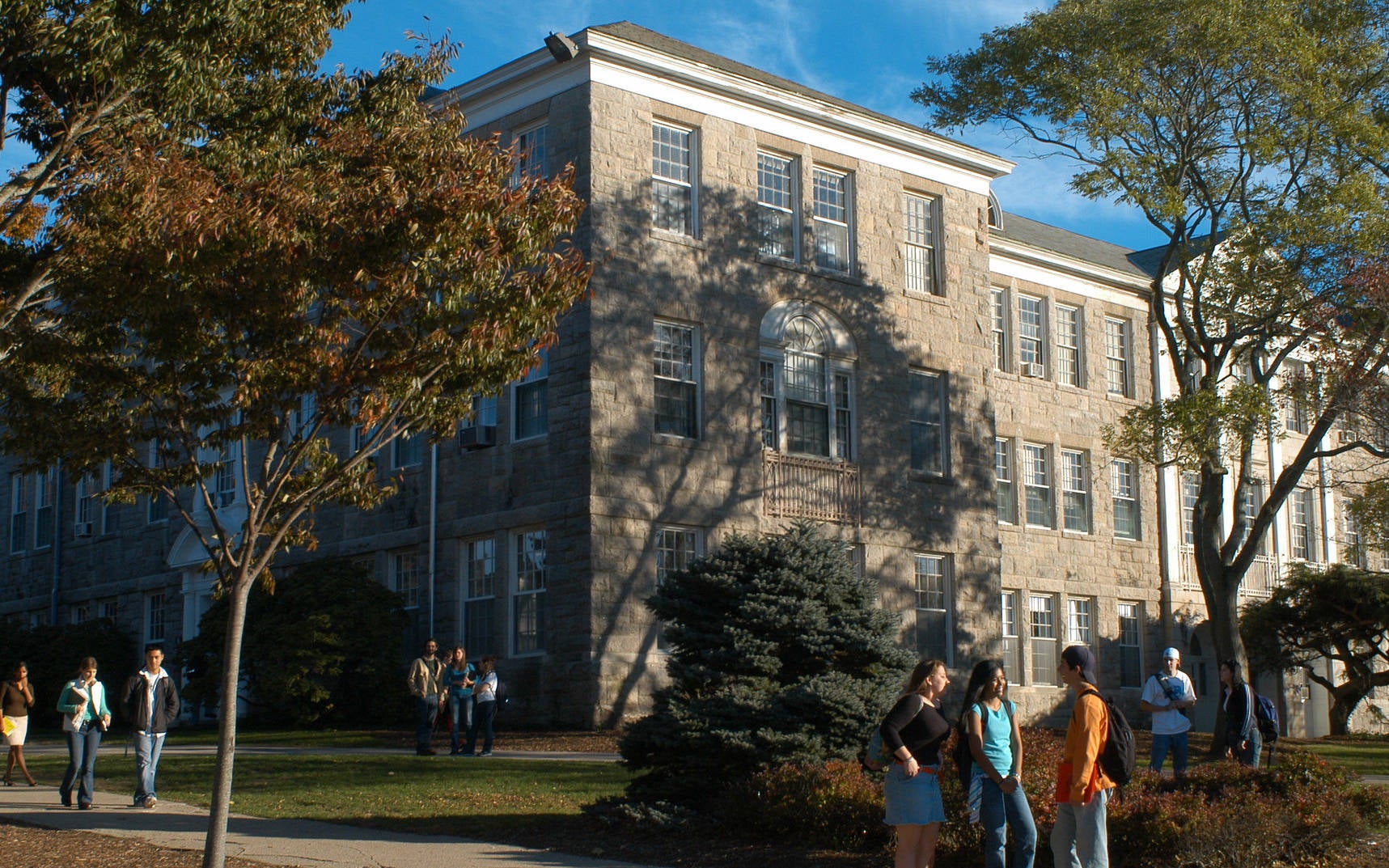
The main campus of the University
is in the village of Kingston, in rural southern Rhode Island,
about six miles from the ocean. The central quadrangle of the
green and spacious campus is on the top of Kingston hill, with
student housing on the hillside and athletic and agricultural
fields and buildings on the plain below.
Kingston is 30 miles south of
Providence, and just across Narragansett Bay from the resort of
Newport. It lies between two major metropolitan areas. New York is
160 miles southwest, Boston 70 miles north, and both are within
easy reach by rail or car.
The University has about 10,600
undergraduate and 2,300 graduate students on the Kingston campus,
and about 750 full-time and 100 part-time faculty. Because URI is
a state university, the faculty is involved in teaching, wide-ranging research, and in reaching out with practical
information to help the people of the state. Given the wide
diversity of families in the U.S.A., the program is particularly
interested in attracting minority graduate students.
For additional information,
please contact:
URI Transition Center
2 Lower College Road
Kingston, RI 02881
FAX: 401-874-4020
E-Mail: jadams@uri.edu
Faculty in the Marriage and
Family Therapy Program
Clinical Faculty
Jerome
F. Adams, Ph.D. (Purdue University). Professor and director of
the Marriage and Family Therapy Program. Interests:
family therapy process research, adolescent drug abuse, family
assessment, and family therapy training and supervision. Rhode
Island Licensed Psychologist; member American Psychological
Association, Division 43; clinical member and approved supervisor
AAMFT.
Tiffani S. Kisler, Ph.D. (Arizona
State University). Assistant professor. Interests: sex
therapy, human sexuality and couples therapy. Clinical member
and supervisor candidate AAMFT; member National Council for Family
Relations; International Association of Relationship Research; The
Society for Scientific Study of Sexuality.
Jacqueline A. Sparks, Ph.D., (Nova
Southeastern University). Associate professor.
Interests: Client-directed, outcome informed therapy, community and
family based services, brief and postmodern applications to
client-directed change.
Florida Licensed Marriage and Family Therapist; clinical member and
approved supervisor AAMFT.
Dale
Blumen, M.S. (University of Rhode Island). Clinical
Coordinator of Family Therapy Clinic. Interests: family therapy
training and supervision, family relations in later life,
parent-child issues, remarried families, divorce counseling. Clinical
member and approved supervisor AAMFT; member National Council for
Family Relations; Rhode Island Licensed Marriage and Family
Therapist.
Additional Faculty
Phillip
Clark, Sc.D. (Harvard University). Professor and Director,
Program in Gerontology. Interests: geriatric health promotion,
comparative health care policy, ethical issues in caring for the
elderly, interdisciplinary health care teams, and aging and
developmental disabilities/mental retardation. Member,
Gerontological Society of America; Canadian Association on
Gerontology; Association for Gerontology in Higher Education.
Barbara M. Newman, Ph.D. (University of Michigan). Professor and
HDF Program Chair. Interests: lifespan development,
adolescent-parent relationships, theories of human development,
psychosocial theory, and parent involvement and its relationship to
academic achievement.
|