In Memoriam.
Frank Newman (1927-2004)

    Frank Newman was born on February 24, 1927 , in Orinda , California .  He graduated from Brown University in 1946 with a Bachelor of Arts degree in Naval Science and Economics.  In 1949 he received a Bachelor of Science degree in Electrical Engineering, also from Brown.  Later that year he traveled to England , where he studied economics at Oxford University .  Upon returning to the States, Newman began working for the Honeywell Regulator Company based in Minneapolis , Minnesota .  His last position at Honeywell was as a market manager in New York , N.Y.   He graduated from Columbia University with a Master of Science in Business Administration, which he earned during his employment at Honeywell.  In 1955 he started a new job with Beckman Instruments, Inc., where he worked until 1966, ending his employment as Division Manager in Richmond , California

    Newman began working as Director of University Relations for Stanford University in 1967.  His responsibilities included federal, state, and public relations management, public and cultural events coordinator. He was also Associate General Secretary, and participated on the President's staff.  In 1969, while still Director of University Relations at Stanford, Newman was asked by Secretary Robert Finch of the Department of Health, Education, and Welfare (HEW) to chair the first Task Force on Higher Education.  The project was being funded by the Ford Foundation and Newman was given the opportunity to choose the people he wanted to serve on the task force.  He selected a handful of education professionals, but most of the research and preparation was done by interns and university students.  In 1971, they presented HEW Secretary Elliot Richardson with the 130 page Report on Higher Education.  This was the first of two documents that later became known as the "Newman Reports." The findings revealed that many of the federal financial aid policies available to students of higher education were inordinately selective and biased towards the agendas of the institutions that regulated them.  The report was received enthusiastically by HEW officials, but remained controversial and widely debated in the academic community.

    In 1973, the Assistant Secretary of HEW, Sidney P. Marland, appointed a second Task Force to recommend an itemized plan to address the problems raised in the first Report on Higher Education.  This project was supported by the federal government and received national attention.  Newman was again chosen as chairman of the Task Force on Higher Education and, in January of 1974, he and his staff produced The Report on National Policy and Higher Education.  This second report recommended increased funding for work-study and internship programs, tuition credit for community service modeled after the G. I. Bill, and increased fellowships for graduate students.  It also strongly recommended that the federal government adopt a strict anti-trust position toward organized professions, such as the medical and legal, and investigate prerequisites for certifying and licensing examinations.  Both these reports helped generate expanded student scholarship and loan programs and encouraged increased educational opportunities for minorities. 

    Newman became the eighth president of the University of Rhode Island on August 1, 1974 , succeeding Dr. Werner A. Baum and academic vice president Dr. William R. Ferrante, who had served as acting president during the interim.   The selection process was one of the most extended and involved in the University's history.   It took an eleven-member panel six months to review 389 applications and recommendations.  The panel consisted of four faculty members, two administrators, two students, an alumni representative, a regent, and a member of the staff of the state commissioner of education. The field was narrowed to three candidates and further inquiries were conducted until one was chosen.  

Newman delivers inauguration speech, 1974 View of crowd, Newman inauguration 1974, Newman lower center First Meeting as President, 1974
  More images...


    In 1981, Newman received a Ph. D. in History from Stanford University. His dissertation, "The Era of Expertise: the Growth, the Spread and Ultimately the Decline of the National Commitment to the Concept of the Highly Trained Expert, 1945 to 1970,"  focused on the success of higher education institutions to adapt to rapid advancements in technology while at the same time adapting to unpredictable economic environments.

    Newman served as President for nine years until July 31, 1983 , when he resigned to accept a presidential fellowship with the Carnegie Foundation, where he was asked to develop a new national policy on education.  During his tenure at URI, he managed to secure over 25 million dollars in annual funding for University research within the oceanography, resource economics, robotics and pharmacy programs, which in due course gained international prestige.  His emphasis on human resource development and academic excellence helped keep the University of Rhode Island 's reputation intact despite numerous state and federal budget cuts throughout the latter half of his presidency.

Newman announces resignation 1983

CHRONOLOGY

1927 Born in Orinda California, grew up in Manhattan, New York
1944 Enlists in the Navy, serves on a destroyer at the end of WWII
1946 BA in Naval Science and Economics from Brown University
1849 BS in Electrical Engineering from Brown University
1951 Marries Lucile Fanning
195(4?) Masters degree in Business Administration from Columbia University
1955 Employed with Beckman Instruments in California
1966 Runs unsuccessfully for congressman, California's 14th district
1967 Director, University Relations, Stanford University
1971 Authored "Report of Higher Education", also known as the Newman Report
1974 Frank Newman assumes presidency of the University of Rhode Island
  Budget Task Force created
  Bond issue passed for a 70,000 square ft. addition to the University Library
1975 Commission on Undergraduate Education created
1976 Graduate School of Oceanography's research ship Endeavor commissioned
  Addition to the University Library completed
  Bicentennial Museum established in Green Hall
  Graduate Library School loses accreditation
1977  Bachelor of General Studies Program established
  White Hall, College of Nursing.
  Chapter of Phi Beta Kappa national honor society established
  Center for Ocean Management Studies established
  Center for Energy Study established
  Regional Coastal Information Center established
1978   College of Human Sciences and Services succeeds College of Home Economics
  Norman D. Watkins Laboratory on the Narragansett Bay Campus
1979 Faculty strike for 12 days at the beginning of the Fall semester
  Graduate Library School reaccredited
1980 Institute for Human Sciences and Services established
  Robotics Research Center established
1981 Ph.D. in History from Stanford University
Center for Atmospheric Chemistry established
  Division of University Extension becomes College of Continuing Education
  Board of Governors for Higher Education established by act of General Assembly
1983  Marine Resources building
  Small Business Development Center established
  Frank Newman resigns as president and is succeeded by Edward D. Eddy
1985 President of the Education Commission of the States
1999 Chairman of Futures Project, Brown University
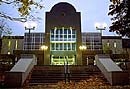
2002 Admissions Building is named the Frank Newman Admissions Building
2004 Frank Newman dies at Miriam Hospital of Melanoma on May 30th