
Funded by a $1.3M NIH grant, URI scientists will lead students in virtual and in-person experiments on natural medicines
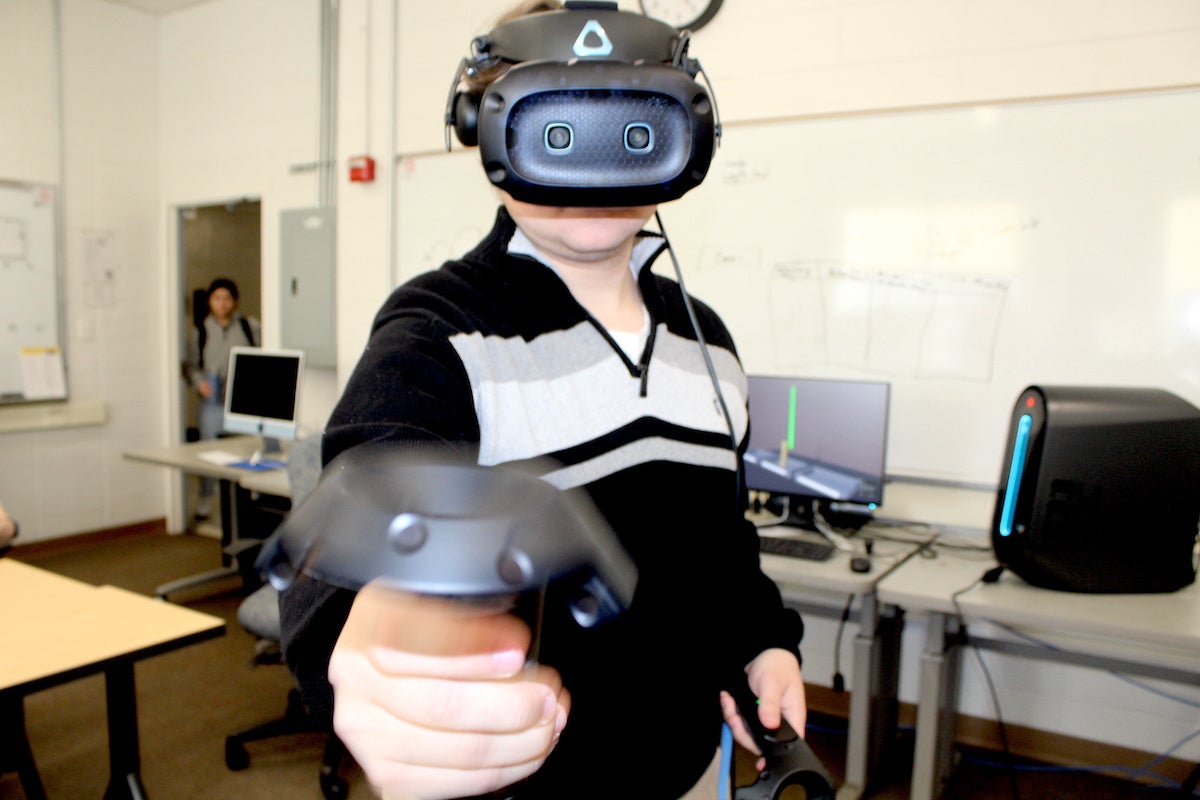
Through the use of a virtual reality laboratory and in-person lab experiences, scientists at the University of Rhode Island College of Pharmacy are working with high school students around the state, teaching them about natural therapeutic plants and herbal medicines, while helping stimulate an interest in Science, Technology, Engineering and Math disciplines among the next generation of scholars.
URI students and faculty members in pharmacy and computer science are working with their counterparts at Woonsocket, the Met High School and South Kingstown high schools on “Hands-on Education and Research for Biomedical and Analytical Learning (HERBAL).” The curriculum includes a virtual lab designed by computer science students at URI. Funded by a five-year, $1.35 million Science and Education Partnership Award from the National Institutes of Health, the college is designing scientific experiments and virtual reality lab simulations to familiarize students with research and modern lab settings.
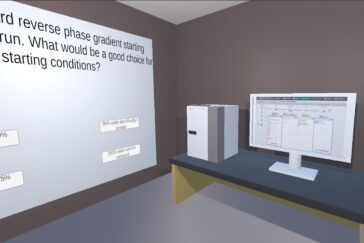
“Students will wear VR headsets and proceed into the virtual reality laboratory to conduct experiments,” said pharmacy Professor David Rowley, principal investigator on the grant from NIH’s National Center for Complementary and Integrated Health. “They’ll move about the lab to accomplish goals toward the investigation of a medicinal plant and its molecules. Students will conduct experiments such as performing a biological assay, and the VR laboratory will generate results. High school students will also gain VR experiences such as purifying molecules using sophisticated instrumentation that cannot be accomplished at their high school.”
The program allows high school students to conduct virtual experiments in their classrooms and science labs, investigating plants that have medicinal properties. Students can take the first steps in being able to extract molecules and test them for biological activities—the existence of antioxidant properties, for example—that may have human health benefits.
That will be followed by real-life experience in an actual lab in Avedisian Hall. Students will visit the Kingston campus over the summer to conduct research using the same instrumentation they’ve been learning to work with in the VR environment.
Working with Garden Coordinator Elizabeth Leibovitz to access the Heber Youngken Medicinal Garden outside Avedisian Hall, the students will work with a variety of medicinal plants and herbal remedies. In both the VR and in-person labs, they will focus on notable natural drugs like Paclitaxel, a cancer medication that originates from the bark of the Pacific Yew Tree, and antibiotics that are derived from natural products.
“I think that the presence of VR is on the rise and kids are eager to engage with this new technology,” said computer science student Dylan DiFilippo, who is working with Rowley on the program. “This is the perfect opportunity to incorporate a new form of learning where students can experience new ideas in a fully immersive setting that they are genuinely interested in.”
Among the experiments students will conduct is high-performance liquid chromatography, during which a scientist purifies a particular molecule from a complex mixture so that it can be tested for drug-like qualities. Students would go into the virtual lab, set up the necessary instruments and solvents, and then perform the experiment. Students will then evaluate the outcome, and interpret what the results mean.
“In the VR lab, we’re trying to make the experiment pretty close to what we would do in an actual lab. It’s interactive learning at the interface of chemistry, biology and health,” Rowley said. “Many people have experience with traditional or herbal medicines because they are used by their families and communities. These are topics that are closely tied to people’s cultural backgrounds, so we’re using medicinal plants to help stimulate student interest in scientific pursuits. We see the project as a bridge to build connections between URI and high schools so students may identify interesting career paths, and potentially consider STEM majors. Our goal is to help high school students build their STEM confidence, STEM identity and interest, especially in the sciences related to human health.”
After the on-going pilot phase of the program, Rowley is hoping to include other high schools so more students can familiarize themselves with a professional lab setting, and interact with young scientists from URI who could be role models or mentors.
“Once we get the HERBAL program established, we would like to expand our reach,” Rowley said. “We are trying to design transportable experiments that can be consucted in basic laboratories or science rooms at high schools. Also, we want to make the VR experience open access so people can download and use it wherever they are located.”