
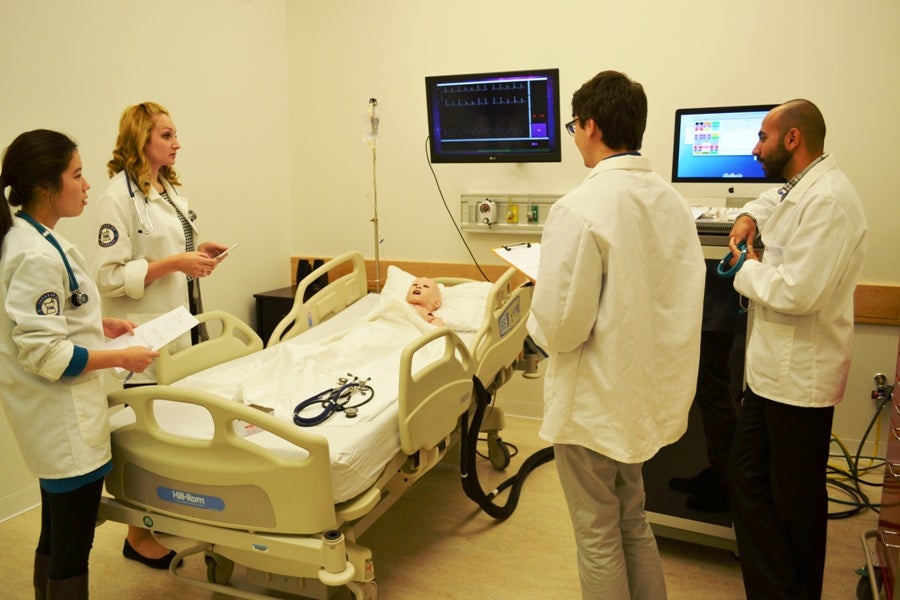
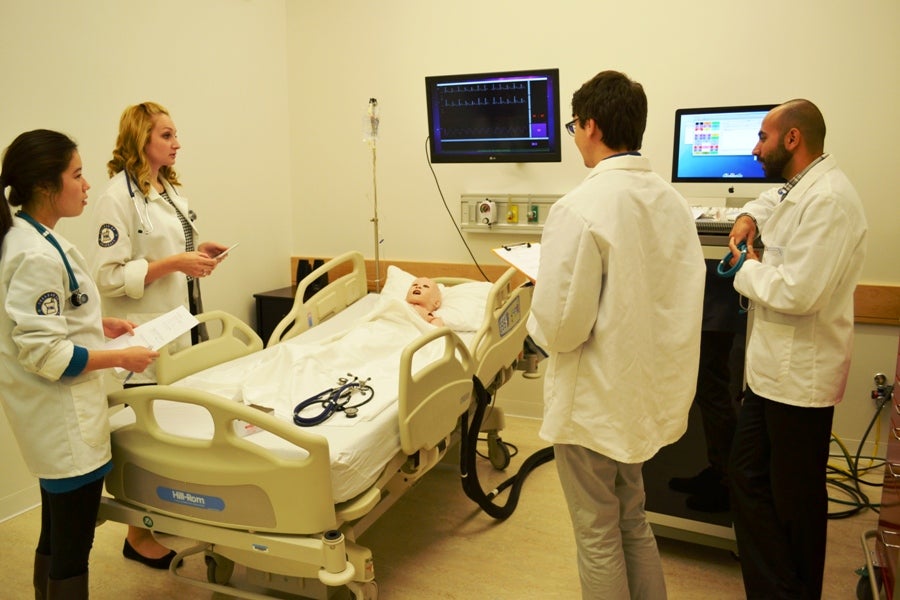
Ten years ago the University of Rhode Island College of Pharmacy was the first college of pharmacy to purchase a high fidelity human patient simulator. Since then faculty and staff have worked hard to integrate this technology into the pharmacy curriculum and established themselves as leaders in this field.
EquipmentThe center houses the following equipment.
|
|
![]() |
METI Emergency Care Simulator x 2The ECS provides an anatomically correct, feature-rich mannequin, which allows for the physical demonstration of various clinical signs including bleeding, breathing, blinking eyes and convulsions. The human physiology models at the core of the ECS provide appropriate responses to treatment interventions, including airway and oxygenation management, fluid administration, defibrillation and the administration of drugs. Together, these systems deliver a realistic and objective training ground for learners to practice and perfect patient care without risk to real patients.
|
|
METI BabySIM x 1The Baby SIM makes it possible to prepare students for interaction with our most vulnerable patients—in a safe, realistic learning environment. Intricate details such as realistic touch and feel, clinched fists and a layer of baby fat help create an appropriate representation of a three- to six-month old infant. BabySIM allows critical care interventions—such as infant CPR, airway management, drug administration and defibrillation, to name a few—to be practiced on the simulator, better preparing healthcare professionals for critical events involving infants.
|
METI PediaSIM x 1The METI Pedia SIM recognizes the minute but crucial differences that make pediatric medicine uniquely challenging – distinctions in anatomy, reactions to drugs, types of injuries and underlying physical conditions. Just as the HPS relies on highly precise computer modeling of human physiology and pharmacology, the PediaSim operates on the basis of delicately calibrated mathematical equations that reflect those of the pediatric patient. |
|
Media Contact: Dave Lavallee, 401-874-5862
Patient simulators provide pharmacy, nursing students with realistic treatment scenarios
KINGSTON, R.I. – May 7, 2007 – Surrounded by computer screens, an intravenous line, trays of medical equipment and nine of his peers, a pharmacy student works vigorously to administer a drug that will save the life of the “man” who lies on the gurney in front of him.
Across campus, a “baby” with septic shock lies in the arms of a nursing student, surrounded by other future nurses who are contemplating the next step to save this baby’s life.
These are among the situations that URI pharmacy and nursing students find themselves in several times throughout the semester in the lab components of some of their classes. If the wrong action is taken and the patient dies, a quick switch will bring him or her back to life for the next trial-and-error run. The University’s patient simulators are the closest a student can get to the clinical world of health care before actually stepping into it.
Pharmacy students use simulators several times a semester, and nursing students have continual access to the simulators from their sophomore year through graduation. Scenarios increase in complexity as the students advance in their classes.
The URI College of Pharmacy has had one adult male simulator for about six years. It has expanded its use as faculty and students have learned more about the technology. It has also recently obtained a baby simulator. The College of Nursing has both of these simulators, as well as a birthing mother simulator and 15 low-tech simulator mannequins. All simulators are life size, and the baby simulators even coo and cry.
“I think the students respond better to the baby,” said South Kingstown’s Amanda DeAngelis, co-director of the Human Patient Simulator Center in the College of Pharmacy. “It is wireless and mobile. We added the baby to our program because it is very different than the adult simulator. It requires different dosages and responds differently than an adult patient.”
While students in both colleges use the simulators to familiarize themselves with clinical settings, nursing students use the simulators for more procedure-based learning, while the pharmacy students use them to observe drug use and reaction.
Click here to read the full article
Clinton Chichester
Co-Director, Human Patient Simulation Center
Professor and Chairman, Biomedical & Pharmaceutical Sciences
401-874-5034
chichester@uri.edu
Amanda De Angelis
Co-Director, Human Patient Simulation Center
Instructor, Biomedical & Pharmaceutical Sciences
401-874-5038
Ian Lester
Lead Information Technologist
401-874-9239
ian@uri.edu