
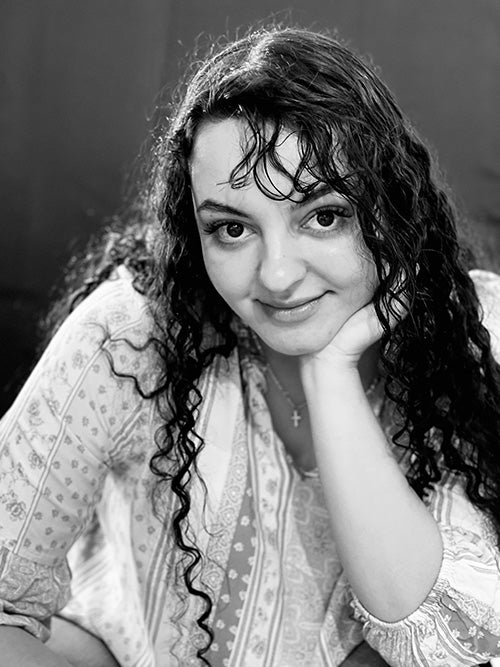
KINGSTON, R.I. [May 15, 2023]—Three years ago, at the University of Rhode Island Composer’s Concert, Milana Cepeda showcased a 9-minute orchestral piece she had written—the first live performance of her music at URI after she had transferred from CCRI. After the performance, she was thrilled to hear the piece had struck an emotional chord with audience members.
“People were telling me that it made them feel these very specific emotions,” said Cepeda, who will graduate this month with a degree in music composition. “And their emotions changed with different movements.”
That reaction got Cepeda thinking about how artists connect with their audiences emotionally—and the extent artists are able to convey the specific emotions they intend an audience to feel. That’s particularly important for Cepeda because she would like to compose film scores, which need to match the emotional arc of a story.
So she came up with a project idea that would help her explore how emotion is transmitted through music and visuals. Over the course of her senior year, she composed an original piece of music and worked with a visual artist to create an accompanying animated video. At each audience screening, a QR would prompt audience members to give feedback on how the piece had made them feel. The idea, Cepeda says, was for her to better understand the impact she was having on her audience, and to encourage her audience to be mindful of their emotions during the performance.
“It’s great to be able to have other people’s thoughts about my music,” Cepeda said. “It helps me as a composer to learn what can I do better next time. It’s the same reason that film directors do test screenings. They like to see how the audience reacted.”
To get the project off the ground, she applied to the College of Arts and Sciences Student Fellows Program, which provides funding for students to work on research or creative projects over the summer. The program aims to give students who would normally have to work over the summer a chance to devote themselves to an independent project under the mentorship of an Arts and Sciences faculty member. Cepeda received additional funding from URI’s Office of Undergraduate Research and Innovation.
Cepeda started by composing the musical piece for strings and piano, working with graduate student Natasha Rosario to record a cello part. Then she created a storyboard for a visual component, which an animator brought to life. Finally, she developed the survey questions for audience members to report how the piece made them feel.
A key component of the film is that includes no dialogue or narration.
“It was really important that I not put any words in people’s mouths,” Cepeda said. “I wanted people to tell me what they felt just based on the music and images.”
Cepeda showcased the piece in April for fellow students in the URI Fine Arts Center, and she says she’s encouraged by the response. She says that audiences have largely reported feeling precisely the emotions she intended, and feedback on the quality of the composition has been very positive.
In addition to helping Cepeda hone her artistic vision, the project is important in a professional sense as well. Not only does it give Cepeda a fully independent work to add to her portfolio, but it also helped her to gain confidence in her ability to deliver on a project from concept to completion.
“I found myself in a managerial position and that I excelled at it,” she said. “Everything got done on time and I showcased on the day I intended. I felt like I kind of exceeded my own expectations, and showed what I can do when I put my mind to something.”
Cepeda says she wasn’t always so organized or focused. She admits that she struggled for much of her high school career before turning things around as a senior. She says it was the birth of her daughter, during her senior year of high school, that changed her outlook.
“I realized that I had a bigger purpose now—my daughter,” Cepeda said. “And I really turned it around. My teachers were amazed because suddenly I was getting straight A’s. This isn’t an advertisement for teen pregnancy, but it really helped me change myself for the better.”
The soon-to-be college graduate hopes other young mothers will take inspiration from her story.
“Some people might see having a kid as getting in the way of pursuing their dreams,” she said. “But for me it was the other way around. I need to be able to show my kid that she can do whatever she wants, no matter what. And I want to show other people that they can get what they want if they really try—and of course get the kind of support that URI gave me.”