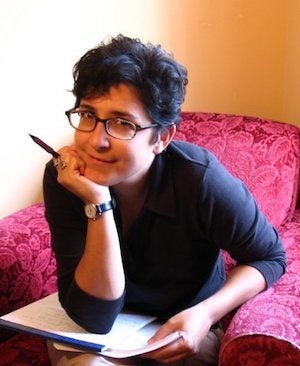
In this piece Chase Hoffman ’20, an anthropology and writing & rhetoric double major, interviews Professor of English Mary Cappello about her new book Lecture, her upcoming (albeit postponed) keynote speech for NonfictioNow in New Zealand, and why English majors are particularly well prepared to “creatively respond to the challenges of our contemporary world.”
Chase: What is your position at URI, and what are your research/professional interests within the English Department?
Dr. Cappello: I’m a Professor of English and creative writing at the University of Rhode Island, and my research and professional interests are wide-ranging. My last book was on the subject of “mood,” and I’m currently moving between three book projects: one on dormancy and dormant states; another on the forms that intimacy takes between strangers; and a collection of literary études that treat the question of the limits and possibilities of what we used to call “study” in the digital age. The literary forms I work in—the essay, literary nonfiction and experimental prose—allow for this sort of interdisciplinary capaciousness, and I continue, decades after the fact, to draw on the principles of my own graduate training, which emphasized the importance of combining a poetic sensibility with a scholarly ethos.
Most recently the classes that I teach in literary nonfiction—for aspiring writers as well as students of literature—have focused on what Freud famously called dreamwork. This is a sort of nonfiction where the imagination is as important as all that we daily notice and witness. It’s a sort of writing whose aim is to access truths unavailable to us under normal circumstances when we blindly follow conventions of looking, listening and narrating. A wonderful book called Dreaming in Dark Times by Sharon Sliwinski has served as a centerpiece in this course, and more recently, Jonathan Crary’s fabulous 24/7, on capitalistic colonizing of both our sleeping and our waking hours.
I try to teach the classes in nonfiction with a different emphasis each time. Last year, for example, I oriented a graduate seminar around non-fiction’s relationship to documentary art, which allowed for some dialogue and cross-pollinating with the fabulous documentary filmmakers on our campus, Professors Mary Healey Jamiel and Kendall Moore. We screened and studied their work and they made visits to the seminar that were invaluable.
Occasionally I teach classes in Literature and Medicine, and other cross-disciplinary subjects, like “Literary Acoustics,” that takes a Sound Studies approach to literature. My own writing in medical realms has taken me to venues far and wide, directed at doctors, patients, as well as physicians-in-training who want to be writers. I’ll give one such Keynote this Fall for the New England Otolaryngology Society (though we’ll probably be Zooming in, we’ll make it work!)
What is your new book about? Who do you hope to reach as an audience?
There’s a statement I find useful on the website of Columbia University’s Institute for Ideas and Imagination where they write that the purpose of the Institute is “to question the established ways in which knowledge is defined, produced, and taught.” That’s pretty much the point of my latest book. I’m very interested in what might be called “re-mediations of knowledge”—I want to pause to consider why we adhere unquestioningly to the forms that shape how and what we learn, how and what we convey or perform as writers or scholars, this includes everything from re-thinking the traditional panel presentation, to the public reading, from the conference to the syllabus. Each of these forms deserves a book in my opinion (or many books), at the least, a curiosity-imbued genealogy that might bring to the fore each mode’s historic, educational, and ideological supports. What purpose did these forms originally serve and how are they serving us (or failing to serve us) now? What might incite their re-invention, and how do the challenges of our current moment suggest the need for new ways to think about knowledge and understanding?
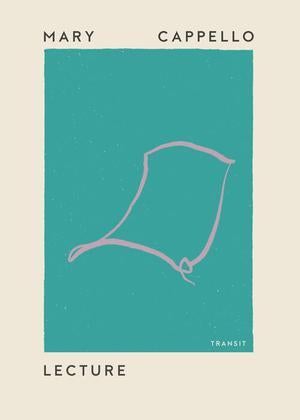
My new book, Lecture, will inaugurate Transit Books’ “Undelivered Lectures Series” this coming September. Here, I’m only dealing with the lecture—and some of its favorite companion forms, the note, the notebook, and the nap. This might make the project seem fanciful, but I mean it in all seriousness: the book is basically a kind of lyric manifesto; it’s a call to re-think how and what we notice, and most of all, how we are trained to listen or to shut down. In a culture that is dream-averse and sleep-deprived, I have no trouble with the idea of the lecture hall as inductive of a particular type of sleep that might, in time, generate a particular form of wakefulness. That sounds counter-intuitive, but I hope you begin to get my drift! The lecture, as I dream it, isn’t something that dictates. It intones.
When you ask what my book is about, well, the sort of writing I do is less interested in theme than in voice and movement. I’m trying to offer a reader a particular experience, like listening to a piece of music that is part riff and part highly orchestrated meditation. In this, it is perhaps reminiscent of the great lectures I have known (though I don’t claim greatness for it). Can I reach an audience that is in the mood for an unusual piece of music on something they thought was familiar or that they imagined they already knew? That would be nice. I think I’d also like to reach a younger generation with this book who might feel that their attention to life is flagging, or whose attentions are being corralled and usurped. I’d like to help them to begin to learn to listen for the sound of their own voices. In this sense the book really is meant for the student in all of us who wants to find a way to listen past the noise. If there’s a specialized audience for the book that is built-in, though, it is fellow writers of nonfiction who I’m imploring to rediscover the forms the essay can take in public.
Note: Watch Dr. Cappello discuss Lecture on a Kirkus Author Video Feature here.
Can you tell us more about serving as Keynote speaker at the conference in New Zealand? What do you plan on speaking about?
It’s a very thrilling invitation. I was to Keynote at NonfictioNow, one of the premier conferences in the genre, alongside Ngahuia Te Awekotuku and Behrouz Boochani in Wellington, New Zealand in December 2020. Incidentally, the founder of the conference, the writer Robin Hemley was to read from his new book, Borderline Citizen, here at URI this Spring. It was to be a literary celebration of the tenth anniversary of our literary annual, the Ocean State Review, with readings as well from fiction and nonfiction writer, recent NEA honoree, Hester Kaplan. All of this you’ll notice is in the past tense since the pandemic has required that all such plans be suspended until 2021.
When you originally asked me the question of what I planned to speak on, I had happened upon a sentence that I knew I was going to follow, and I still might. None of us knows where the world will be by then, but certainly the vast community of nonfictionists who constitute this group will continue to talk to one another. My own feeling is that we should be quiet for a long, long time. Or at least I mean that for myself. I don’t wish to react to the pandemic and I think it is too early to do what, as a writer, I am called to do—respond, reflect, create.
Why do you personally believe it’s so important to continue to teach creative nonfiction, and how do you feel the genre has evolved over time?
Relatively speaking, “creative nonfiction” as a category was only recently coined so it’s really only in its infancy, though it could be argued it’s a name for something that people have always been doing. It’s an umbrella term for many different types of non-fictive practice; at its core, it is inventive. In super-flat times, it is a genre that is all about nuance; it is hospitable to competing truths. It invites the movement of “a free mind at play” (to quote Cynthia Ozick) over and against a pre-determined course; it shares with journalism a dedication to truth-telling, witnessing, and the lives of others. It strives to ask the question no one else is asking. Like poetry, it understands the power of language as such; it doesn’t treat words as transparent vehicles to reality but as worlds unto themselves. Every few years or so, I try to offer a new contribution to the on-going discourse of what we mean by the category. One such can be found in The Cambridge Companion to Autobiography.
Students of creative nonfiction enjoy the experience of multiple epiphanies across the course of a semester, starting with the fact that the essay they learned to write in high school bears no relationship to the long tradition of the literary essay, which is often multi-discursive, meandering, and unpredictable. There’s nothing more exciting than watching a student who previously knew nothing about the genre realize that they can, after much practice, a dose of inspiration, and always, an immersion in reading, create their own work in this form. Most students love the way the genre slows them down and asks them to discover their own meditative capacities. Whether they are grappling with the twists and turns of their own memories, or tapping into the beauty of an abstruse scientific theory; if they are dealing with personal or generational trauma, or seeking a form for their own confusion, creative nonfiction asks them to start from what they don’t know rather than what they think they know and see where that takes them. The results are often breathtaking. A semester doesn’t go by in which I’m not astonished by the beauty of what my students are able to invent.
What are your final thoughts about URI English, the university itself, and your students?
In our current crisis, English majors are creative problem solvers. They are trained to analyze situations and to discover new ways to talk about them. In a recent class on literary nonfiction as dreamwork, I asked my students if the pandemic made them want to take a course in a subject they may never have considered studying before. We talked about all of the different disciplines that might help us both to approach and understand the pandemic, from virology to world economy, public health to ethics, psychology to history to environmental studies and sociology. And how about the discipline we can’t imagine being linked to the virus? Maybe that’s the course most definitely to take. We talked about whether COVID-19 is an instance of a natural force’s power to change the course of human history or whether human history has changed the course of a natural force. My students’ answer: “both.” We wondered to what extent we have been sleeping, and what it might take for us to wake, to see further, clearer? Here’s where English comes in, because one answer to the latter question is “art.” The English major is the person who can understand the ways in which the disciplines I just listed are inter-related—how no one way of knowing can “answer” the problem of the current crisis, or “explain” the situation on its own, but how, each intersects with the other, often inter-dependently. The English major learns how to investigate the ways in which these ways of seeing and ways of saying cross-over and depart.

I was recently reading an interesting interview in Slate between Rebecca Onion and Elizabeth Outka, a scholar whose book, Viral Modernism: The Influenza Pandemic and Interwar Literature, on the 1918-1919 flu pandemic appeared last year. In it, Outka says: “My specialty is literature, and literature is especially good at capturing these elements of disease that are difficult to represent…There’s that sort of invisible, strange conversation that happens between the body and the mind. Literature can capture that. Literature can also capture the way a loss of a loved one lives on in all those very small gestures … you turn around and no one is there as you’re brushing your teeth—all these small, terrible, but largely invisible losses…”
Then there’s the great French philosopher, Roland Barthes, who in his 1977 lecture to the Collège de France, explained, “Literature accommodates many kinds of knowledge. In a novel like Robinson Crusoe there is a historical knowledge, a geographical, a social (colonial), a technological, a botanical, an anthropological knowledge.”
Literature represents the un-representable, and in that gives us a new ground from which to act. And it does so by working inside the interstices of various types of knowledge. During this time, I’ve found myself returning to a favorite book by Ed Cohen, A Body Worth Defending. The book traces a medical paradigm shift from thinking about the body as an organism that works in concert with the environment in which it lives—an implicitly integrative model of the human organism—to imagining the body as distinct from, ever at odds with, and in need of defense against, that very environment. The notion of the immune system, he demonstrates, is built from a notion of war as the condition of life itself—the arrival at this paradigm is complex, fascinating, and sobering. How can we, and why might we want to, disturb foundational certainties that are ascribed to the body? What would happen if we understood immunology as a set of mutable ideas rather than intractable facts-of-the-matter? In the course of re-reading him, I re-discovered the work of paradigm-shifting immunologist, Polly Matzinger only to then learn that a scholarship at URI exists in her name!
In a book by a URI alum, Penelope Cray’s Miracles Come on Mondays, who we were hoping to host this Spring, I find many pieces that speak directly to what we are living with now. Great literature is also prescient. This is why we need to heed it, now, and always.
Or I turn in the direction of an insight from a current student, Marissa Wilson, who wrote that if a hallucination is seeing or hearing something that is not there, a dream is seeing everything that has been there all along. We just weren’t willing or able to see it. That seems to say it all!
In my closing classes this semester, I was graced with sophisticated and beautiful work that my students created under super-stressful circumstances. This gives me hope, for sure, and also tells me that I needn’t worry about them. The months ahead will be supremely difficult, especially for seniors, but our students have the resources of their hard-won intelligence and imagination. They have to be the drivers of the change this global crisis calls for. I know they can, and will.
As for incoming students, we are rolling out a new curriculum this Fall that is flexible, diverse, and that will continue to help our students creatively respond to the challenges of our contemporary world. It has two streams—literature and creative writing.