
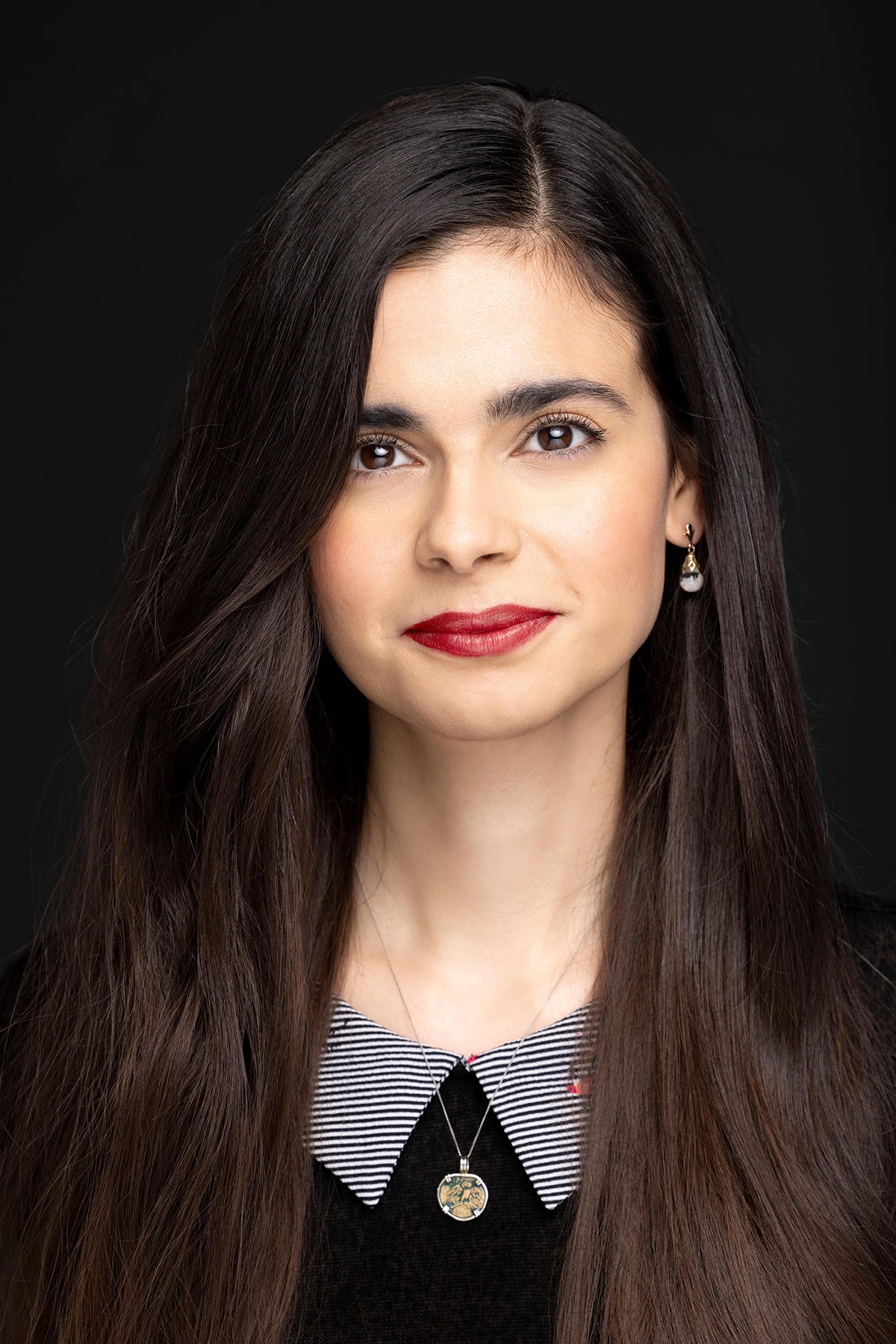
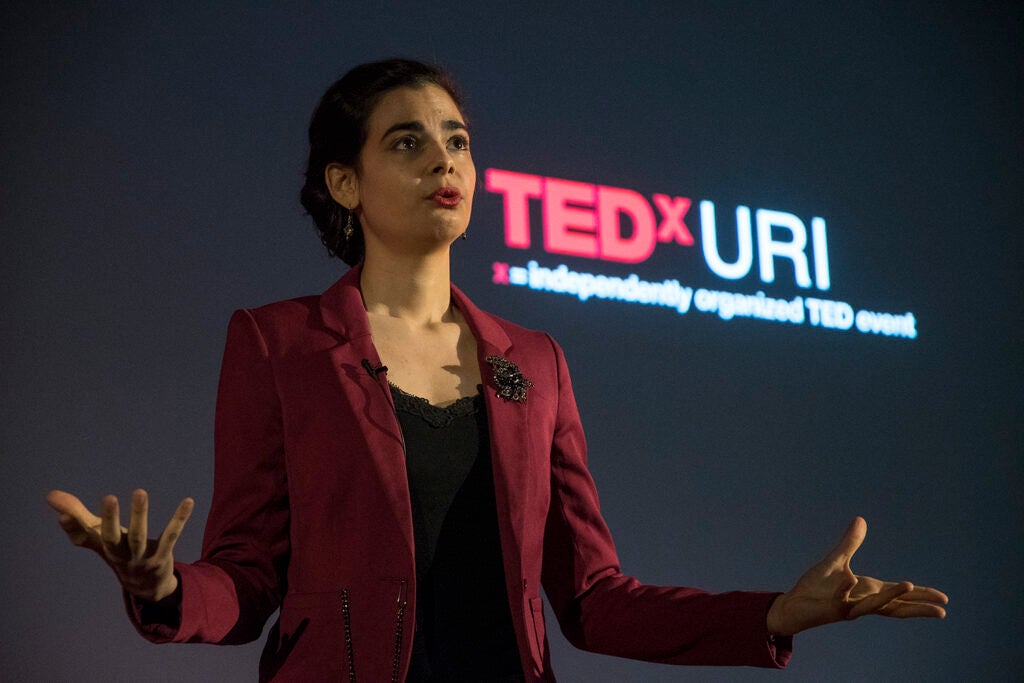
KINGSTON, R.I. – Jan. 14, 2022 – Aria Mia Loberti ’20 has long been a powerful advocate for people with disabilities, sharing her struggles from a young age as a blind person on stages such as the Rhode Island Statehouse, the United Nations, and a TEDxURI talk. Now the University of Rhode Island alumna is taking her message to a larger arena.
In news announced in early December by such entertainment trade publications as Variety and The Hollywood Reporter, the acting newcomer has been named the lead in the upcoming Netflix adaptation of the Pulitzer Prize-winning novel “All the Light We Cannot See.” Loberti won the part over thousands of hopefuls after a worldwide search for blind and low-vision actresses.
“I was so shocked,” said Loberti, a US-UK Fulbright Scholar and first-year Ph.D. student in rhetoric at Pennsylvania State University. “It’s just ludicrous. There were thousands of people [who auditioned] and it’s a lead role. It was such a fun audition process and it was very empowering. That’s all I was seeking – a new experience, a challenge. I didn’t expect anything more to come of it. I think it was just pure shock when I learned.”
In Anthony Doerr’s “All the Light We Cannot See,” Loberti will play Marie-Laure, a blind teenager in Nazi-occupied France during World War II who meets a German soldier, Werner, as they try to survive the war’s devastation.
Loberti, who grew up in Johnston, is a big fan of the 2014 novel and the story of the blind teenager resonates with her family. She found out about the global search to fill the role of Marie-Laure in late October from a former childhood teacher, who reached out to her unexpectedly, saying Loberti was the only person she could imagine in the role.
In the casting announcement released by Netflix, Shawn Levy, executive producer and director of the four-episode miniseries, said: “We searched the world and reviewed thousands of auditions. We never thought our path would lead to someone who has not only never acted professionally, but never auditioned before. It was a jaw-drop moment when we first saw Aria Mia Loberti, who is both a natural performer and an advocate for disability equity and representation. I can’t wait to tell this beautiful story with her at the center.”
After the news became public, Loberti heard from old friends and acquaintances, along with strangers telling her how much the book meant to them, teenagers and adults who are experiencing sight loss, and parents of children with vision loss who have told her how important it means to have her playing the role.
“These beautiful stories from strangers, I can’t even process it,” said Loberti about a week after learning she had landed the role. “I think today’s been the first day it’s sort of mellowed out just enough that I can breathe.”
Loberti was born with a severe form of the rare genetic eye condition achromatopsia. As a result, she is completely blind in some environments and has minimal, variable residual vision in others. She is color blind and particularly sensitive to light.
She learned to be a fearless advocate and public speaker for herself and other people with disabilities at a young age, as she and her parents, Paul and Audrey, fought to get her the education services to which she was entitled.
“My mom tells a story that when I was really little, I used to line up all my dolls and stuffed animals in rows and give a speech to them or perform or pretend to be a lawyer and advocate,” she said. “Looking back, I realize storytelling and performing were always a part of me. I think having to advocate for myself from a very, very young age instilled in me that storytellers have a lot of power.”
At URI, Loberti’s advocacy for people with disabilities and women’s rights extended to the United Nations as the first legally blind youth delegate. At the same time, Loberti dabbled academically in everything. She triple-majored in philosophy, political science and communication studies, while minoring in rhetoric and Ancient Greek, and won a Fulbright to earn a master’s degree in ancient rhetoric at Royal Halloway University of London.
An honors student, Loberti, who attended URI on a Centennial Scholarship and other endowments, carried 19 credits a semester and took classes over J-term, finishing with about 150 credits, well over the usual 120 of most graduates. This was all done while working full-time to meet her tuition and rent.
“It was difficult, and sometimes felt impossible, to balance everything,” she said. “I think a lot of students like me who don’t come from a more fortuitous financial background might feel super overwhelmed in college.”
While there was the occasional issue of access or inclusion, Loberti says she found an embracing community in Kingston. “The world always told me you don’t belong. My immediate family were the only people countering that message,” she said. “Then I got to URI and I had a whole community of people who were telling me ‘you belong here, you can do these things.’”
That community included several professors whose classes were constants on her schedule – Daniel Carpenter in Ancient Greek, Kathleen Torrens in communications, and Honors Program Director Lynne Derbyshire. “I took every class they taught,” Loberti said. “If they were going to teach Phonebook Reading 101 that semester, I would have taken it.”
As she prepares for the filming of “All the Light We Cannot See,” classes she had with Derbyshire are particularly on her mind. “They weren’t theater classes but they were about race, class, gender and disability in media,” she said. “I didn’t realize I was going to be living that so I’m very grateful I took that series of classes.”
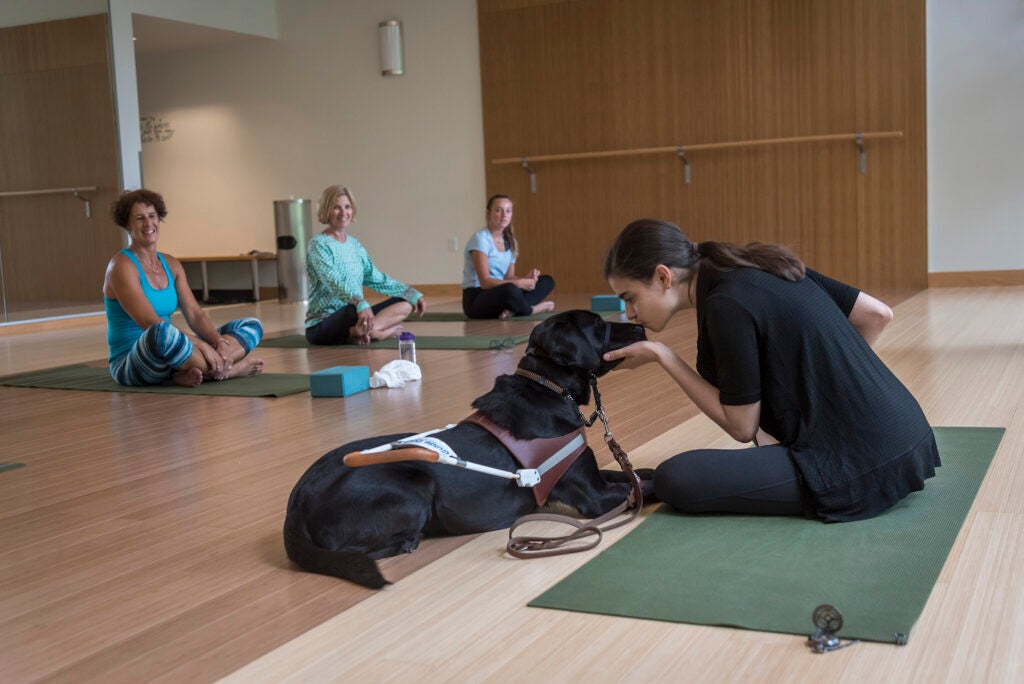
When filming begins, her guide dog, Ingrid, who became a star at URI, will be at Loberti’s side – although she can’t say whether Ingrid will make the cut for the miniseries. Nonetheless, Ingrid will bask in Loberti’s spotlight.
“She knows something big has happened,” Loberti said. “But I don’t think she realizes she’s going to be famous yet. We’ll see how fame affects her. Hopefully, she doesn’t turn into a diva.”