
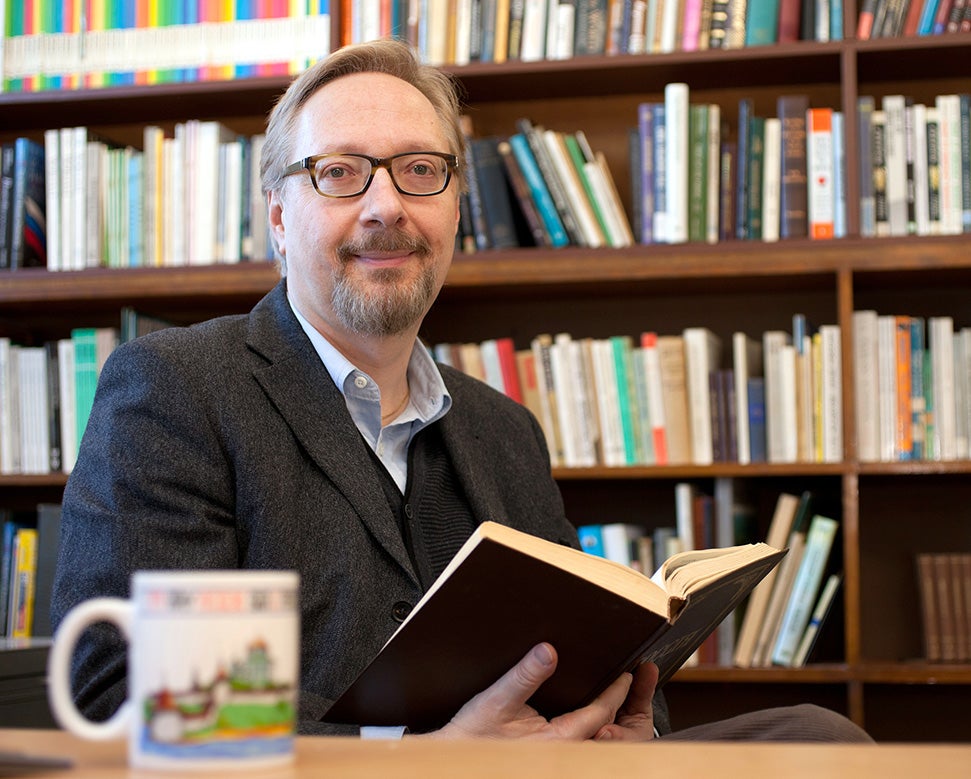
KINGSTON, R.I. – Dec. 19, 2022 – On a Fulbright research trip to Ukraine in 2014, Nicolai Petro had a front row seat to the eruption of the Maidan revolution, which led to the ouster of the country’s president who sought closer ties to Russia.
The revolution also exposed the deep domestic conflict over Ukraine’s national identity between those in the country’s east who honor their Russian heritage and welcome ties to their neighbor and those in the western region who reject everything Russian.
Petro, a professor of political science at the University of Rhode Island, was in the southern port city of Odessa, where the division between these groups was not as sharp. But he could still see the divisive schism.
“It opened my eyes to how deep the divisions within the country were,” said Petro. “While 80% of Western Ukrainians supported the Maidan, 80% of Eastern Ukrainians opposed it.”
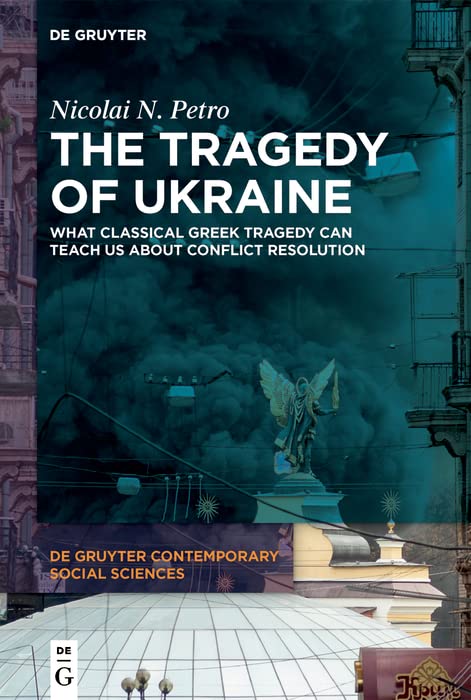
In his new book, “The Tragedy of Ukraine: What Classical Greek Tragedy Can Teach Us about Conflict Resolution,” Petro explores the more than 150-year history of this destabilizing struggle. He also argues that the current war between Ukraine and Russia has deep roots in that internal strife, which has led to armed clashes three other times in history.
Petro says his interest in writing about the decades-old domestic division was fueled by curiosity.
“I was troubled by how difficult it was for people to get along,” he said. “I didn’t understand why there was so much mutual hatred in the country,” he said. “I was trying to understand these divisions, which used to be widely accepted among Ukrainian specialists. People were always talking about them when writing about Ukraine.
“Then there’s the added question of why it became a military conflict,” he added. “Once you go back in history, though, you see even that’s not unusual. There’s been infighting with large numbers of deaths between Eastern and Western Ukraine four times already. This is the fourth.”
Petro suggests that classical Greek tragedy offers a way to overcome the civic conflict.
“Recurring conflict is as much a problem of the heart, as it is of institutions, and the enduring value of classical Greek tragedy is that it seeks to induce a change of heart, a catharsis,” he said. “Oedipus was blinded by his anger long before he laid hands upon himself, and only began to see truly when he lost his outward sight, and was forced to look inward. It is my hope that by drawing attention to the tragic cycle that entangles them, more Ukrainians will be encouraged to look inward. That is where they will find the compassion and forgiveness needed for reconciliation.”
Petro, who joined to URI in 1991, has worked on the book for about the last 10 years, mining Ukrainian newspapers and media sites for original sources to chronicle the tragedy. (The book has more than a thousand footnotes.)
But he also has brought to the project a long history of work in both Ukraine and Russia.
His connections to Russia go back more than 30 years. In 1989 and ’90, he was an International Affairs Fellow for the Council on Foreign Relations, an American think tank, and served as a special assistant in the Office of Soviet Union Affairs in the U.S. Department of State. He was also a political attaché at the U.S. Embassy in Moscow, monitoring local elections in Russia, Belarus and Latvia. He later worked privately as a consultant to the municipal research and training center Dialog, and was an adviser to the mayor of the Russian city of Novgorod. In 1996-’97, he served a Fulbright Lectureship in Russia.
Since 2008, when he was invited to speak by the National Academy of Sciences in Kyiv, he has made nearly annual visits to Ukraine, traveling throughout the country. In 2010, he spoke at the V. N. Karazin National University in Kharkov and, in 2013-’14, he did research on the Orthodox Church in Ukraine as part of his Fulbright.
A frequently cited expert for national and international media on Russia and Ukraine, Petro has been published in numerous newspapers and journals in the U.S. and Russia. He is also the author or editor of eight books, including “The Rebirth of Russian Democracy: An Interpretation of Political Culture” and “Crafting Democracy: How Novgorod has Coped with Rapid Social Change.”
“The Tragedy of Ukraine,” which will be published Dec. 19 by De Gruyter, Germany’s oldest academic publisher, has received advance praise from scholars and international affairs experts. Jack F. Matlock Jr., former U.S. ambassador to the USSR, called the book “brilliant, insightful, thoroughly researched study. Essential reading for those who wish to understand the causes of the war in Ukraine and its implications for the rest of the world.”
Petro answered several questions about his new book.
What is classical Greek tragedy “therapy” and how can it heal national divisions?
For the Greeks, tragedy results from the inability of individuals to see how much their own actions have contributed to their current predicament. By re-imagining on stage the horrors that result from the unyielding pursuit of vengeance, Greek playwrights sought to lead audiences to catharsis, a purging of emotions so powerful that it would allow pity and compassion to enter the soul and take the place of rage. Aristotle thought that catharsis could liberate individuals and societies from the endless repetition of a tragic script.
Since the production of these plays was sponsored by the ruling elite, and the attendance of the entire adult population was considered a civic duty, I see tragedy as part of the therapy used to heal society from the trauma of war.
What are the internal conflicts in Ukraine and how does it resemble tragedy?
Simply put, the conflict within Ukraine stems from the state’s reluctance to recognize the “Other Ukraine” – the third of the population that regards its own Russian cultural identity as compatible with a Ukrainian civic identity – as a legitimate part of the Ukrainian nation. As a result, the government has systematically suppressed the Russian language and culture. Since these are native to a large portion of the population, these policies have in the past spawned considerable resistance.
This tragic cycle is fed by the destructive narratives that each side tells about the other, which are then used to justify conflict in the name of achieving justice. Trapped by their insistence on correcting the injustices of the past before engaging in dialogue, both sides have unwittingly contributed to the perpetuation of their mutual tragedy. Today’s tragic events are thus part of a larger tragic cycle that has gripped Ukrainian political elites for the past century.
How have these divisions contributed to the ongoing war with Russia?
The current war is merely the latest in a series of conflicts that have bedeviled this area of the world. These include: the great power rivalry between Russia and the West; the conflict between Russian and Ukrainian elites; and finally, the conflict within Ukraine itself over its proper national identity, its relationship to Russia, and its role in the world. It is, in sum, a conflict about who gets to define Ukrainian identity.
For many in Western Ukraine (Galicia) being Ukrainian means rejecting all things Russian – language, religion, trade, resources, science, music, books – everything. Only after Ukraine has thus “decolonized” itself, will the true Ukraine be able to emerge. During the 2014 Maidan revolution they referred to this as making a “civilizational choice.”
For many in Eastern Ukraine (Malorossiya), however, being Ukrainian means cherishing the country’s historical and cultural ties to Russia. Most people in this Russophile half of Ukraine saw the call for a civilizational choice as unnecessary, divisive, and demeaning. This conflict of visions regarding Ukraine’s past and future has erupted into armed conflict within Ukraine at least four times – during World War I, during World War II, after the 2014 Maidan, and now again in 2022.
What do you see as the road to a settlement in the conflict?
Although a peace accord can mute the conflict, temporarily, there will be no permanent resolution until the issues at the heart of this conflict are addressed as well.
The current situation may seem hopeless, but understanding the therapeutic role of tragedy allows us to see that the key to breaking the cycle is to move social discourse away
from the quest for vengeance (often mislabeled “justice”), to the goal of building a society together with one’s former enemies. For this to happen in Ukraine, the government would need to embrace three postulates:
First, that being a Russophile Ukrainian does not mean being anti-Ukrainian. Greek tragedy tells us that to achieve social harmony, one must be willing to treat one’s enemy with the same honor that one seeks for one’s self. This truism is not based on moral abstraction, but on the practical calculation that fair and equal treatment is the most binding of all social ties.
Second, that punishing Russia does not mean healing Ukraine. It is an axiom of international politics that no country has ever prospered by making an enemy of a more powerful neighbor. Moreover, countries that obsess over their national identity and security, often wind up losing both.
Third, that social harmony in Ukraine can only be established by Ukrainians themselves. External actors have their own agenda, which will rarely, if ever, coincide with the interests of Ukraine. To establish lasting social harmony Ukrainians will have to overcome their fear of their own diversity, and be willing to call upon their entire history and culture, both Galician and Maloross.
How can tragic therapy play a part?
By drawing attention to the true meaning of justice—which is mercy—instead of settling for vengeance, Greek playwrights hoped to stop the cycle of tragedy from repeating.
But while the Athenian polis was small enough that it could engage nearly every adult member of society in its rituals, there is no mechanism that can perform this function today. A comparable process, however, has been around for more than 40 years, and been implemented in over 50 countries—Truth and Reconciliation Commissions.
Like the Greek tragedies of old, such commissions work to heal deep social trauma and bring about social reconciliation, by gathering and putting on public display riveting emotional testimony from all sides. This leads the public to catharsis—a purging of mutual hatreds that allows society to heal by restoring humanity to the once enemy Other.
The most important lesson of tragedy, however, is that the pursuit of total victory over one’s enemies can only breed renewed conflict. The tragic cycle of Ukraine will therefore end when Ukrainians realize that true victory means the victory of compassion and dignity over hatred, so that all Ukrainians, regardless of religion, language, or cultural heritage, are seen as indispensable to the Ukrainian nation.