
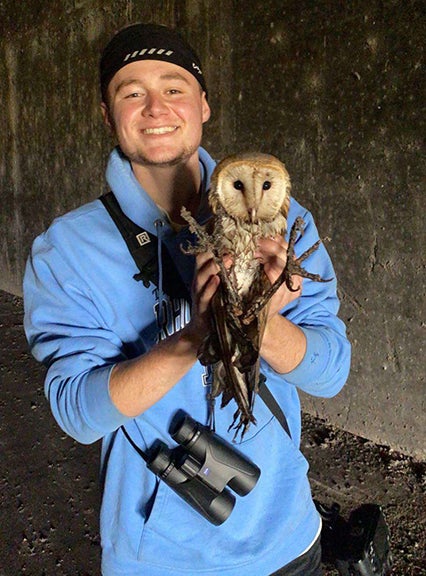
KINGSTON, R.I. – May 9, 2022 – It’s well before dawn at Point Judith. The salt mist mixes with a chill autumn wind that seems to sneak down the neck. It’s too early for walkers along the shore. But a lone figure stands perched atop a two-story concrete bunker left over from World War II. He points a microphone toward the sky.
Instead of searching for enemy warplanes, Sam Miller is tracking bird migration as part of his pursuit of a bachelor’s degree in wildlife and conservation biology in the University of Rhode Island’s College of the Environment and Life Sciences.
Miller’s interest in wildlife dates to his preteen years, when he would borrow his mother’s camera to take pictures of any wildlife he could find. “And then that shifted to taking pictures of birds at our feeders,” Miller said. “It progressed to wondering what species those birds were and putting a name to the picture. I opened my first field guide and started flipping through the pages and seeing all the different birds that I never knew existed. From there, I just started going out and looking for them.”
Miller first considered a major in biology, but the lure of the outdoors was strong. “I’ve always been interested in the natural world, and wildlife conservation just seemed to be the most fitting major,” said Miller, who graduates in May from URI. “I wanted to focus on being more so outside dealing with animals, rather than the nitty gritty of studying cellular life and the more medical aspect of it.”
Originally from Gambrills, Maryland, Miller came to URI as part of his college search and fell in love with the area. “I saw that they were doing some really cool research up here. I love to study and look at the migration of birds in the Northeast. This is one of the best places to observe fall migration, so I figured I’d be able to keep busy. And on top of that, I also I liked the size of the school and the campus. It was a kind of a good compromise between a small campus and the overwhelmingly large ones.”
One of the high points of Miller’s time at the University came in November when he discovered a sharp-tailed sandpiper, a bird that belongs in Siberia, while leading a birding event at the Galilee Bird Sanctuary in Narragansett. He had recruited roughly 35 birders and was searching around when a bird exploded into flight right in front of him.
“I was extremely shocked, and I think it was just as startled as I was,” he said. “My heart jumped for a second, and then I realized that it didn’t seem to align with anything I had in my memory bank of birds.”
Eventually the rare bird sighting was confirmed, and Miller realized that the sighting made an important contribution to the birding community. It was the first time a sharp-tailed sandpiper had been spotted in the Ocean State.
Experiences like that were part of the reason Miller continued with his initial choice of wildlife and conservation biology. “I loved all the classes in my major because they really had a focus on experiential learning outside of the classroom.”
That experiential learning was why Miller spent many hours standing atop a Point Judith bunker, pointing a microphone at the predawn sky. He was listening to bird calls in order to gather data on their migration for a class.
“I was able to secure a grant that gave me enough money for the microphone technology, but outside of that, I was on my own with the birds. It seemed fitting for my entry level research to have a little bit of the high-tech mic, but for the most part doing it with human labor,” he said.
“I’m still working on the data analysis of that through a course that URI Professor Peter Paton recommended. So, everything has a way of fitting together again.”
The coming months will find Miller working with a bird biologist from the Rhode Island Department of Environmental Management, which is an exciting prospect for him.
“I’ll be busy running around salt marshes and doing aerial surveys of colonial waterbirds and saltmarsh sparrows and more. I’ll be doing all kinds of fun projects this summer,” Miller said. “My first day is before graduation, so I’ll be hitting the ground running.”
Hugh Markey wrote this media release.