
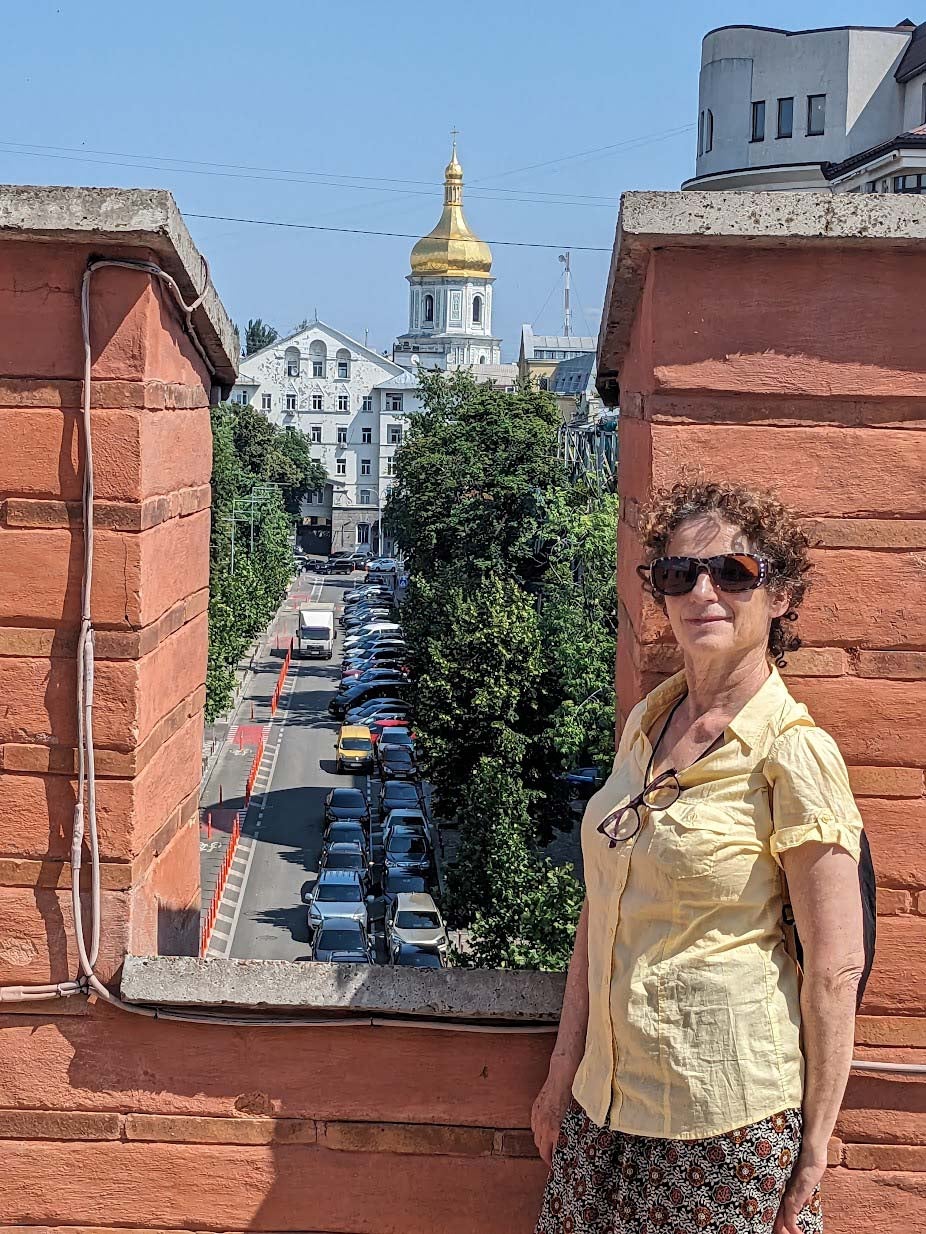
KINGSTON, R.I. – Aug. 10, 2023 – Speaking through a translator, the woman told Eliane Aberdam how the concerto she had written to honor Ukrainian fighters described exactly what she was feeling. Near tears, the woman, Ina, described being a soldier for seven months on the front and seeing friends she had known since kindergarten killed.
“She said she and her friends were not trained soldiers at all. They came to fight,” said Aberdam, professor of music at the University of Rhode Island. “She told me that the courage her friends exhibited was just incredible.”
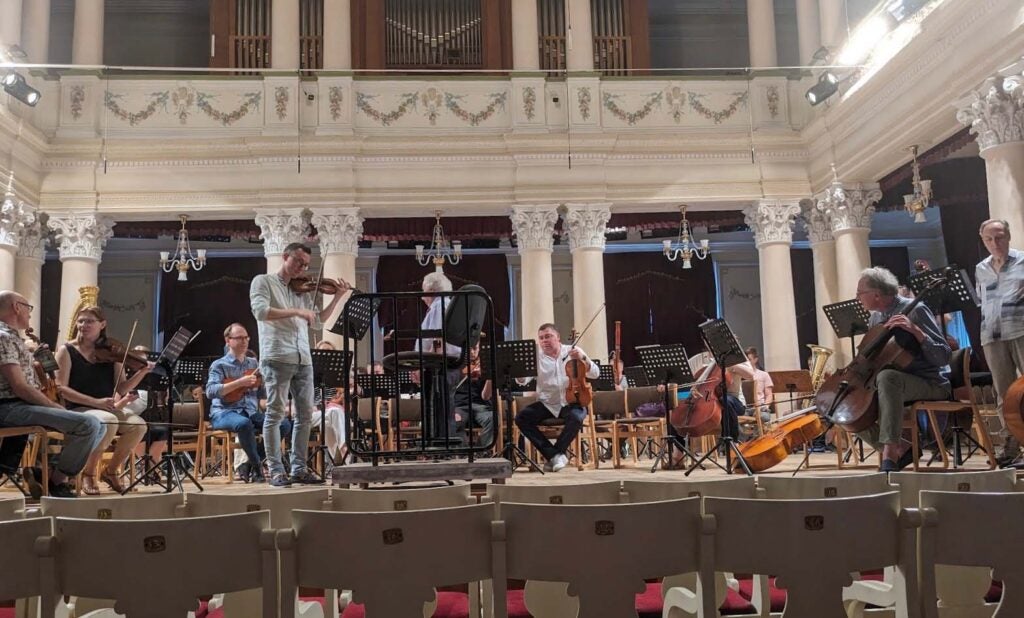
In the concert hall in Kyiv, Ukraine, others came up to Aberdam, who was in the war-torn country for the premiere of her violin concerto, “In Memoriam: For the Ukrainian Fighters, Hope, Fallen Ones,” which was performed by the National Philharmonic Orchestra in Lysenko Hall on June 23. One couple gave Aberdam a white rose and said they were very moved by the concert. A man asked to have his picture taken with her.
“I think a lot of people were appreciative that we came there because it shows that the world— the people in the general population, not just the politicians—care about the fate of Ukraine,” Aberdam said.
Aberdam started writing “In Memoriam” in January, but it wasn’t first intended with Ukraine in mind, she says. But the feel of the music, with its themes of yearning, sorrow and hope, turned her in that direction. She wanted to write something to pay homage to Ukraine and had been fundraising to help musicians in the country who are feeling shortages of the basics, such as strings for their instruments.
She shared the piece with a long-time friend in Kyiv, Alla Zagaykevych, who said she knew a conductor who might be interested. A few days later, the conductor, Natalia Ponomarchuk, one of Ukraine’s most in-demand conductors, said she wanted to premiere it and already had the soloist, violinist Kyrylo Bondar.
Aberdam, who arrived in Kyiv with her husband, Eran Makover, three days before the concert, was impressed by the professionalism of the National Philharmonic and its conductor, who had closely studied the 15-minute score and found a minor mistake.

“This was the only mistake I had, but she caught it,” Aberdam said with a laugh. “She was very immersed in the music. I think that was also the conductor’s way to forget about everything that’s going on in the country. I know that she was worried about her mother and brother.”
At the concert, the fine-tuned score was very touching and the National Philharmonic was “just fantastic,” she says.
Aberdam and Makover spent four days in Kyiv, a sprawling city of about 4 million people. While the capital has been the frequent target of Russian missile and drone attacks, there were only some signs of the ongoing war.
“I think Kyiv is well protected, relatively, from all these air raids because of the batteries of anti-missile weapons,” she said. “But I’ve seen photos of other communities in the surrounding areas where churches are completely destroyed. Villages are bombarded and evacuated. It’s misery.”
On the 19-hour train ride from Warsaw, the couple saw only women and children heading to Kyiv. On trains heading out of Kyiv, they again saw just women and children, refugees toting large pieces of luggage. She said men cannot leave the country.
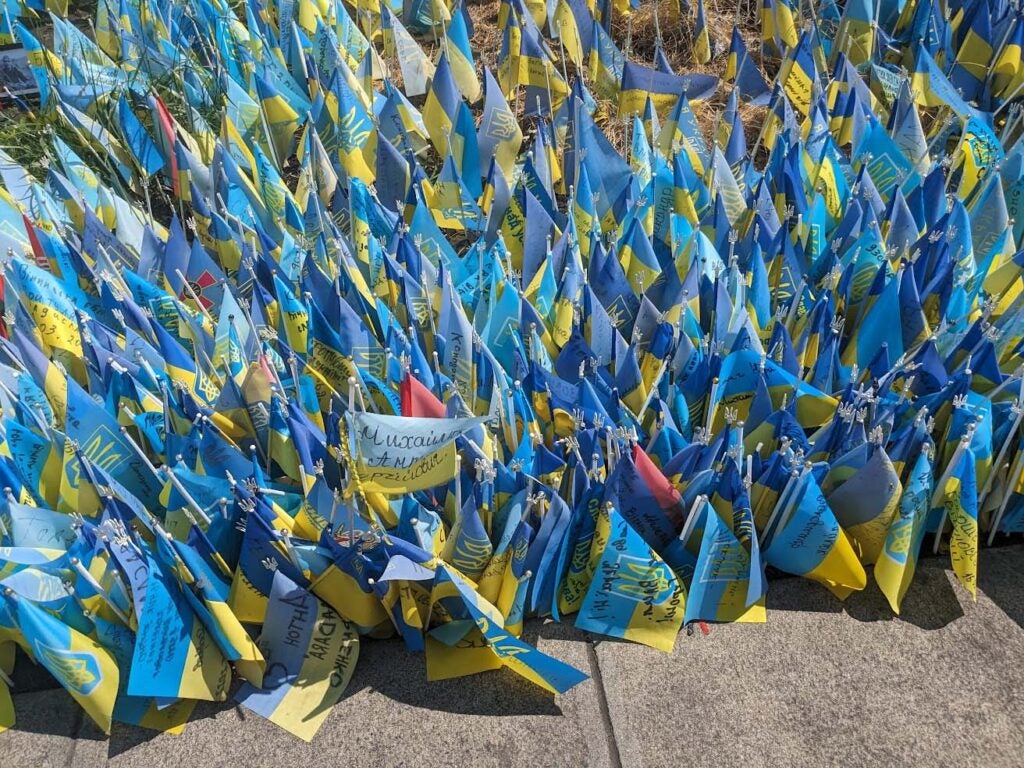
In Kyiv, they found wall displays of photographs of fallen Ukraine soldiers, beds of yellow and blue Ukrainian flags honoring the war’s victims, anti-tank obstacles in the main plaza, and a display in the plaza of a big church of captured Russian tanks, damaged and rusted.
But they also found an active city, she said. The metro was operating and full of passengers. On the streets, they met tourists from other parts of Ukraine, which surprised Aberdam. The restaurants were full and food was not lacking, and kiosks sold lemonade, tea and coffee.
“If you don’t know it you would not really notice that something is off,” she said. “But people who live in Kyiv said it’s empty compared with before the war.”
But there were also air raid sirens, alerts and curfews. On three of their four nights in the city, there were red alerts, when people had to seek shelter either in the subway or in a building with two walls between them and the outside, she said.
The night of the concert, there was an alert at around 10 p.m. as they held a small reception just outside the philharmonic hall to thank the conductor and orchestra for the performance. Because of the curfew, some of the musicians who needed to make trains had already left.
“Then there was an alert. It was kind of far away and I didn’t even hear it,” she said. “People heard it but nobody moved. I was a little surprised.”
Aberdam said plans for a recording of the concert are in the works and it should be available soon. Also, money is still being raised to support musicians of the National Philharmonic Orchestra in Kyiv. To give to the Solidarity with Ukrainian Musicians fundraiser, go to the website.