

KINGSTON, R.I. – Aug. 15, 2023 – University of Rhode Island Provost Barbara Wolfe and URI Research Foundation Executive Director Christian Cowan have been named recipients of the 2023 PBN Leaders and Achievers awards this year by Providence Business News. The annual program recognizes honorees with long-standing commitment to the Rhode Island business community and a sustained demonstration of leading others, community service and mentoring.
Cowan and Wolfe will be recognized at an event on August 23 with other 2023 honorees.
E. Paul Larrat, Dean of URI’s College of Pharmacy, received the award in 2019, the first year of the award.
Barbara Wolfe: URI’s top academic leader
Barbara Wolfe has been a member of the URI community since 2016 and served as the dean of URI’s College of Nursing before her appointment as provost and executive vice president for academic affairs in January.
She is an internationally recognized expert on psychiatric and mental health nursing and eating disorders and led the elevation of the College of Nursing’s national profile and reputation while improving student success and experience and increasing faculty support. She is a recipient of the Psychiatric Nurse of the Year award from the American Psychiatric Nurses Association.
“I was drawn to URI for its mission and commitment to accessible public education,” Wolfe says. “Public education is critical to how society thrives. We have an obligation to look forward, to provide accessible education that prepares students to lead the next generation to address the many challenges facing society.”
As the top academic official at URI, Wolfe oversees the University’s nine academic colleges, University College for Academic Success, and more than 800 faculty, and her priorities as provost cover everything from diversity and enrollment to research and scholarship.
Her regular walking circuit of campus keeps Wolfe in step with the life of the University and energizes her to tout URI far beyond that route. She’s glad to see recognition for URI by Providence Business News, and for good cause.
“We have a renewed investment from the state of $65.8 million with the additional renewal and the revitalization of the Narragansett Bay Campus,” she says. “Our enrollment numbers are surpassing national trends. URI has committed community members and wonderful students and offers a high-caliber quality education. This is not a sleepy university. There’s an energy here that people want to be part of.”
Christian Cowan: connecting URI research to the state
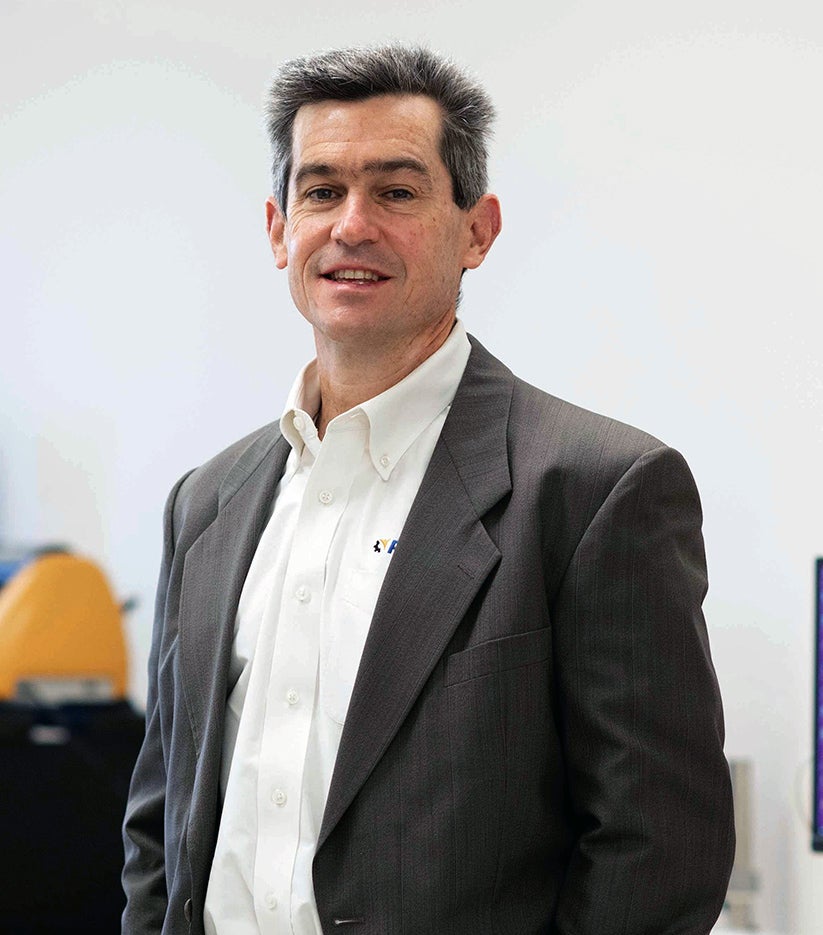
Christian Cowan, one of this year’s recipients, is a highly respected expert on economic and workforce development, and the first full-time executive director of the URI Research Foundation. He previously served as the foundation’s chief operating officer.
Under Cowan’s leadership, the URI Research Foundation stewards millions of dollars in sponsored research and economic development grant funding, supports URI’s engagement with industry partners, and assists companies and enhances workforce development opportunities in the state, particularly for underserved communities. This includes providing more than $20 million of economic impacts in the state annually, retaining important manufacturing jobs here, and facilitating meaningful corporate engagement to bring new investment to URI and Rhode Island.
The work of the URI Research Foundation is vital to Rhode Island’s statewide economy, connecting University expertise and innovation to the broader community and bringing technology to market through research, projects, and partnerships. The foundation engages with URI research projects and initiatives, the manufacturing community, and other regional resources to accelerate innovation, advancement, and entrepreneurship in Rhode Island’s commercial and technological ecosystem.
The foundation is expanding its partnerships in several areas of interest, including offshore renewable wind energy, local healthy food supply, and a robust Blue Economy for the state and region. Just this summer, the URI Research Foundation was awarded a $2.4 million grant by the Office of Naval Research to develop and advance blue economy, marine and energy technologies and opportunities that strengthen the Rhode Island economy and its workforce.
Cowan says that connecting URI student/faculty teams with technology-based ventures helps solve large problems.
“The URI Research Foundation has evolved into a catalytic organization with tremendous impacts from its component organizations in the technology acceleration and manufacturing communities,” Cowan says. “I am glad to better define our role in the regional ecosystem and increase our positive impact on the economy, URI, technology-based industries, and opportunities for all communities.”
Cowan is also a URI graduate, with his MBA from the University in 1998.
Both Cowan and Wolfe are looking forward to representing URI at the August event and connecting with other University alumni being honored to hear about their experiences and represent the value of a URI education as a group: Jonathan Houston ’73, Justice Assistance founder and CEO; Jeffrey Cascione ’82 ’01, senior vice president, Navigant Credit Union; James McAssey G’94, president, Brave River Solutions Inc.; and Leland Merrill G’98, executive vice president, Centreville Bank.
Their recognition also follows a recent Providence Business News event, where 12 URI alumni represented the largest alumni group in this year’s 40 Under 40 Award winners.