Designing Systems for Free, Fair, and Efficient Elections
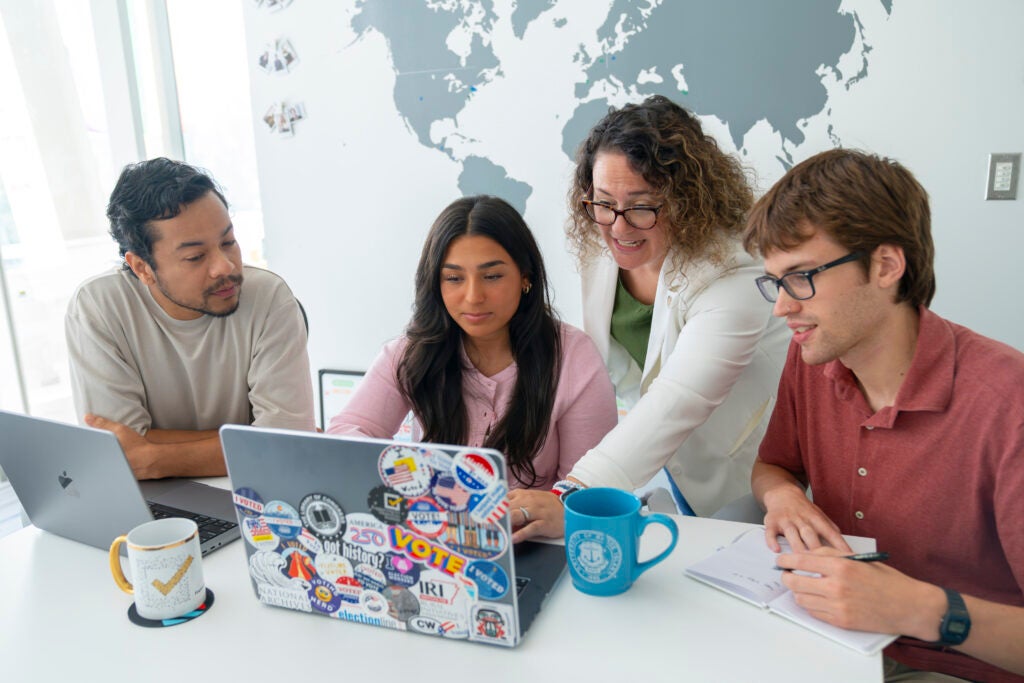
Gretchen A. Macht (standing), associate professor of industrial and systems engineering and the founder and executive director of the Engineering for Democracy Institute, with software engineer Kushas Khadka, M.S. ’25, industrial and systems engineering major Adriana Esposito ’27, and graduate research assistant Nathan Jolicoeur ’26.
For URI’s Engineering for Democracy Institute, the ultimate measure of success is a seamless voting experience for all.
By Marybeth Reilly-McGreen
Photos by Leah Pisari
It is September 10, 2026, the morning after Rhode Island’s primary election, and the students and staff of URI’s Engineering for Democracy Institute are toggling between weary and wired.
Gretchen Macht, associate professor in URI’s Department of Mechanical, Industrial and Systems Engineering and the founder and executive director of the Engineering for Democracy Institute (formerly URI VOTES), understands this peculiar emotion. Using engineering to improve election efficiency is real-world work for these students, and it’s a heady experience.
Macht founded EDI in 2017, in the wake of local complaints of polling-place confusion and voter disenfranchisement associated with the 2016 national election. For the past nine years, the nonpartisan institute has been working with election administrators across the nation to create a more streamlined and efficient voting experience.
Initially, Macht and her group focused on physical space, assessing how a polling location layout might be optimized to avoid delays and bottlenecks. Over time, the institute has branched out, taking on issues related to mail-in ballots, voter turnout trends, and signature verification; developing digital tools; and building relationships with nonpartisan nonprofits and election officials. And because the institute is grant-funded, the majority of EDI’s work is provided to its clients free of charge.
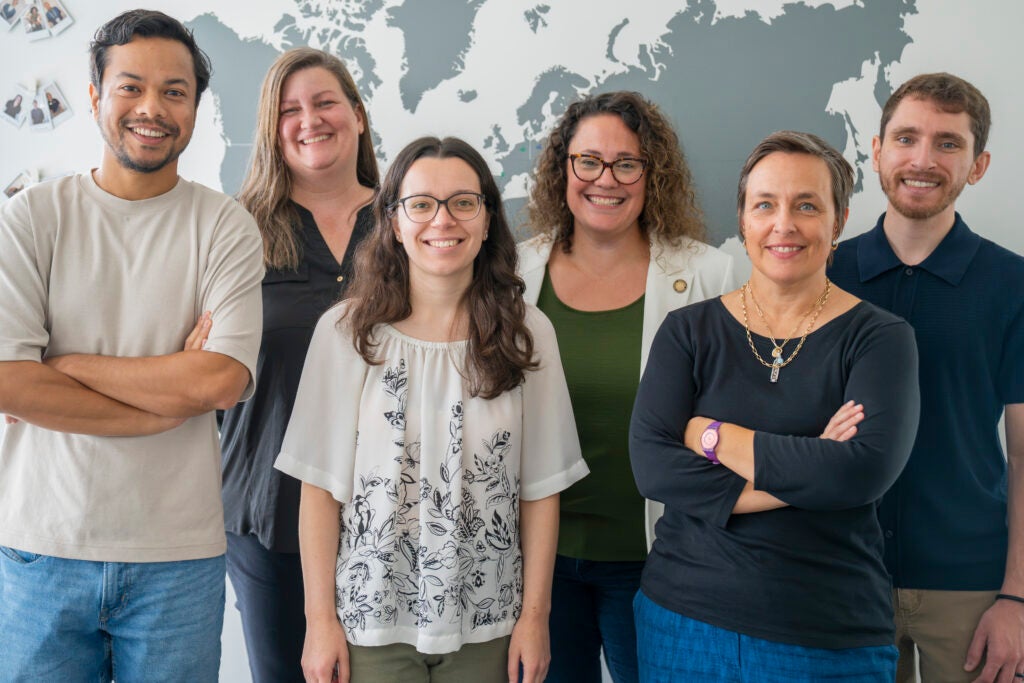
Engineering for Democracy Institute staff: (front row, from left) software engineer Kushas Khadka, M.S. ’25; research associate Sara Nunes ’24, M.S. ’25; and coordinator Amber Fearn. Back row (from left), communications and digital media specialist Melody Garren; founder and executive director Gretchen A. Macht; and assistant director Nicholas Bernardo Jr. ’18, M.S. ’19, Ph.D. ’22.
The institute works with election administrators across the nation to create a more streamlined and efficient voting experience.
“We’re here as engineers supporting election officials across the country,” Macht says. “Election officials are using our tools. They are using good engineering practices and methods to help make their systems more effective and efficient.”
And flexible and scalable. If election administrators have scant resources, Macht says, the institute helps them work with what they have: “We try to help.”
To date, EDI has worked in 18 states and 35 counties.
“We’ve helped over 26 million registered voters vote more efficiently,” Macht says. “What we’re trying to do is make complex processes and systems more efficient.”
But what does the Engineering for Democracy Institute do exactly?
One example:
An election official from Yellowstone County, Montana, approached Macht at a 2025 presentation she gave to the National Association of Election Officials, Election Center, a nonprofit that provides training and support to election officials. The official had a long list of questions. Montana has same-day voter registration, and she anticipated issues with voter registration lines on Election Day.
The institute went to work, creating 2D and 3D models of the office, arranging voting booths and computers, accounting for the office’s entry counter and welcome area, and accommodating eight election workers. Nine weeks into the work, the Montana Legislature changed the state’s voting law. Previously, Montana citizens could register to vote until 8 p.m. on Election Day. The new law allowed citizens to register only until noon on Election Day. As a result, the election official told Macht that none of the work EDI had done could be implemented and they would have to end the project.
Macht jumped on a Zoom call with the official. The issue was that, essentially, the new law cut the hours for Election Day voter registration in half. Could Macht and her team design the entire process to work within the new timeframe?
The short answer: Yes.
But that answer came only after a lot of questions and discussions. And “some pushing and asking and more pushing,” Macht says. She laughs.
“We helped them facilitate a conversation about their preconceived notions of what actually happens during the voting process,” says Macht. “Together, they realized they could cut the time in half, and then we took that and modeled it. We did it together.”
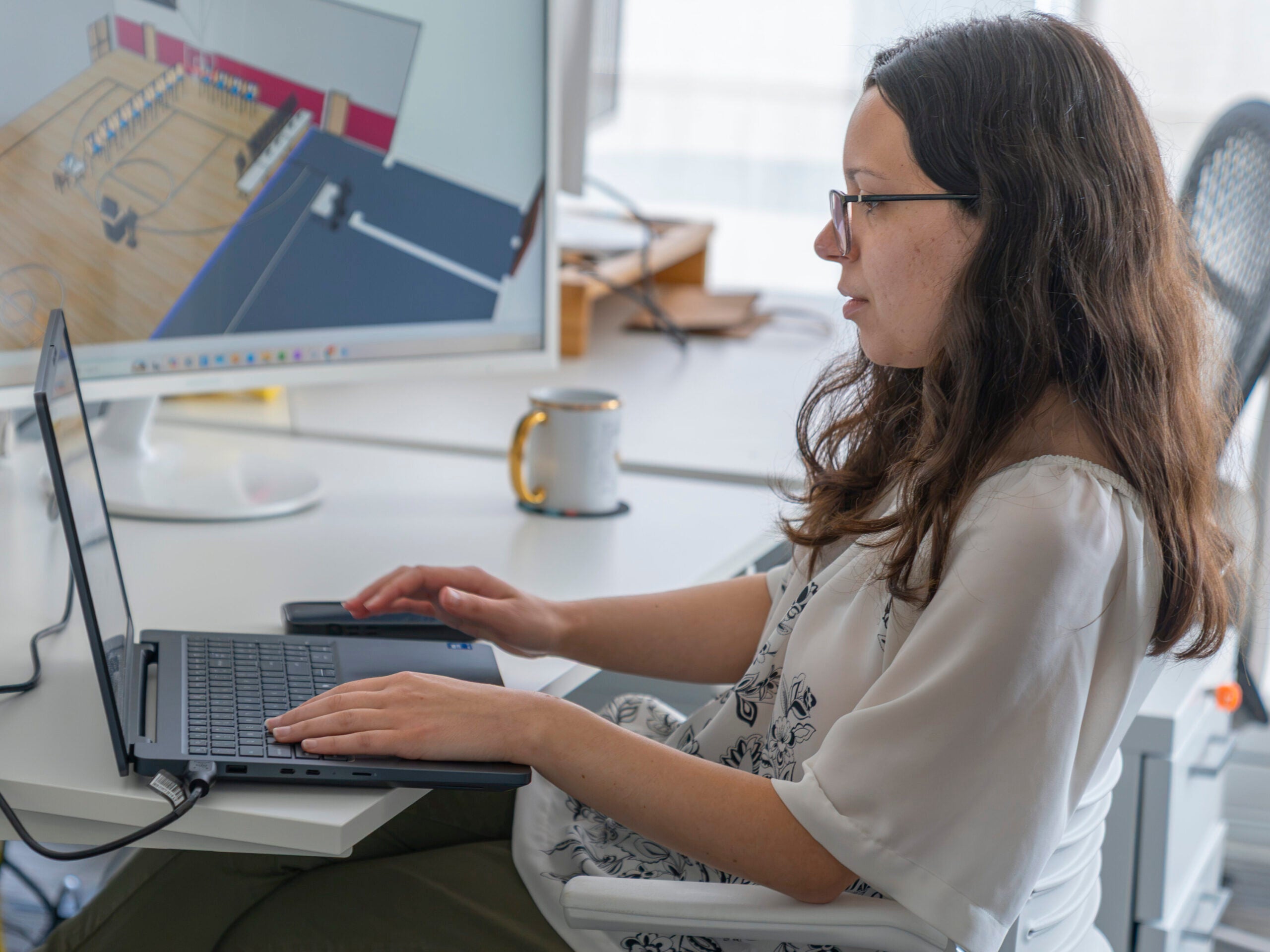
Sara Nunes ’24, M.S. ’25, a researcher at the institute, runs election simulations in local public middle and high schools.
On this sunny Thursday morning in the Engineering for Democracy Institute’s lab, there are remnants of a modest post-primary-day breakfast: bagels, cream cheese, and a Dunkin’ Box O’ Joe. Results are in, but there’s no pause. The work begins anew and in earnest. It’s only 54 days to Election Day, after all.
There’s plenty of work. Engineering voting systems requires everything from planning operations, logistics, staging, and hardware and software systems to analyzing voter turnout numbers, ensuring voter privacy—and anticipating and accounting for the mercurial nature of human behavior.
Alexis Ahle ’27, an industrial and systems engineering major, is energized.
“I’m only 20 years old, and I’m seeing research applied, used in elections and counties,” Ahle says. “I mean, it’s one thing to be taught a thing but then to actually apply it in real life: It’s so cool. What we do is going to affect so many people.”
You might say that systems engineering done well is forgettable. Efficient election processes are invisible. Success goes unnoticed—by the public anyway—because it is seamless.
But for election administrators, “seamless” takes a lot of planning. Nick Lima is the registrar and director of elections for the city of Cranston, Rhode Island’s second-largest city. He has overseen more than a dozen elections. He has successfully lobbied the state for increased grant funding for election officials and for better election security.
To call Lima a fan of the institute is an understatement. EDI provides services that election administrators just couldn’t afford otherwise, Lima says.
“Professor Macht’s team has been instrumental in helping us solve longstanding challenges from logistics and polling place operations to storage space challenges. Through its partnership with our state Board of Elections, EDI has created efficient polling place setup diagrams for more than 400 precincts throughout Rhode Island, which has had a direct effect in reducing—and in some cases, even eliminating—lines on Election Day,” Lima says. “The tools that have been made available at no cost to election offices through EDI and their collaborations with organizations like the Partnership for Large Election Jurisdictions have provided us with resources and ingenuity that we would never have had the budget to independently design and develop.
“Election officials are constantly being asked to do more with limited resources, and having access to a team that can apply engineering principles and innovative thinking to real-world election challenges is incredibly valuable. So much of our work is centered on improving the voter experience, and EDI’s tools and resources have become essential to supporting our mission.”
Efficient election processes are invisible. Success goes unnoticed—by the public anyway—because it is seamless.
EDI’s expertise has been sought by election officials affiliated with both major political parties in the United States, and Macht is impressed by officials like Lima and others EDI has worked with over the past nine years.
Nicholas Bernardo Jr. ’18, M.S. ’19, Ph.D. ’22, has been involved with the institute since its founding. He’d heard that the Rhode Island secretary of state’s office had reached out to Macht’s office about a research project dedicated to making the voting experience more efficient. Bernardo was interested—so much so that he decided to pursue a master’s degree and a Ph.D. at URI, both in industrial and systems engineering, all while continuing to work in the lab.
“It’s such a unique application of engineering,” Bernardo says. “I was always engaged, so I thought I might as well stick around longer.”
He’s now assistant director of the Engineering for Democracy Institute.
Macht, Bernardo, and the rest of the institute’s students and staff characterize their work as building a suite of tools for election officials. In addition to voting-site design, EDI offers a vote-by-mail processing time tool that enables election officials to run a simulation using their own data (around numbers, returns, bottlenecks, timetables). The institute’s Turnout Trend Analyzer highlights election turnout irregularities by processing and analyzing historical voter turnout data alongside current data. A Hand Count Workload Calculator uses election officials’ data to estimate resources needed for manual ballot counts. EDI staff and students also attend conferences and make site visits.
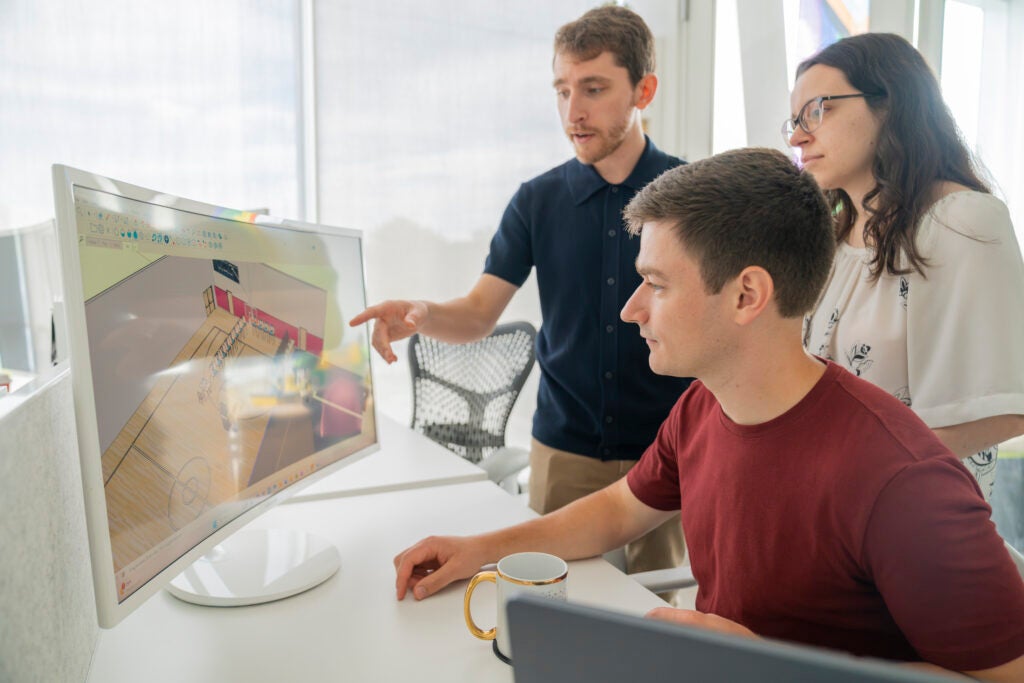
Nicholas Bernardo Jr. ’18, M.S. ’19, Ph.D. ’22 (standing), assistant director of the Engineering for Democracy Institute, with research associate Sara Nunes ’24, M.S. ’25, and industrial and systems engineering major Joshua Stebner ’27.
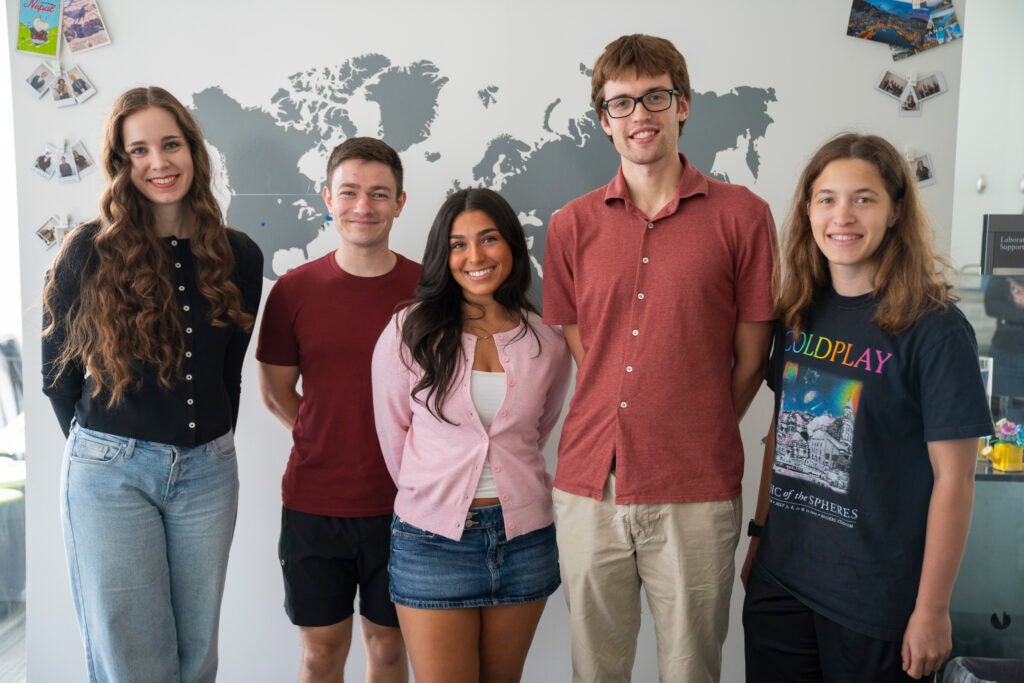
Students in the Engineering for Democracy Institute apply systems engineering theory to make elections more efficient. From left, doctoral student Leonie Otte, M.S. ’23; undergraduates Joshua Stebner ’27 and Adriana Esposito ’27; master’s student Nathan Jolicoeur ’26; and undergraduate Alexis Ahle ’27.
EDI is also involved in community outreach to Rhode Island public secondary schools. Sara Nunes ’24, M.S. ’25, a researcher at the institute, runs in-person simulations in local middle and high schools showcasing the connection between elections and engineering.
“We have teachers set up mock elections with poorly designed layouts,” she says. “There aren’t enough stations for students to vote quickly. It automatically causes a bottleneck. Then we facilitate a discussion about the experience.
“The big thing we try to drive home to teachers is that they need to let the system fail. Failure is basically the whole point,” Nunes says. “Then we have the students pitch what they want to improve: more stations, more people, whatever, to help balance the process. Then we rerun it.”
Both the initial and subsequent simulations are timed. The election simulation is an exercise that can be used in a civics class or altered for a math or science class. The goal is to get kids thinking about what a career in systems engineering might look like.
“I want to make sure kids understand that engineering is much broader than designing cars and bridges,” says Nunes.
“I have grown an unexpected passion for this work. There are pockets within engineering for everyone. Engineering and elections make sense. Engineering and healthcare make sense.
“If you’re a natural-born problem solver, systems engineering might be for you.”
It’s a familiar refrain at the institute. Undergraduates, graduate students, and staff routinely talk about how their work on elections has opened up unanticipated opportunities, some life-changing.
Adriana Esposito ’27 is majoring in industrial and systems engineering.
“I’ve had once-in-a-lifetime experiences,” she says. “How many college students get to go to Colorado and collect voting data? Professor Macht pushes you to your limits. She wants you to do the research and have the career you want—and the skills to do well in it.”
Leonie Otte, M.S. ’23, earned her master’s degree through a program she began at Technische Universität Braunschweig, Germany, and completed at URI. She’s remaining at URI to complete her Ph.D. Otte has worked at the institute since 2022. Her research focuses on processing mail-in ballots. She conducted in-person data collection during the 2022 midterm election.
“In my country, I would just cast my vote, and I would look at the results and never really think about how it all happens,” Otte says. “Then I started this work and saw how much goes into setting up the process and making sure that on Election Day the voter has a good experience: that someone is answering the phones, and the voter has their ballot on time, and that all the equipment is working. So much goes into an election.
“I never could have imagined that I could help the civic system in this way. I really enjoy this work.”
Otte also relishes the opportunities she’s had to present her research at conferences.
“To talk with people who are planning and implementing systems, to get their feedback and get into conversations with them to make their work better …” Otte pauses mid-thought and switches gears. “I made a promise when I came here to take every opportunity I get, to step out of my comfort zone, to do something different, to grow.
“I definitely have done that.”
Macht wants to make one thing very clear: EDI is not the hero of this story. The institute’s function is to facilitate, not dictate, how an election is run, she says.
That said, EDI is the only dedicated engineering institute in the country doing this kind of work, Macht notes. She allows herself a moment’s pride, expressed as a smile.
“This is our job; this is who we are,” she says. “We are out here helping support governments and processes: the bedrock of democracy.”