
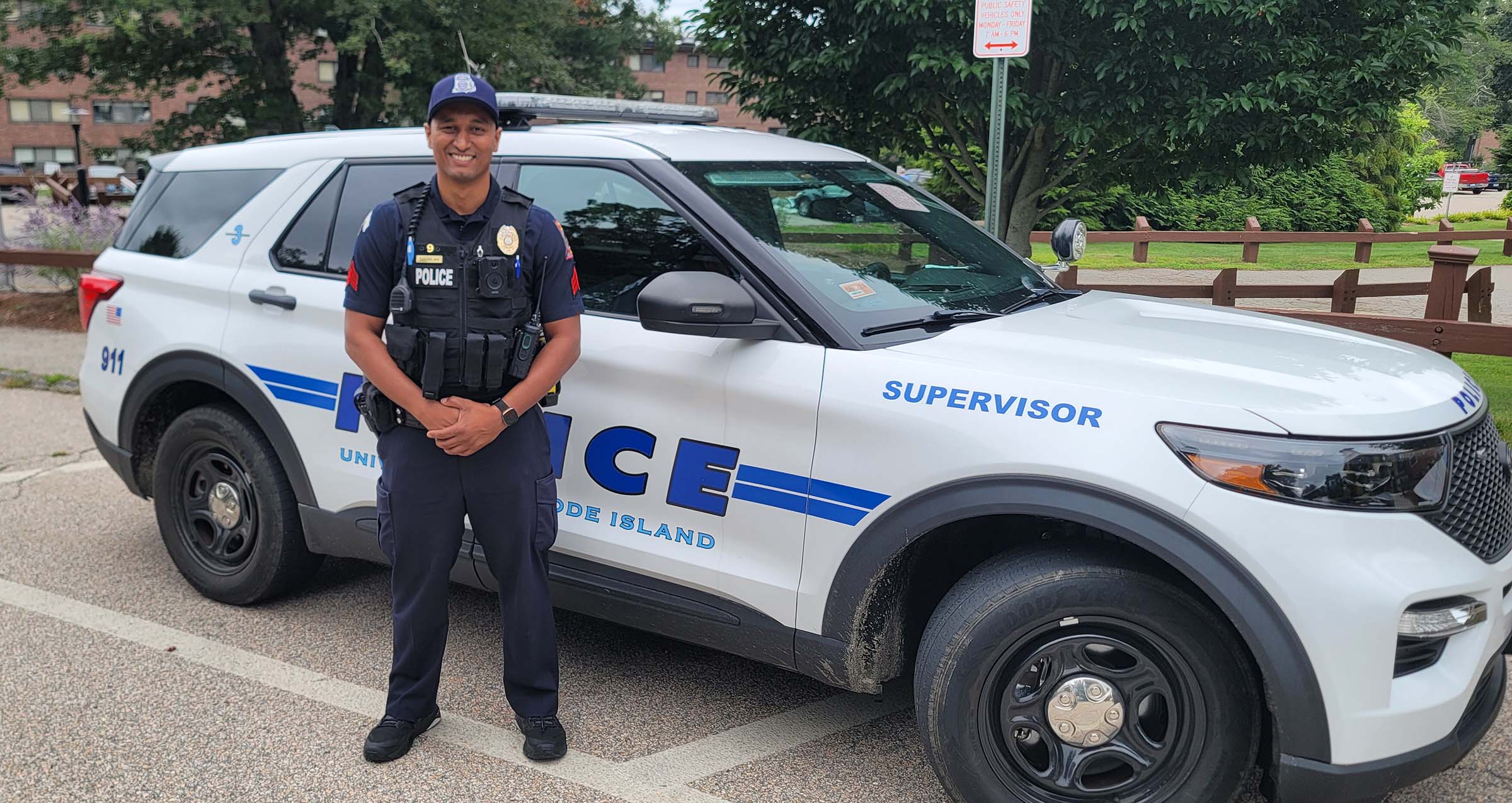
KINGSTON, R.I. – Sept. 6, 2023 – The University of Rhode Island Police Department is adding a new tool this semester as it officially rolls out its body-worn camera program.
The Police Department has been testing new Axon cameras since early August and fully implemented the program Sept. 1. All uniformed officers are being issued the cameras, which are affixed to their uniform shirts. Along with supervisors, the officers have been trained in the use of the cameras as well as state and department policies governing when the cameras should be activated.

“This is a progressive move that can bring measurable benefits to relations between police and our community members. Body-worn cameras are a modern-day tool that officers should have in their tool kit,” said Michael Jagoda, chief of police and director of public safety. “The cameras provide transparency of police actions and will capture information that will significantly improve services provided to the general public.”
Jagoda, who joined the URI force in 2015 from the Connecticut State Police, which uses body-worn cameras, wanted to implement the cameras at URI when he became chief in 2021. Through focus groups and community meetings, he found support from the University and community.
In setting up its program, the department researched different camera brands and established procedures and policies for use of the cameras, along with training standards, supervisory review of interactions, meeting legal standards related to storage and public records requests for video footage.
In the spring, URI received 33 Axon cameras through a three-year, $288,750 grant from the U.S. Department of Justice, part of a $16 million award that outfitted 42 local departments in Rhode Island with a total of 1,773 body cameras. The departments also adopted the Statewide Body-Worn Camera Law, which sets comprehensive standards for the use of the cameras. The policy was drawn up by the Rhode Island Office of the Attorney General, the Rhode Island Department of Public Safety, and the Rhode Island Police Chiefs’ Association.
Under the URI department’s policy, officers must wear the body cameras at all times during their shifts and manually activate the body-worn cameras during such interactions with the public as service calls, investigations and enforcement actions. Cameras are automatically activated when an officer deploys his or her taser or issued service firearm—one of the reasons the department chose to go with Axon cameras.
“Certain interactions with the public are not going to be recorded,” Jagoda said. “Officers should have the discretion to keep the cameras turned off during conversations with a crime victim or members of the community who wish to report or discuss quality-of-life issues. Officers will be considerate of the expectation of privacy when activating cameras, especially in areas such as residence hall rooms, health-care facilities and during sensitive investigations.”
While ensuring officers are following department policies and procedures, the cameras can be an important policing tool, he said.
“It gives us the total picture in terms of seeing what’s happening,” he said. “Sometimes as an officer, you have tunnel vision. The camera will give you a wider view of the totality of the circumstances, what’s really going on. It can also capture physical evidence that we need for an investigation or that could help a victim.”
He added that the cameras could also help in terms of training and updating policies, while also deescalating situations at times.
The response from URI officers to the body-worn cameras has been very positive, he said.
“Like 99.9% percent of the police officers in this country, our officers do the right thing for the right reason. They act professionally, they’re there to help people, they’re there to make a positive difference,” he said. “And this supports their actions, it supports their decision-making.”