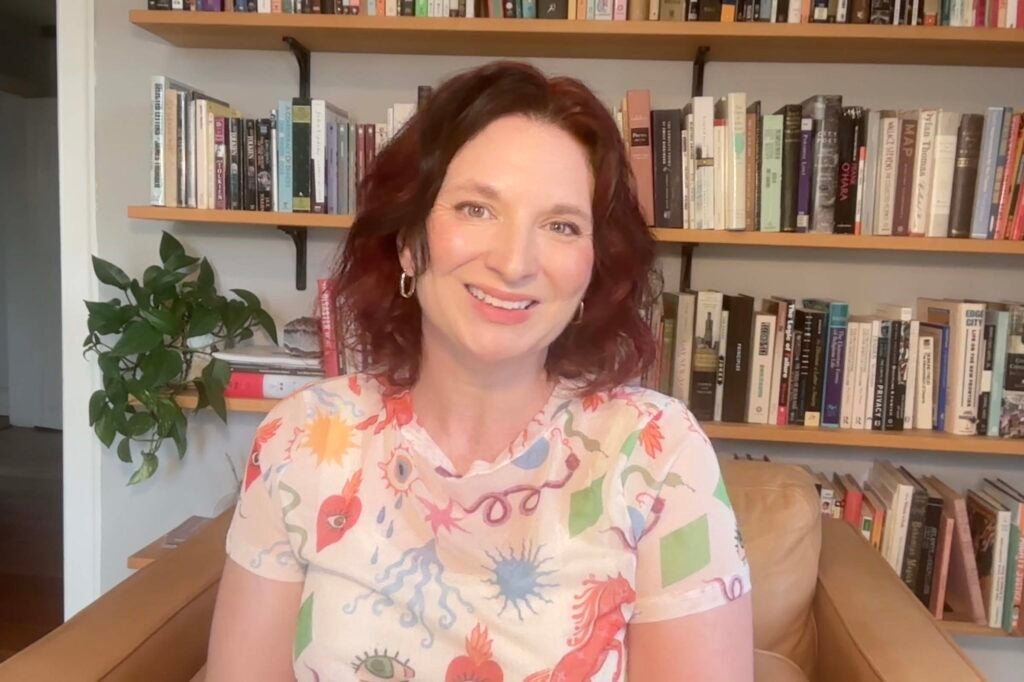
KINGSTON, R.I. – Aug. 19, 2026 – Before becoming a mother, Virginia Killian Lund had been an English and language arts teacher for years, teaching countless children to read. “I taught children how to ask questions about books, about writers, about stories that are told and stories that are untold,” she said. “I had a lifetime of reading behind me.”
An assistant professor of elementary language arts in the University of Rhode Island’s Feinstein College of Education, Lund is clearly familiar with the subject of reading, but years of reading under the covers in Warwick with her child gave her a distinctly personal spin on the topic; they even presented on the topic together this summer.
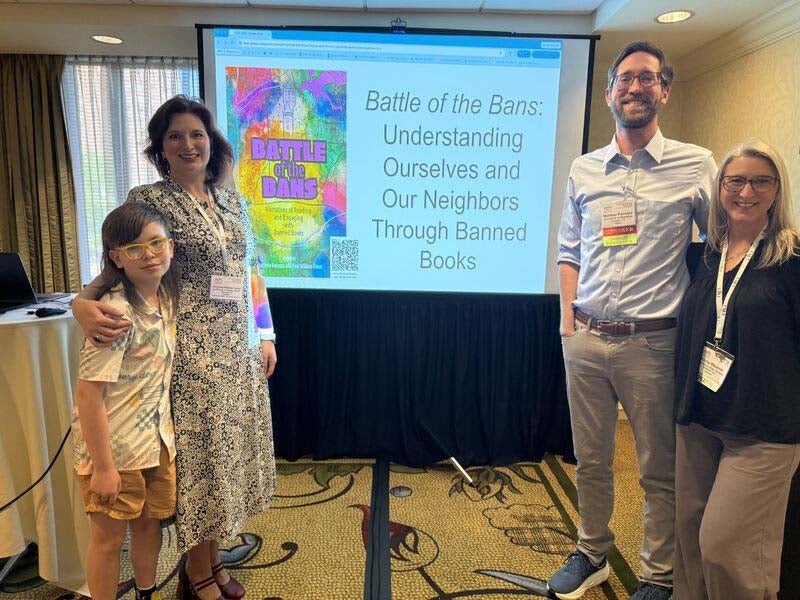
Lund and Calder, now 11 years old, co-wrote and published a chapter on their reading together in “Battle of the Bans: Narratives of Reading and Engaging with Banned Books,” describing the reading experience both from the point of view of an education professional/mother—and a child reader.
The two also shared on the parent/child reading experience at this year’s annual Children’s Literature Association conference in Pittsburgh, describing reading books whose appropriateness for young readers has been questioned or which address difficult stories.
To parents of school-age children looking for ways to elicit interest in reading, Lund says aim to discover shared delights with your child. “I think lots of parents start from what they loved as children — which makes sense,” she said. “We want to share what we love. But it takes away some of the shared exploration that can be a part of reading together.” She says that discovering books with your child is a way to find authors and genres you both like—with award lists one good source for ideas. (The Newbery, Caldecott, Coretta Scott King, and Pura Belpré awards are some of Lund’s favorites.)
Growing readers
Lund also encourages her URI students not to just teach reading, but to model it.
“I tell students to read lots of things,” she said, “and talk about it with their students. Talk about books you don’t like and what you don’t like about them. Talk about books you do like and what you like about them. Let them see you reading sometimes, just to enjoy it. Your students notice so much about you—including if you read.”
When Lund was a seventh-grade teacher, she would sometimes come into school, hair in a scarf, glasses instead of contacts, and explain to her students that she didn’t sleep the night before because of the book she had just finished. Conversation would ensue and the book would be handed around—and a couple weeks later, they’d talk about it.
“There are lots of books out there that I know aren’t for me,” she said. “It’s not that they’re bad, it’s not that they’re too hard, it’s just that we all have tastes and preferences. I can learn from almost any book, but I won’t love almost any book. Kids are the same. We need to connect with the pleasure in pleasure reading.”
Reading between the lines
As a parent, books have helped Lund find connections with her child.
Lund and Calder—now a preteen—have read a “bajillion” books together. Nearly every night, they read a chapter book, with Lund reading until Calder drifts off to sleep.
But sometimes she says, instead of ushering a sleepy child to slumber, the books wake Calder up. She calls it, “the 90-degree sit,” the kind of book that makes a child pop up and start asking questions.
The books in question are not banned per se; you can get them at most any bookstore or library. Though award winners, they are books that have been challenged in school libraries, classrooms and curriculums.
“We wanted to show what happens when we trust children to take on difficult stories,” Lund said.
In the article and at the conference, Lund and Calder discussed Louis Sachar’s 1998 “Holes.” Despite the book’s cruelty, Calder liked its action, which launched conversation about treatment of children and what happens to children in foster care. Lund notes that challengers of “Holes” as an upper-elementary read-aloud say the book is too violent; she says it can help readers work through worry and let parents talk to children about ways to be resilient.
They also read Elizabeth George Speare’s Newbery Award-winning “The Sign of the Beaver” (1983), which has been challenged due to the author’s portrayals of the Penobscot people. Even if a book is not written to 2026 standards, it can generate discussion and open up conversations on attitudes, history, even writing itself, Lund says.
And she notes the freedom to read in one’s own home. She may pick books for Calder that would not necessarily work as a curriculum text for a class of students. “Calder and I can stop as often as we want, for as long as we want, to dig into questions and feelings we have about the text,” she said. She says that readers can make sense, alone or together, of what they find in a book’s pages.
“Sometimes books make us confront hard realities and hard histories,” Lund said. “Reading together, we can step through the portals that books offer to us—even if it means sitting up straight.”