

KINGSTON, R.I. – Nov. 9, 2026 – Poetry has had a universal appeal across centuries; words penned in earlier times are still with us, quoted and shared, today.
Unfortunately, something else in our world has similar staying power. Now, a University of Rhode Island professor is connecting the two for a new collection.
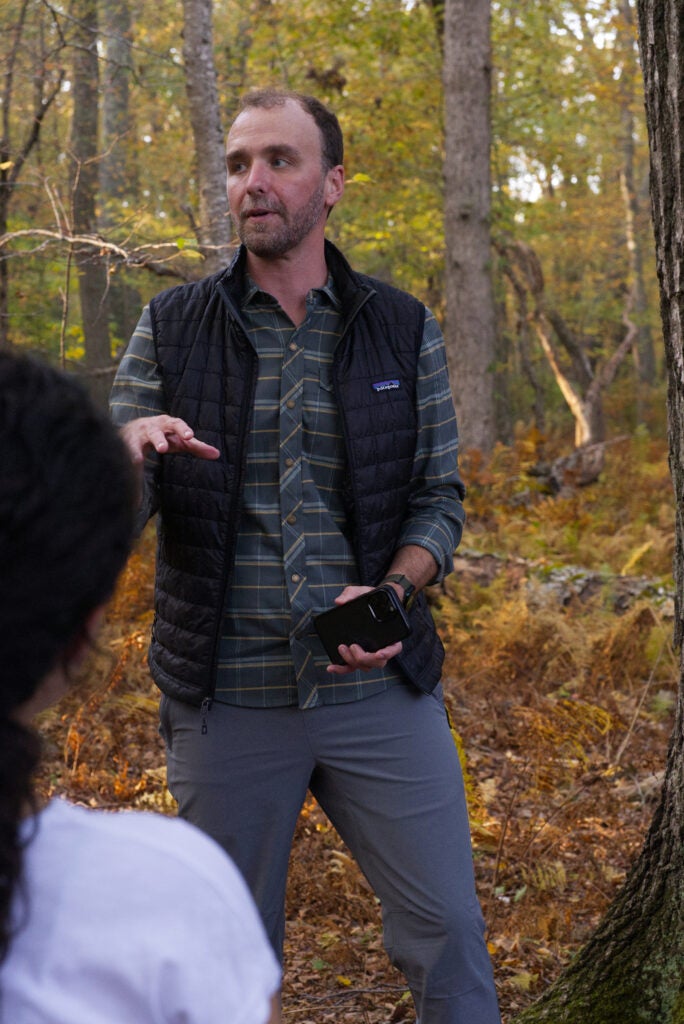
URI DWELL Lab founding Director Madison Jones, associate professor of science and writing at URI, and his co-editor, Beth McDermott, are calling for poetic responses to the pressing concerns of persistent pollution, soliciting contributions for the new collection, “Forever: Poets on PFAS, Plastic, and Persistent Pollution.”
URI’s STEEP Superfund Research Program, a frequent DWELL Lab collaborator, is helping share the call. DWELL and STEEP have worked together on several PFAS communication projects, most recently PFAS Kitchen, an augmented reality experience to educate consumers about PFAS in household products. That game, along with other work on PFAS and plastics, gave Jones the idea to bring creative writing into the mix.
“We’re inviting poetic responses to the pressing concerns of persistent pollution and welcome submissions from poets working across disciplines,” Jones said. “We’re especially interested in reaching writers whose work engages with science, literature, ecology, and the environmental humanities.”
Submissions are due by Jan. 31, 2027. For the full call and submission guidelines, visit the call for poetry submissions.
A perpetual problem
While microplastics have received wide coverage and study at URI, the emerging research around the dangers of PFAS is also garnering significant attention.
These harmful chemicals can persist in bodies for years, a topic being studied by URI’s College of Pharmacy and Graduate School of Oceanography. Known as “forever chemicals,” PFAS—short for per- and polyfluoroalkyl substances—are a large family of synthetic chemicals that have been used in a vast array of industrial and consumer products since the 1940s. PFAS do not easily degrade in the environment, and for the last seven decades have contaminated drinking water and food webs, increasing exposure and risks to human health.
At URI, Jones coordinates the University’s Certificate in Science Writing and Rhetoric, and has a dual appointment in URI’s departments of Professional/Public Writing and Natural Resources Science. He has presented on science communication for the National Park Service and is the author of “Inventing Ecosystems: The Rhetoric of Science in an Ecological Age” and two poetry collections. He is also co-editor of “A Rhetorical Arboretum” and has been involved with the University’s North Woods Project. In “Visualizing Environments,” he discusses how the arts influence science communication.
Jones’ recent personal poems describe a vernal pool at the former West Kingston Town Dump (closed in 1978 and now part of an EPA Superfund site) and a variety of residents of the natural world, from blackberries to sparrows. He and McDermott previously worked together as editors for the journal Kudzu House Quarterly, a journal of environmental arts and letters, now archived at the University of Florida.
“‘Forever’ chemicals move through our air, water, food, and bodies,” said Jones. “It is our hope that our collection, ‘Forever,’ can voice a response to the problems of persistent pollution that we face, reckoning with the realities of living in today’s age of change.”
He hopes to receive submissions from across URI and beyond and is asking the URI community to share the opportunity with colleagues, students, and others in their networks who might be interested. “The call is open to anyone,” Jones said. “We’re hoping for an international reach.”
To submit, visit the call page. For additional questions, contact Madison Jones at madisonjones@uri.edu.