
KINGSTON, R.I.—Nov. 13, 2026—Nineteen Flinders University students are the first graduates of Australia’s inaugural undergraduate nuclear engineering major, earning a certificate from the University of Rhode Island through a pioneering partnership with Flinders to help build the workforce needed for AUKUS.
The research and education partnership between the two institutions, signed in May 2023, advances AUKUS, a security partnership signed by the governments of the United States, Australia, and the United Kingdom.

Australia’s Deputy Prime Minister and Minister for Defence, the Honorary Richard Marles, congratulated the graduates in a video message played during the certificate presentation.
“Today is a really important day, not just for your careers, but actually for Australia’s future,” Marles said. “As the first students to complete Flinders University’s undergraduate nuclear engineering major, you will be part of delivering Australia its nuclear-powered submarine capability under the banner of AUKUS.”
The students completed a nuclear engineering major within their Flinders degree in mechanical engineering, electrical and electronic engineering, chemical sciences or physics. They also earned URI’s certificate, a separate university credential, by completing five specialized URI nuclear engineering courses totaling 15 credits. Through dual enrollment, they received academic credit from both universities. URI faculty teach the courses in person at Flinders during intensive sessions each January and July.
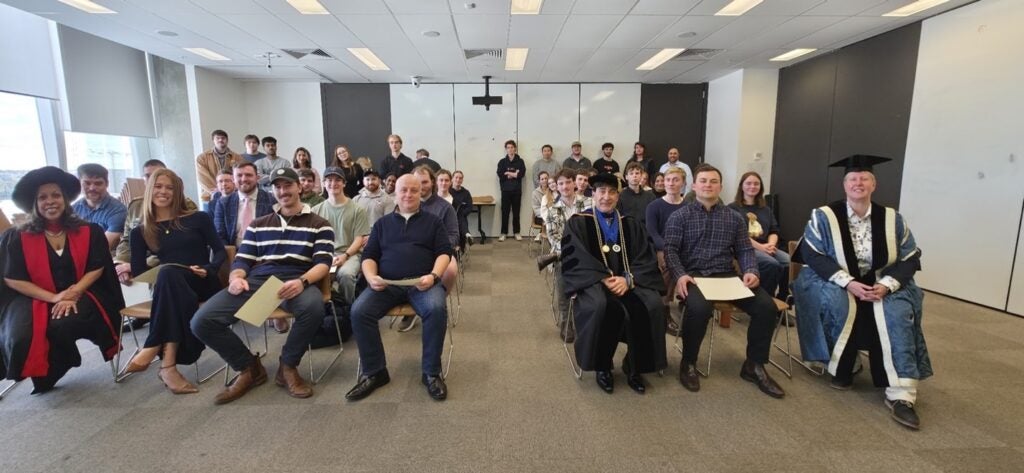
“These students are, quite literally, the pioneers of nuclear science and technology in Australia,” said Bahram Nassersharif, Distinguished University Professor and director of URI’s nuclear engineering program who taught three of the program’s five courses. “They worked through a demanding sequence of intensive courses with exceptional discipline and intellectual maturity. They will form the technical foundation of Australia’s future nuclear workforce, particularly in naval propulsion, advanced reactors and strategic energy systems. It was a privilege to hand them their URI certificates in person.”
Nassersharif carried the certificates from Kingston to the ceremony, which also brought together students from later cohorts and Flinders faculty and leaders.
“This milestone reflects exactly why Flinders moved early to establish Australia’s first undergraduate nuclear engineering pathway: to give talented students the skills, confidence and international exposure needed to contribute to a sovereign, safe and highly capable future workforce,” said Romy Lawson, senior deputy vice-chancellor at Flinders. “Working with URI has allowed us to bring world-class nuclear education to South Australia and create a course that is already opening new opportunities for our students, our partners and the nation.”
URI President Marc Parlange and Flinders President and Vice-Chancellor Colin Stirling formalized the partnership in May 2023. Teaching began at Flinders in January 2024, launching Australia’s first undergraduate nuclear engineering major. The collaboration supports workforce development under AUKUS.
The partnership also brings Flinders students to Rhode Island. In 2025, seven Flinders students spent 15 weeks in the state and another eight visited this year. They gained hands-on experience at the research reactor of the Rhode Island Nuclear Science Center, located on URI’s Narragansett Bay Campus, and took part in projects connected with the U.S. submarine and defense sector.
“Seeing the first cohort complete this program is a proud moment for the College of Engineering,” said Anthony Marchese, dean of URI’s College of Engineering. “This partnership extends URI’s long-standing strength in nuclear engineering and our close ties to the U.S. submarine industrial base to a key AUKUS partner. It is a model for how universities can work across borders to build the specialized workforce that national priorities demand.”
“The graduation of this inaugural cohort marks a watershed moment for the College of Science and Engineering,” said Michael Blumenstein, vice president and executive dean of the College of Science and Engineering at Flinders. “We are delighted to collaborate with URI to deliver an Australian-first program in nuclear engineering. Our graduating students will be among the first to leverage their skills towards the multi-billion-dollar sovereign submarine program that addresses key Australian defense priorities. This partnership clearly demonstrates how universities can make important contributions to international imperatives such as the provision of workforce capabilities for AUKUS and to support key defense initiatives between the United States and Australia.”
More cohorts are on track to complete the program by July 2028, increasing the number of graduates equipped to grow Australia’s nuclear workforce. The current arrangement runs to the end of 2027 with the possibility of continued partner opportunities into the future.
This story was written by Krysta Murray, writer, College of Engineering.