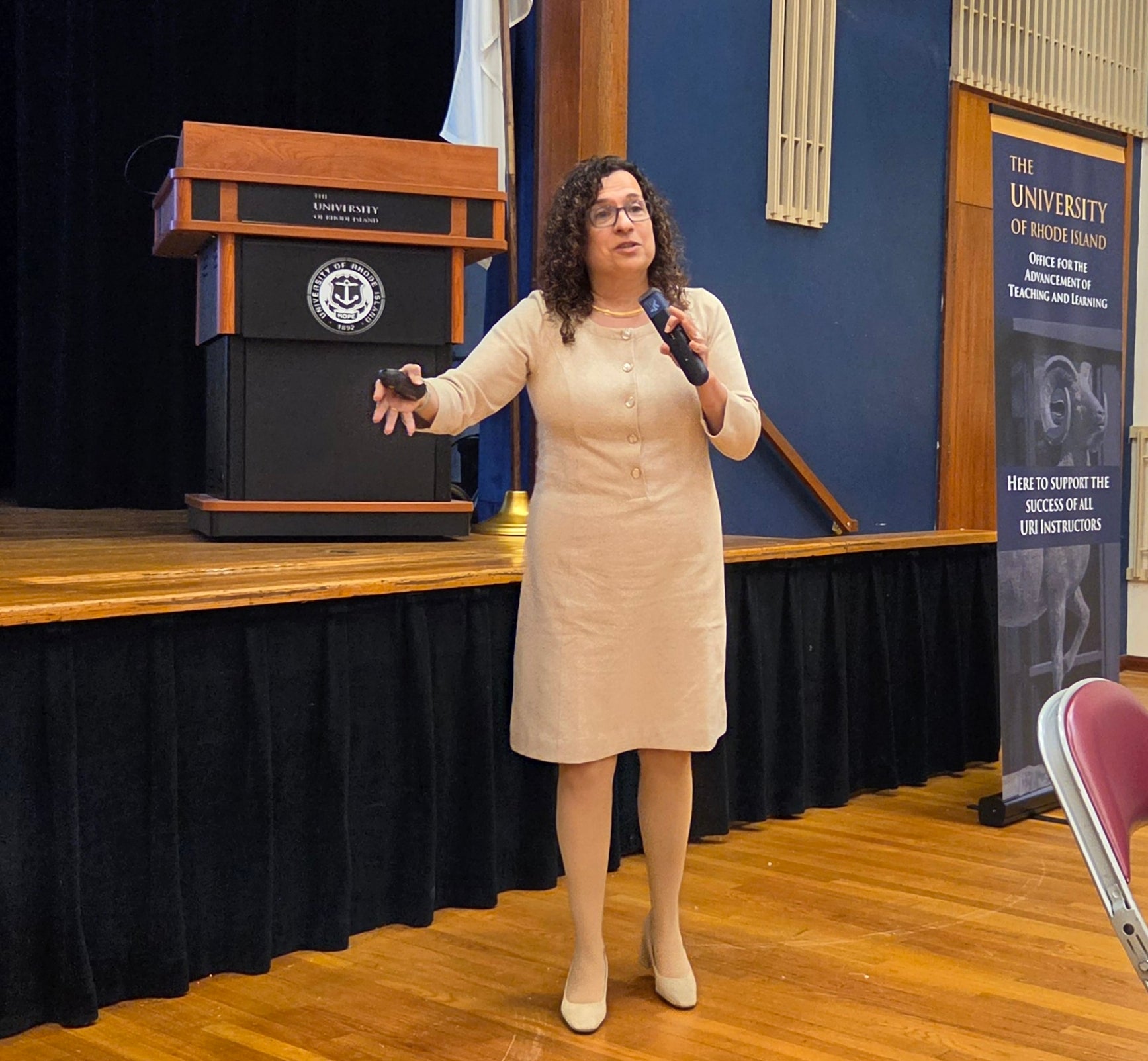
KINGSTON, R.I. – Nov. 19, 2026 – The University of Rhode Island Office of the Advancement of Teaching and Learning held its fall symposium in the ballroom of the Memorial Union on Nov. 12. The event included panel discussions, a poster session, and a keynote address from Laura Gambino, vice president of the New England Commission of Higher Education (NECHE).
“We were elated to welcome and host Dr. Gambino to our university, especially in light of the forward progress we have made at URI in recent years around student learning outcomes assessment, in particular at the undergraduate level,” said Christopher Lavan, associate vice provost for the advancement of teaching and learning in the Office for the Advancement of Teaching & Learning.
NECHE is recognized as an institutional accreditor by the U.S. Department of Education. URI is one of the 200-plus institutions that are members of NECHE. Accreditation serves two main purposes: it assures the public that the university will provide a quality education and it fosters institutional improvement.
“You want to make sure that your students are able to know and do the things you say they’re going to know and do before they walk across that stage and get their diploma,” said Gambino, who has been vice president of NECHE since 2018. “Equally important is the idea of fostering improvement, whether you’re improving student learning or improving your own practice or improving the way you think about where learning happens across the curriculum.”
Gambino emphasized that improvement is not a linear process—that instructors will encounter challenges along the way and things may not always work out as intended.
“We’re looking for that candid story about what is working well and what is not working well, because the folks making the accreditation decision come from institutions just like yours,” said Gambino. “They know that things don’t always happen linearly, and they know that maybe there are certain students who we’re not serving as well as other students. So, keep that in mind when you’re doing your work. The idea is to get better.”
Meeting the standards
Each year, NECHE publishes its Standards for Accreditation, which are used as criteria for institutional quality and to determine the effectiveness of the institution as a whole.
“Our Standards for Accreditation can serve as the framework for the writing of your self-study,” said Gambino. “They establish what the commission thinks are the markers of quality.”
The commission’s five standards include mission, organization, governance and planning; the academic program, faculty, and students; institutional resources; educational effectiveness and the success of all students; and integrity, transparency, and public disclosure.
“When we think of educational effectiveness, we’re thinking about all of your programs in all of your colleges,” said Gambino. “We’re also thinking about all students, in all locations, using all modalities. That includes undergraduate students, graduate students, traditional age students, non-traditional age students, students who transfer in from other institutions, distance learning, and hybrid programs.”
New federal regulations
On Oct. 29, the U.S. Department of Education announced new federal higher education accreditation regulations. According to the press release, the regulations are “designed to strengthen quality assurance and improve affordability in higher education by prioritizing student outcomes, reducing regulatory burdens, promoting innovation and intellectual diversity, and increasing competition among accrediting agencies.” The regulations go into effect on July 1, 2027.