
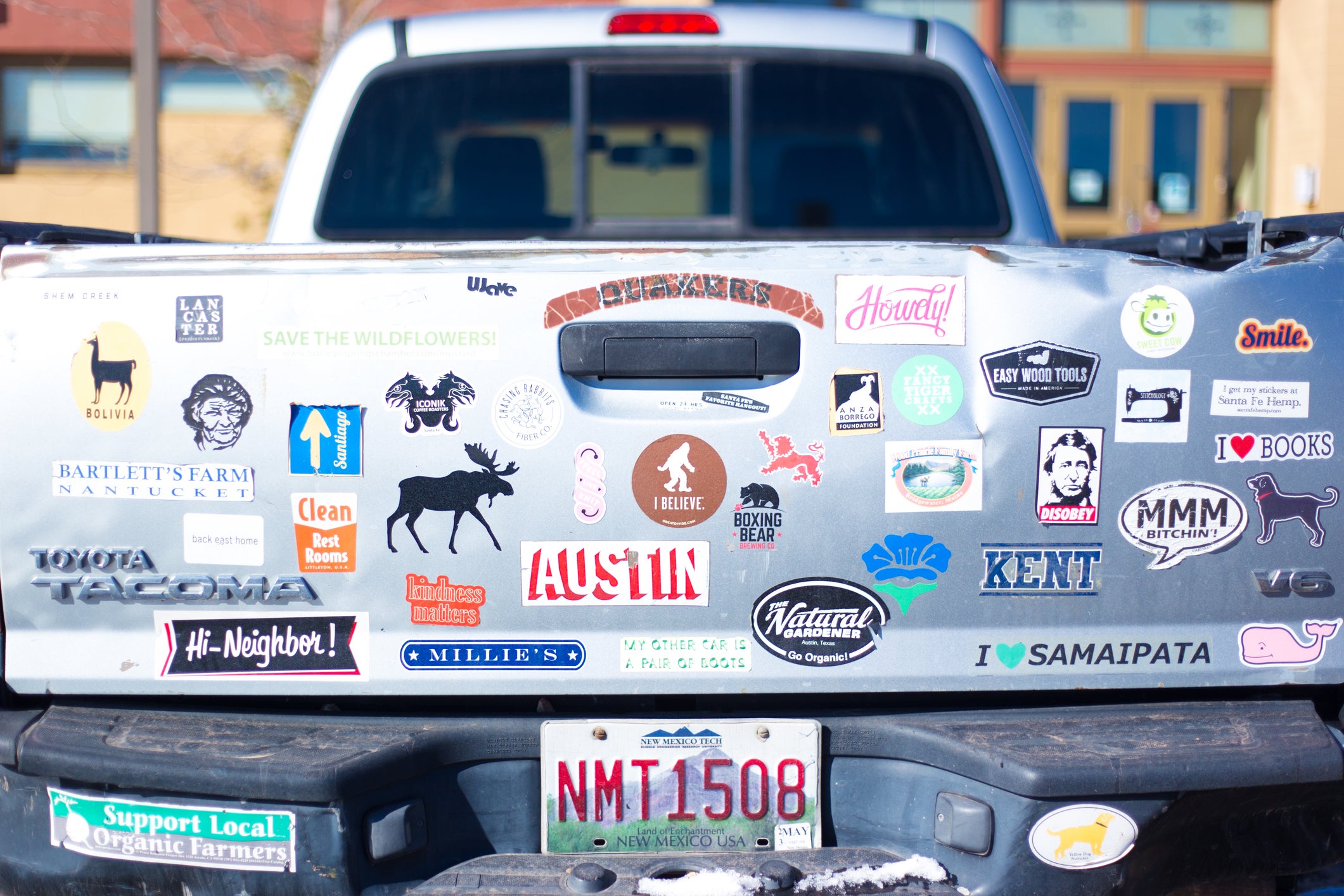
KINGSTON, R.I. – Nov. 9, 2026 – The University of Rhode Island’s Steve Przymus, an associate professor in the Feinstein College of Education, recently returned from Turkey after delivering lectures on topics that provide food for thought for conversation anywhere, including language found on bumper stickers in the U.S. and how best to describe ‘wild’ relations or family members.
Przymus is new to the college, with his focus being educational linguistics. He’s also a member of URI’s Translanguaging Lab, where he is studying — and mapping — the rich linguistic and cultural diversity found in the Ocean State. He was invited to Turkey to deliver keynote addresses focused on sociolinguistics, bilingual education, and language teaching.
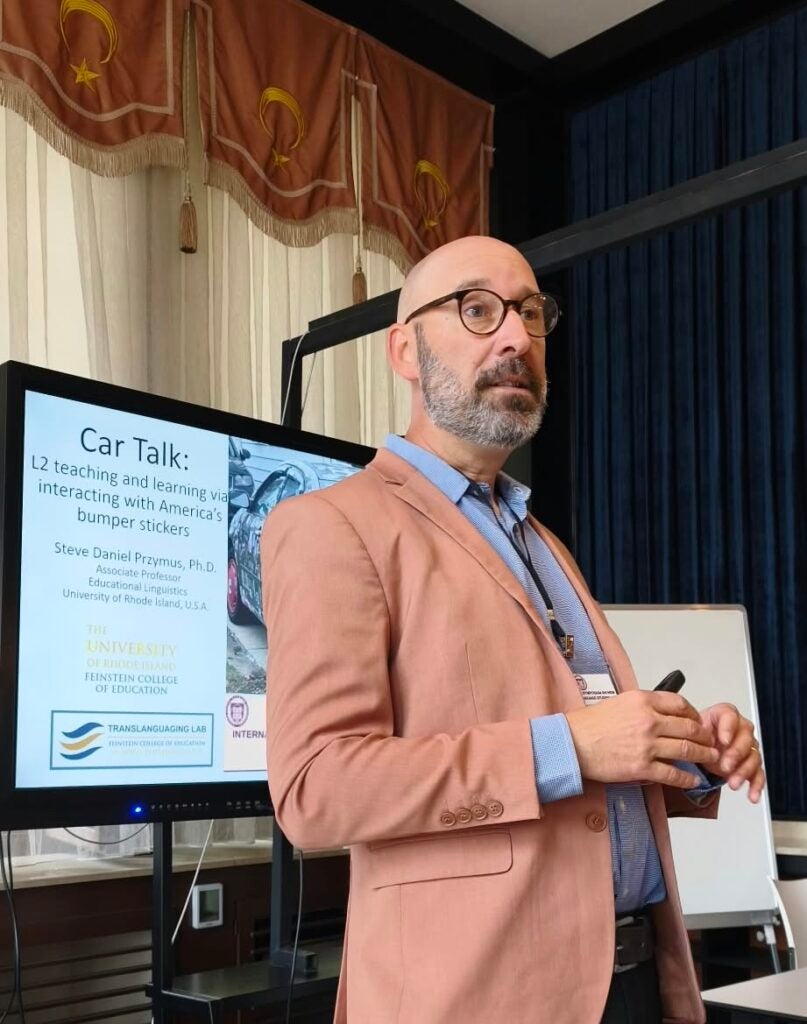
Over a week this fall, Przymus gave three addresses at three different conferences that took him from the southeast city of Diyarbakir to Turkey’s capital city of Ankara, where he gave a presentation at the International Symposium on New Trends in Language Studies.
Sociolinguistics was the connecting thread of all three.
Talking Texas
Przymus’ first address looked at “Multilingual Metaphors of America’s Crazy Family Member,” examining how Texas captures the curiosity of the world at Dicle University in Diyarbakir.
“There is no denying that Texas is big,” said Przymus, who lived in the state for 9 years, while teaching at Texas Christian University. “Texas has captured, in a big way, the curiosity of the world and how the state’s name has come to be used as a metaphor in many other countries.”
This is represented in many different languages for something wild, big, strongly independent, Old West, and cowboy culture, he says.
“Texas as a term helps others understand or describe abstract terms centered on its independent spirit and to better understand the U.S. in general,” he said.
In Norway, the phrase, “Der var helt Texas!” means “That was very completely Texas!” In Turkey, “Burası Teksas değil” means “This isn’t Texas.” For example, if a teacher walks into a classroom where the students are behaving energetically, the teacher might say “Settle down, “burası Teksas değil!” In Iran, there is a similar Persian expression that goes “Inja Texas nist” and means “It’s not Texas here.”
Przymus discussed how the word “Texas” is used around the world to refer to distinct places within countries or even regions that are “like Texas.”
For example, Edmonton, Alberta, Canada is known as “Texas North” or “The Texas of Canada” because it has a lot of oil and has a cowboy culture. Kazakhstan is known as the “Texas of Central Asia” due to its arid landscape, Wild West mentality, cattle ranching, and border culture. Other “Texases” include Bavaria, Mongolia, and Nigeria in, respectively, Germany, Asia, and Africa.
For his second address, Przymus headed to Ankara to present “What Do We Mean by Bilingual?” at the 4th International Symposium on Sociolinguistics Research at Hecettepe University.
Research on bilingualism has historically been dominated by studies on codeswitching, or alternating/switching between multiple languages. However, the past few decades have focused on the importance of the personal experiences of bilingual individuals, calling for practices such as translanguaging. Przymus suggested a new metaphor, proposing “mycelium networks” to better describe bilingualism, instead of prior terminology describing it as a “bridge” or “flowing current.”
Car talk
At Przymus’ last address at Turkey’s Social Sciences University, he delivered a lecture on message-driven media on automobiles in the U.S. and connecting “L2 Teaching and Learning via Interacting with America’s Bumper Stickers” at the 4th International Symposium on New Trends in Language Studies.
Cognitive and linguistic phenomena are created when individuals place bumper stickers on the back of their cars, said Przymus. Language is used to shape identities and realities, he said, noting that when individuals add a sticker to a car, or laptop or water bottle, they are making choices that establish their identities, position themselves in relation to others, and express messages about who they are, what groups they belong to, and how they feel about others.
He provided a quick exercise of how the word “America” demonstrates multiple concepts.
“Even though most people who live in the United States will never actually meet or interact with 99.99% of all of the people who live in the 50 states of the U.S.A.,” Przymus said, “encompassing language use makes them feel that somehow they are the same, share similar ideologies with the rest, share some kind of national pride by default of living within the borders of the U.S.A., and henceforth believe that they belong to the community of ‘America.’”