
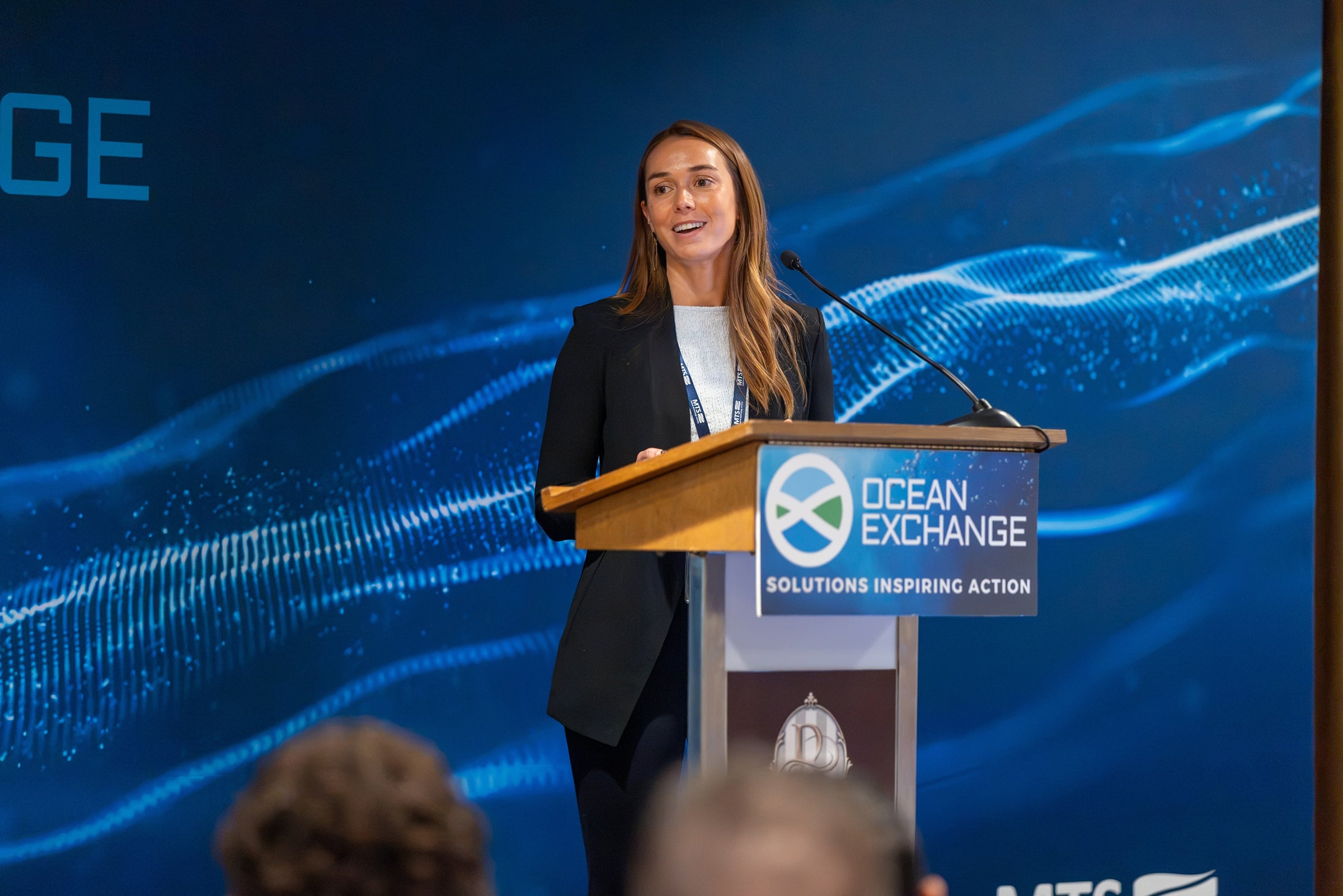
KINGSTON, R.I. – Nov. 24, 2026 – Christine de Silva, a University of Rhode Island student pursuing a Ph.D. in biological oceanography, won $10,000 in an international competition for Ocean Detect, a platform that quickly identifies marine life using a deep-sea video camera and artificial intelligence.
The annual contest was hosted by Ocean Exchange, which accelerates innovative solutions for healthy oceans and a sustainable Blue Economy by connecting entrepreneurs and innovators with funding, expertise, and a global network.
Five $10,000 awards were presented to college students, in addition to a few larger awards to startup companies. De Silva was selected for the Guy Harvey Foundation Collegiate Award, which she received at a recent ceremony in Fort Lauderdale, Florida.
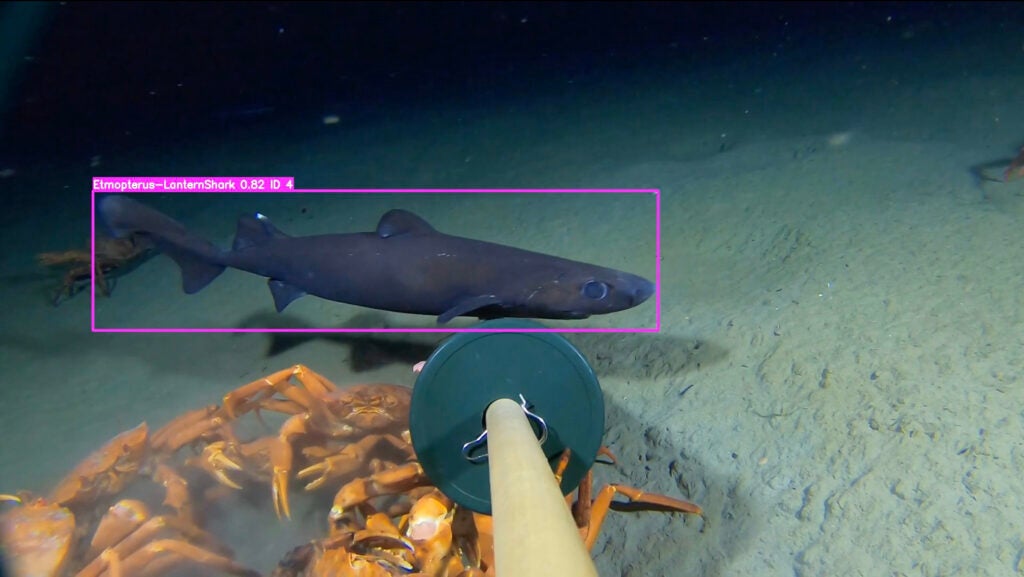
De Silva, who is a researcher in professor Andrew Davies’ marecotec lab (marine ecology and technology), has deployed baited remote underwater video (BRUV) systems in deep sea environments all over New England and the world since 2020. These landers consist of a camera and lights pointed at bait and record anything that comes into frame, such as deep-sea sharks, glow-in-the-dark jellyfish, or eels.
“The fun part is watching the videos, and the worst part is turning those videos into data,” said de Silva, who lives in Jamestown, Rhode Island. “It’s a tedious process to watch every single second and meticulously write down everything we see.”
According to de Silva, it takes an average of 45 minutes to manually annotate one minute of video footage. To put that in perspective, de Silva collected 85 hours of footage from Atlantis Canyon—a submarine canyon about 110 nautical miles from the Rhode Island shoreline—for her Ph.D. thesis.
To drastically speed up the annotation process, de Silva decided to partner with URI’s AI Lab, led by Indrani Mandal, to create computer vision models.
“We needed a way to quickly and efficiently create a dataset that the models would be trained on,” said de Silva. “This included creating bounding boxes and polygons over objects of interest like fishes or anemones.”
Using a tool called Roboflow, marine science students initially helped de Silva correctly identify and label the marine life in the footage.
“After a little while, we realized we were spending a lot of money on Roboflow and it would only help us create the annotations and not actually train or use the models later,” said de Silva. “We felt we could create something similar that better addressed our needs.”
With the help of more than 20 marine science students and 13 students from the AI Lab, the team built the platform Ocean Detect.
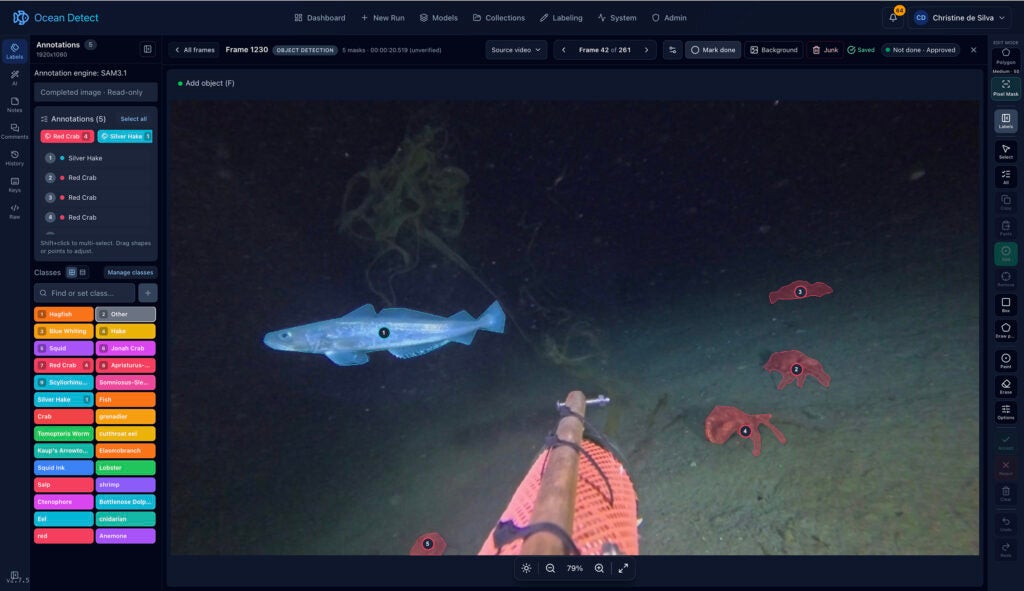
“We custom built the labeling page which allowed us to manually create shapes and pre-run models we had already trained over images before a human ever looked at it,” said de Silva. “This greatly increased the number of images we could label in a day because the AI had already done a first pass.”
Because Ocean Detect is hosted within the multi-institutional high-performance computing collaboration co-led by the University of Massachusetts and URI at the Massachusetts Green High-Performance Computing Center, and not on a local computer, a 30-minute video can be annotated at a rate roughly 133 times faster than doing it manually. De Silva’s research team is working on a quick way for humans to then verify that data and to fix incorrect annotations to continuously improve the models.
De Silva’s goal is for Ocean Detect to be an accessible and useful tool for researchers and the public.
“Ocean Detect can empower local community groups to observe their own waters, help commercial offshore companies remain in compliance with legal environmental monitoring requirements, and provide a tool for researchers to learn from the thousands of hours of backlogged videos they haven’t been able to annotate yet,” said de Silva.
The applications for Ocean Detect, if it eventually becomes available to the public, are endless. De Silva said its applications in commercial, personal, and municipal contexts could range from identifying objects on an assembly line conveyor belt, animals that enter a backyard, cracks on a sidewalk, to much, much more.