KINGSTON, R.I. — Nov. 6, 2026 — Several University of Rhode Island students joined their counterparts from several partner institutions around the state last week to display their dynamic research projects during the annual meeting of the Rhode Island Network for Excellence in Science and Technology.
Representatives of URI, Brown University, Rhode Island College, Rhode Island School of Design, and Roger Williams University met at RISD to discuss Rhode Island’s collaborative research ecosystem as part of the organization’s efforts to broaden opportunities for research and science education, improve and extend collaboration among local researchers, and strengthen workforce development by creating pathways to high-tech careers.
During a panel discussion, members of RI-NEST and the partner schools discussed the importance of collaboration on research projects among the member institutions, and the barriers to such collaboration, including finding time to build research teams during academic periods at teaching universities, and a need to better promote Science, Technology, Engineering and Math programs at the high school level to build a pipeline of new researchers.
Collaborating on research is in large part welcoming multiple voices who feel welcome included in the conversation, according to Daniel Roxbury, professor of chemical, biomolecular, and materials engineering at URI. Meetings like the RI-NEST annual gathering are opportunities to bring diverse people and ideas together, something researchers should engage in more.
“We have R1 institutions, we have private institutions, public institutions; there are so many different backgrounds and cultures,” said Roxbury, who is principal investigator on microplastics’ socio-ecological impact on coastal ecosystems. “There is very limited time during the academic year for in research. We’ve tried to work around these limitations. It’s about making spaces for people to meet, talk about their interests and differences, and finding those commonalities that will lead to future projects. This culture of inclusion is highly regarded among our projects here.”
U.S. Sens. Jack Reed and Sheldon Whitehouse addressed the contingent of Rhode Island researchers, touting the success of RI-EPSCoR projects and stressing the importance of continuing to foster such important research in Rhode Island, some of which was on display at the meeting as students and professors from member institutions touted their work.
Several URI students from the colleges of Engineering, Environment and Life Sciences, and Pharmacy, as well as the Graduate School of Oceanography displayed their research projects, and discussed their studies with professors, fellow students, and passers-by. Some of the students include:
Alireza Ghaderi Bafti, Graduate School of Oceanography:
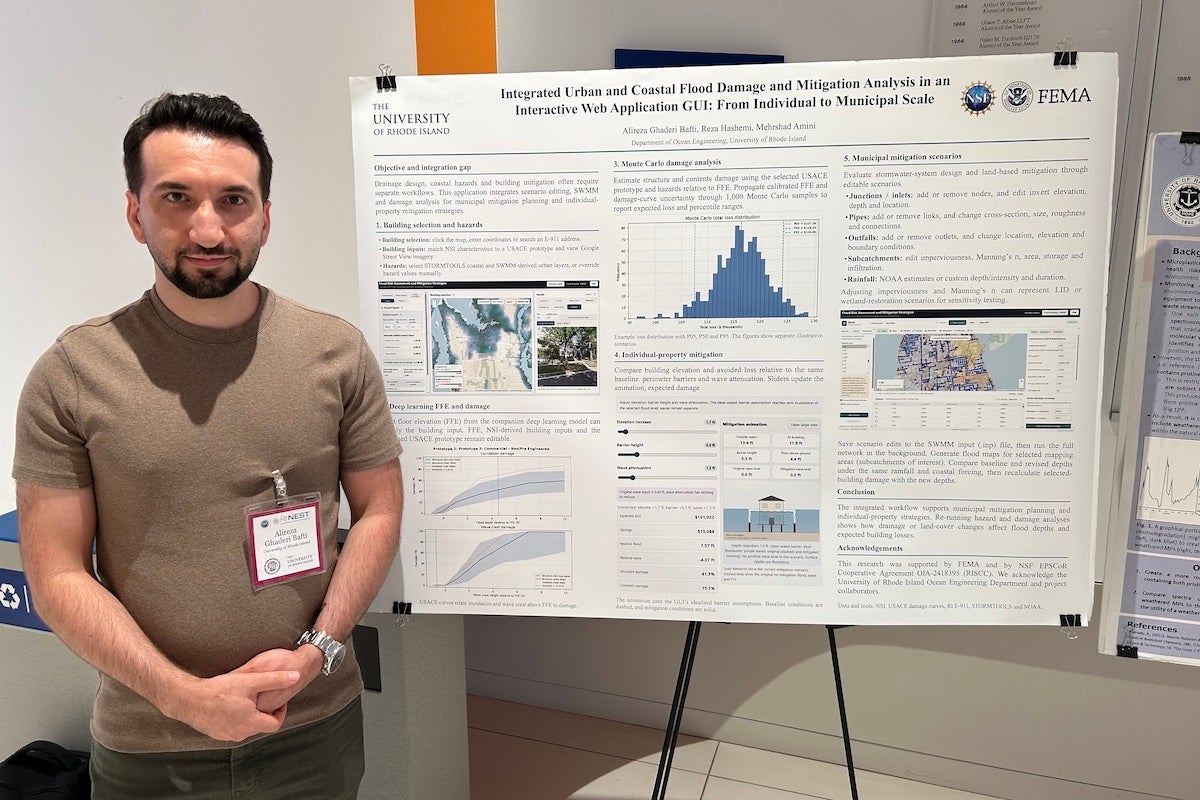
Bafti, a Ph.D. student in the Graduate School of Oceanography, is creating an interactive website that can estimate flood damage to a specific building. Users input the address of a specific structure and the website will produce data on the building listed in the National Structure Inventory—including first-floor elevation, the most important factor in flood damage estimates—as well as U.S. Army Corps of Engineers damage curves, which are standardized mathematical relationships used to estimate the economic impact of flood events. Using damage curves, the first-floor elevation and the depth of a flooding event, the website produces a percentage estimate of potential damage.
“People can go to the website, put in the address, and get the elevation above ground level and estimation of damage with high accuracy—much higher than previous research,” said Bafti, who expects the website to be online during the spring 2027 semester. “The main objective is for users to evaluate the potential damage to their building and how they can reduce it.”
Users can also use the website to evaluate flood mitigation strategies. For instance, if they were to increase a building’s elevation by two feet, or add barriers in front of the building, the website will update the damage estimate based on such mitigation efforts.
Cities and towns can use the website to determine whether to build in a specific area, and to research how infrastructure changes would alter flood damage. For example, if they were to input changes to the stormwater system by increasing the diameter of the pipes, adding new pipes, or restoring some damaged areas, the website will generate new flood maps with new damage estimations.
Ruirui Deng, College of the Environment and Life Sciences
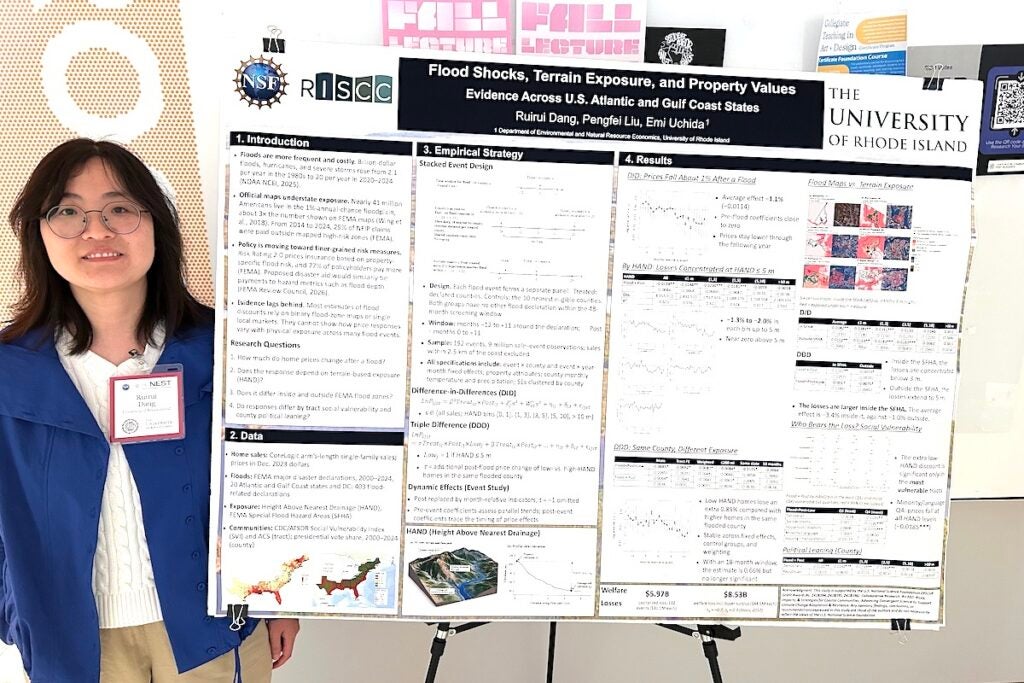
Deng is studying how flooding affects properties along the east coast, finding an overall average decrease of 1.1% in property value per flooding event. As one might expect, low-lying properties and areas in designated flood zones tend to experience the highest loss of value. However, Deng has found that more elevated properties outside flood zones are not immune to property value declines after a flood.
The effect of overall property value loss is concentrated in low-lying areas, especially below three meters of elevation, with an average 1.4% decline. Above five meters, the property decline decreases to about 0.6% on average. Inside designated flood zones, the average property value declined 3.4%, much more than those outside a flood zone. However, being outside a flood zone may provide a false sense of security. Those properties still experienced an average of 1% decline in value, especially those in low-lying areas.
“Outside the flood zone, you think your property will not be exposed to a flood, but it is,” Deng said. “There are usually insurance requirements for properties in flood zones. But even outside flood zones, risk is capitalized in the housing market because they experience a deduction from those low-lying properties. Flood insurance would be a good idea even for those properties.”
Elli Kuester-Ha, Graduate School of Oceanography
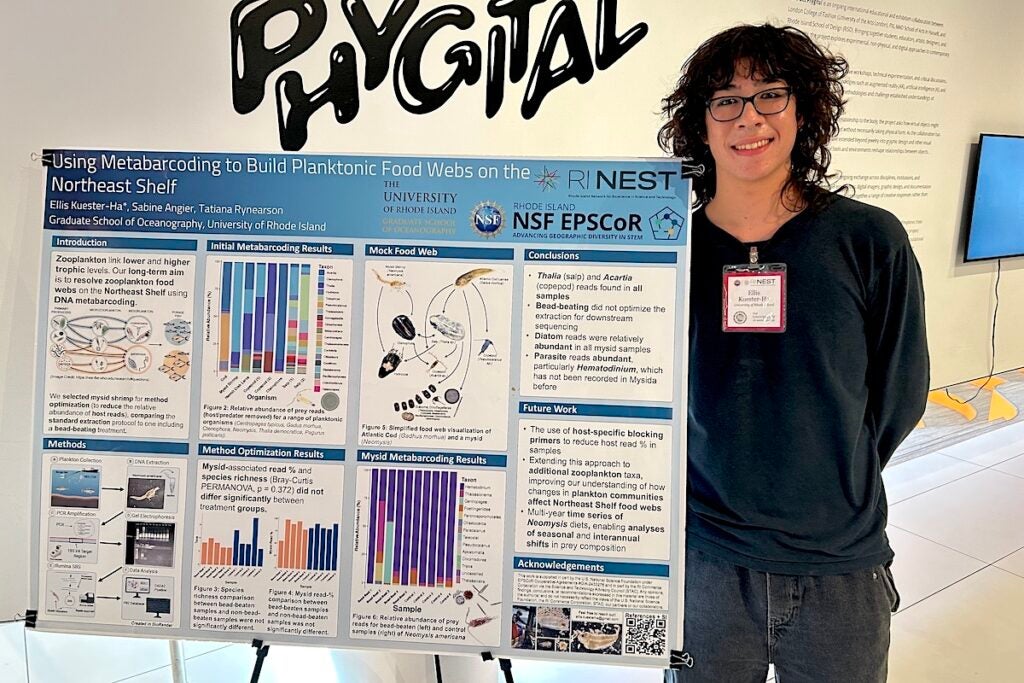
Kuester-Ha, a sophomore marine biology major, is using DNA metabarcoding to build plankton food webs to determine which tiny ocean creatures are most abundant along the northeast shelf of the Atlantic Ocean.
By extracting gut DNA from mysid shrimp and working with the URI Genomics Sequencing Center to sequence it, Kuester-Hu is able to examine the tiny organisms the shrimp has consumed, helping determine the variations of zooplankton prevalent in the region. In addition to algae and microscopic animals like copepods one might expect, Kuester-Hu found an abundance of parasites and gelatinous creatures including salps and cone jellies, which may indicate disruptions to the ocean ecosystem caused by climate change.
“About 80 percent of the DNA found in mysid shrimp gut was cone jellies, which is not what you would expect. We also found a lot of parasites that had not been recorded in mysid shrimp before,” Kuester-Ha said. “You don’t really think of most gelatinous zooplankton as big contributors to food webs; cone jellies, for example, are not something you expect a mysid shrimp to eat. But as the climate warms, we’re seeing changes in food webs. More research should be done on this; climate change is kind of hanging over every field.”
Teresa Sierra, College of Pharmacy
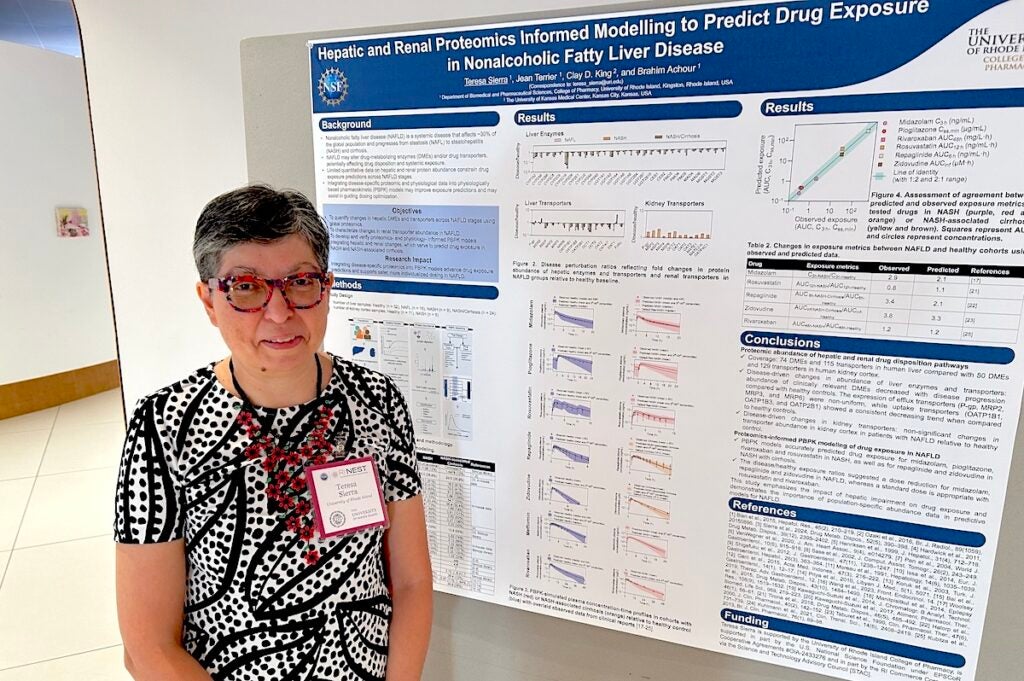
Sierra examined drug exposure in patients with nonalcoholic fatty liver disease, who may have more difficulty processing medications than a healthy individual. Generally, enzymes in the liver help break down medications and transport part of the drug out of the body. However, those with fatty liver disease often have decreased liver enzymes, causing more of the drug to build up in the body and the patient to be more exposed.
“With specific populations, such as those with liver disease, we see a general trend of a decrease of enzymes in the liver,” Sierra said. “What this means is that they’re not going to be metabolizing a drug as quickly as a healthy individual. The concentration is going to be increased in the body because the enzymes can’t fully eliminate it, and that can lead to toxic effects. The purpose of our research is trying to predict the exposure—the amount of the drug that’s in the body—and determine if they need to get a dose reduction.”
MC Cicenia, College of the Environment and Life Sciences
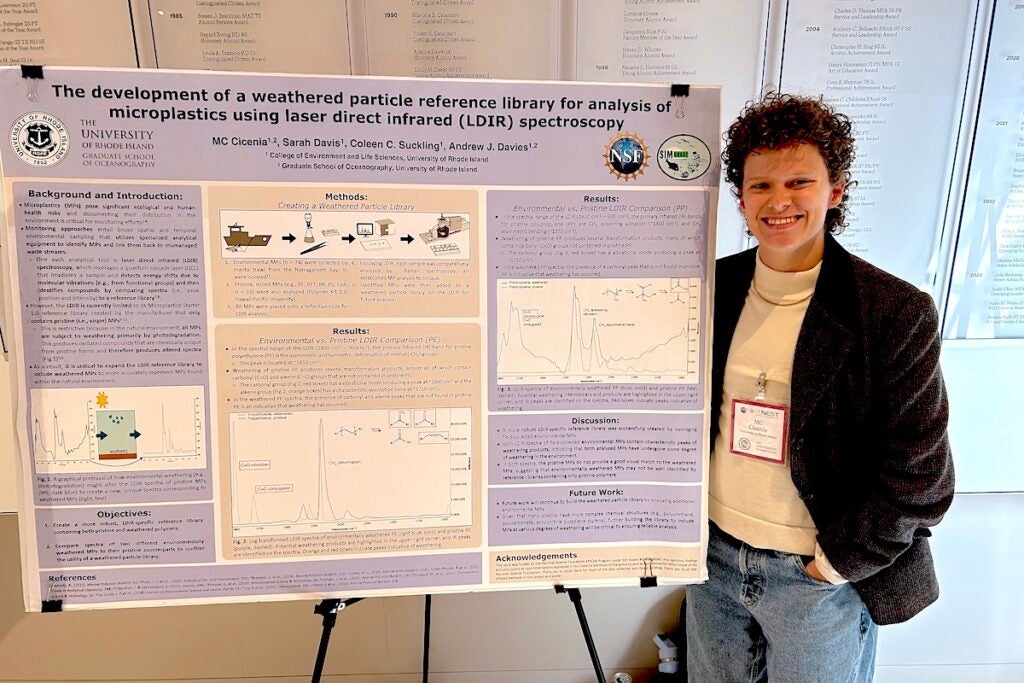
Cicenica, a Ph.D. student in the College of the Environment of Life Sciences, is studying analytical techniques to identify microplastics in the environment, and building a library of “weathered” microplastics that aren’t often recognized and included in such databases.
Scientists typically use laser-direct infrared spectroscopy—the process of directing a laser at a particle and examining the unique spectrum reflected back to identify the particle’s chemical substance—to identify the polymer used in the plastic item, which helps lead to the microplastic’s source. However, when a microplastic is weathered, the chemical structure can change, making it difficult to identify the polymer, or whether the substance is a plastic at all.
Since all plastics that have been in the environment for some time are weathered, they can be misidentified. Consequently, most spectral libraries contain only “pristine” plastics, potentially leading scientists to underestimate the amount of microplastics in the environment.
“It’s important to have a robust understanding of what types of plastics are out there,” Cicencia said. “We know that microplastics are in the environment, but knowing which types are prevalent —whether its polypropylene or polyethylene, for example—can give us a better idea of the sources of microplastics. Maybe it’s a wastewater treatment plant or laundry effluent. It helps us reveal broader patterns that we might not otherwise see.”
Cicencia and her team are building a reference library of microplastics that includes those weathered microplastics they collected and identified. The database can help researchers better match and identify plastics in the future.
“We’re hoping to get this on paper soon, and it will become a public resource other scientists using this instrument can build upon,” Cicencia said. “It’s a good starting point for other research.”