
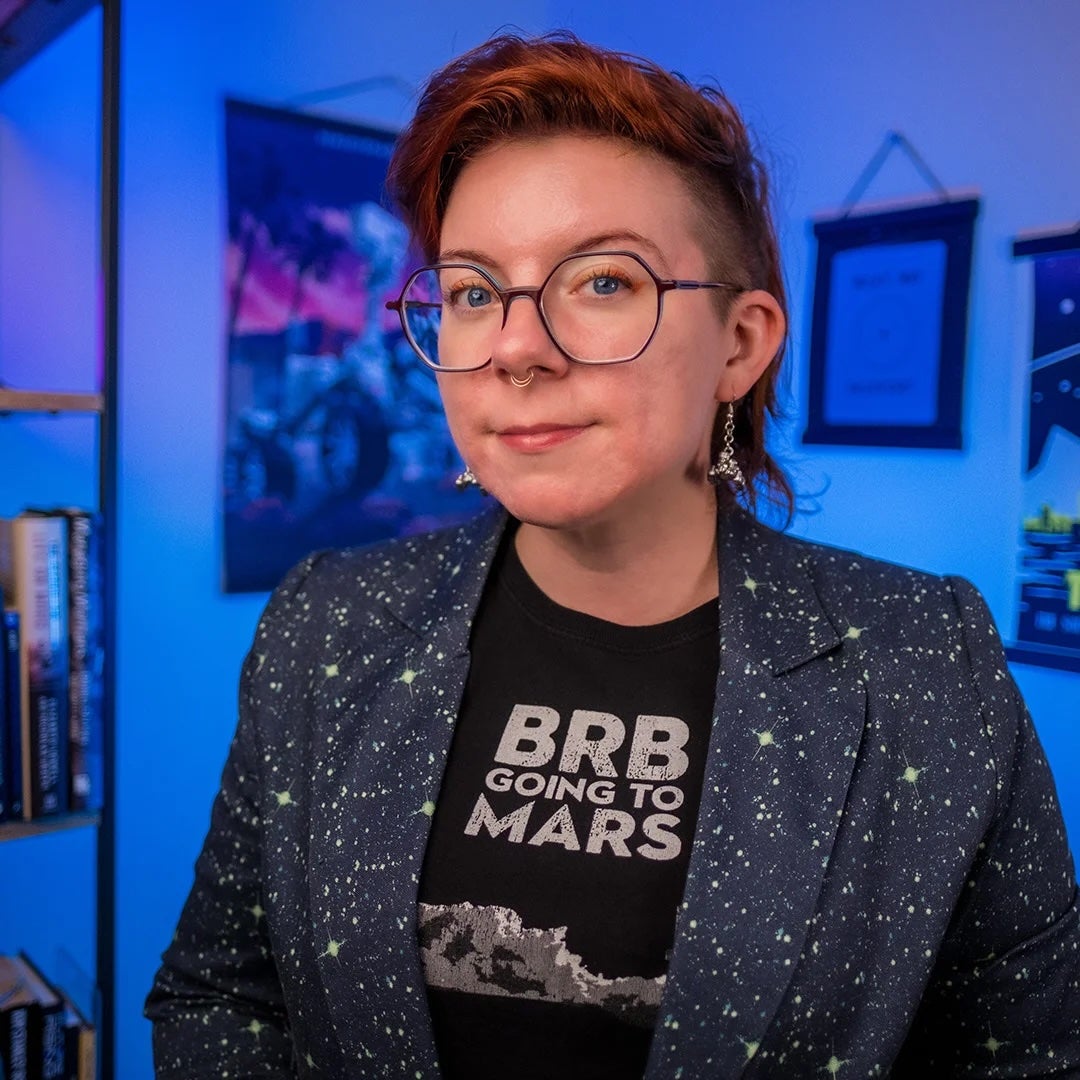
KINGSTON, R.I. – Sept. 28, 2026 – Interest and fascination in space travel isn’t just about visiting far-away planets, including Mars. Sometimes, it’s learning more about other life forms from another world.
But venturing into outer space is still vitally important to understand the world around us, and beyond, even if aliens are never found. Tanya Harrison, a Canadian-based planetary scientist known as a “Professional Martian,” will offer her perspective on the importance of going into orbit on Tuesday, Oct. 6, as part of the falI Honors Colloquium lecture series at the University of Rhode Island.
Hosted by the Honors Program, URI’s premier lecture series examines the science of outer space. Harrison will speak at 5:30 p.m. at Edwards Hall on the Kingston Campus as part of the fall colloquium series, “Interstellar Exploration: Journey Beyond Your Limits.” Harrison’s talk will also be livestreamed on the colloquium’s website.
In her talk, titled “More Than Martians,” Harrison will shed light on the history of the search for life on Mars, and why exploring matters if we never find aliens.
As one of the world’s go-to voices on Mars and space exploration, Harrison has worked on multiple NASA missions to Mars, including the Opportunity, Curiosity, and Perseverance rovers, and the Mars Reconnaissance Orbiter. Her honors include two NASA Group Achievement Awards, the Amelia Earhart Fellowship for women in aerospace and the Vanier Canada Graduate Scholarship—Canada’s most prestigious doctoral award.
In 2023, Harrison was inducted into the Explorers Club as part of EC50, an annual selection of 50 extraordinary people doing remarkable work to promote science and exploration. Harrison also co-founded the Zed Factor Fellowship, which connects students from historically excluded backgrounds with paid internships in aerospace.
Harrison has also actively mentored students in programs such as the Students for the Exploration and Development of Space, the Zenith Canada Pathways Fellowship and the Brooke Owens Fellowship.
Harrison’s lecture will be followed on Oct. 13 by Timiebi Aganaba, international lawyer, and assistant professor and founder of the Space Governance Lab in the Arizona State University College of Global Futures’ School for the Future of Innovation in Society. A full roster of colloquium speakers and sponsors can be found on the Honors Colloquium website.
This year’s URI Honors Colloquium is led by the Department of Physics, bringing forth thought-provoking conversations that bridges cutting-edge science and the boundless imagination of science fiction. The series concludes in December with a lecture on achieving the impossible with outer space.
Hosted by the University’s Honors Program, the annual URI Honors Colloquium is free and open to the public. To see recordings of this year’s speakers, or past colloquiums, visit the Honors Colloquium archives. Sign up here for more information and reminders for colloquium events or by emailing urihonors@etal.uri.edu.