
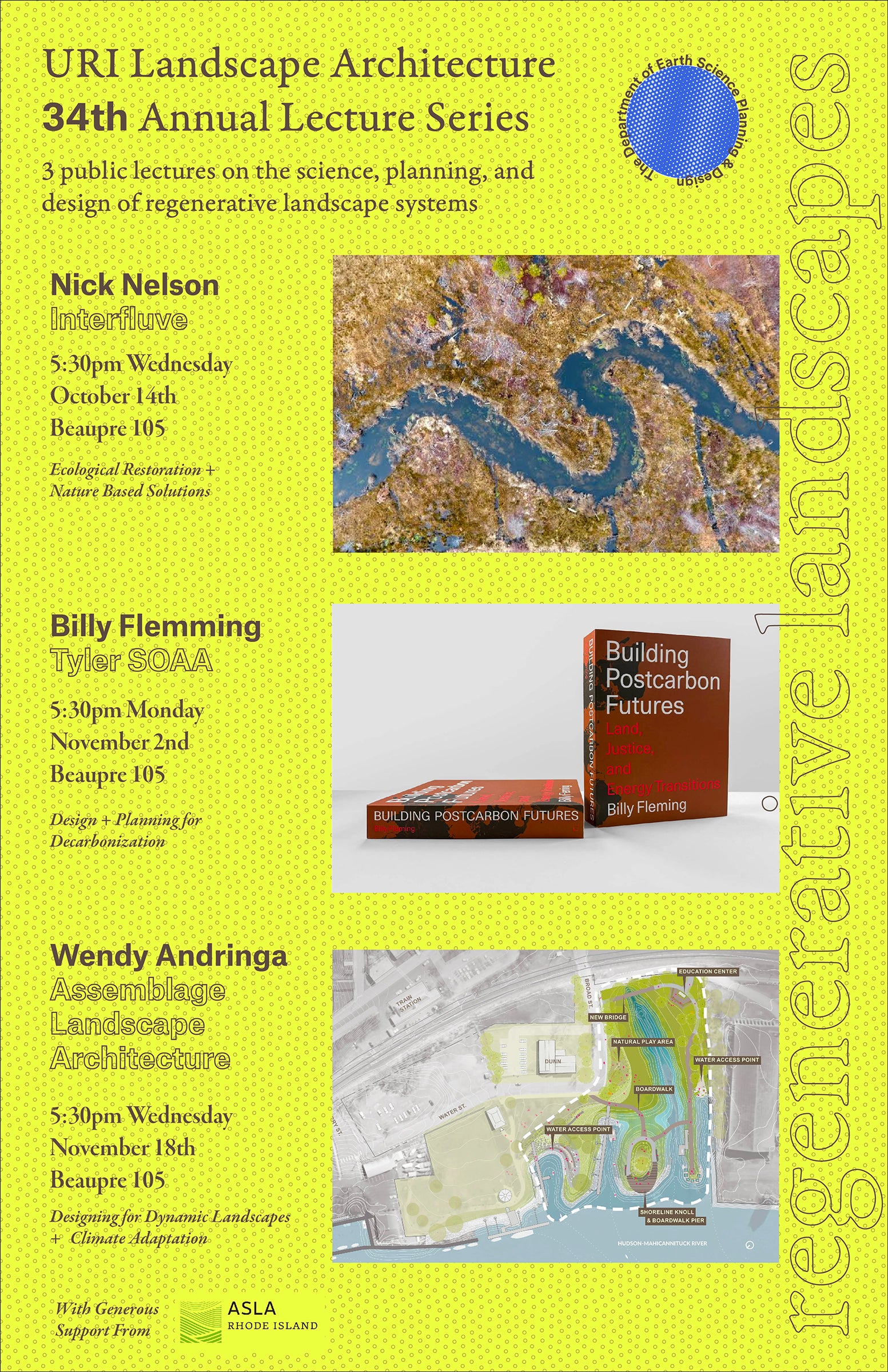
KINGSTON, R.I. – Oct. 6, 2026 – The University of Rhode Island’s 34th annual Landscape Architecture Lecture Series will bring three nationally recognized practitioners and scholars to campus this fall to explore how science, planning, and design can work together to create more resilient and regenerative landscapes.
The free public lectures carry added significance this year as the first series hosted by URI’s new Department of Earth Sciences, Planning, and Design (ESPD), which brings together the former departments of Geosciences and Landscape Architecture and Planning.
This year’s theme, “Regenerative Landscapes,” will examine environmental challenges at multiple scales, from restoring rivers and local ecologies to designing for decarbonization and adapting landscapes to climate change.
“The Regenerative Landscapes theme was inspired by the need to go beyond sustainability and consider how we can repair, restore, and steward positive environmental change,” said Gavin Zeitz, assistant teaching professor of landscape architecture. “The theme operates from a multidisciplinary perspective, exploring how science, planning, and design each approach the challenge of creating regenerative landscapes in their own ways.”
Three perspectives, three scales
The lectures are free and open to the public and will be held at 5:30 p.m. in URI’s Richard E. Beaupre Center (Room 105), 140 Flagg Rd., Kingston.
The series opens Wednesday, Oct. 14, at the regional scale with Nick Nelson, a fluvial geomorphologist with Interfluve and the Harvard Graduate School of Design. His lecture, “Ecological Restoration + Nature Based Solutions,” will examine environmental systems alongside cultural questions about how communities live in harmony with, and restore, rivers and local ecologies.
On Monday, Nov. 2, designer and planner Billy Flemming, assistant professor of landscape architecture at Temple University, will present “Building Postcarbon Futures: Land, Justice, and Energy Transitions,” exploring precedents for using design and planning to address climate change at a planetary scale.
The series concludes Wednesday, Nov. 18, at the site scale with landscape architect Wendy Andringa of Assemblage Landscape Architecture, who will present “Designing for Dynamic Landscapes + Climate Adaptation,” focusing on how landscapes can be designed to respond and adapt to a changing climate.
Connecting knowledge to action
That range reflects the broader ambitions of the new Department of Earth Sciences, Planning, and Design, which was created in response to the increasingly interconnected nature of environmental challenges: Geoscientists help communities understand environmental systems and change, while planners and designers translate that knowledge into policies, plans, and physical interventions.
“Our work bridges a diverse range of scales—from the Earth’s crust to the atmosphere, the garden to the watershed, and the street to the community,” Zeitz said. “We are a department full of systems thinkers, united by a shared interest in tackling the most pressing challenges facing our planet.”
For students and other attendees, Zeitz hopes the series will encourage a broader understanding of environmental responsibility. “To sustain life on this planet, we need to plan, design, study, and advocate for models of regenerative development that actively promote the health and resilience of our living systems,” he said.
As ESPD enters its first year, the lecture series offers an early public expression of the department’s interdisciplinary mission.
“We believe our department can be a model for how science, planning, and design can come together to produce novel, community-engaged approaches to environmental and social challenges,” Zeitz said. “We’re excited to see where this journey takes us.”
This story was written by Anna Gray in URI’s College of the Environment and Life Sciences.