AI at URI
From teaching, learning, and academic integrity to research, operations, and student success, the rise of artificial intelligence raises new challenges and questions for universities. How is URI approaching these?
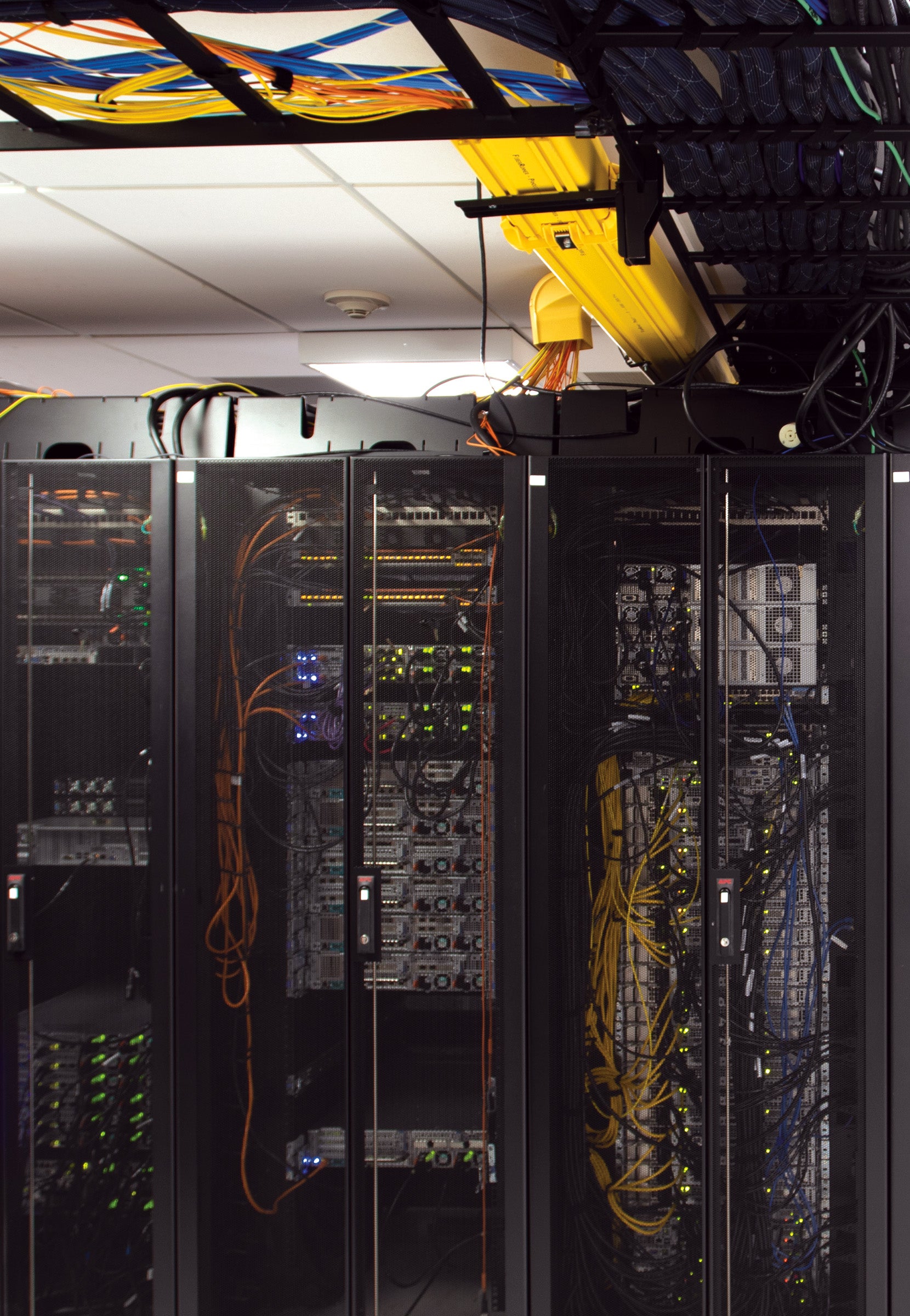
The Massachusetts Green High Performance Computing Center in Holyoke, Mass., is among the world’s most energy efficient academic data centers. It powers URI’s Institute for AI & Computational Research.
By Emily Gold Boutilier
When ChatGPT came out, Ying Chen, associate professor of management, recognized a new challenge facing professors. “What’s a professor’s value now?” she asked herself. “One of our bases of authority is knowledge. Now students have a huge amount of knowledge at the tips of their fingers.”
Seeking to answer her own question, Chen and a colleague in the College of Business, associate teaching professor Christine Stevens, embarked on a qualitative study. Chen and a graduate student interviewed 35 URI undergraduates and eight master’s students about how generative AI affects the student-professor relationship.
“We cannot compete on speed,” Chen knew. So, what could she compete on?
The study has reinforced Chen’s commitment to connecting with students.
It’s also emblematic of URI’s institutional approach to AI: Explore its impact and opportunities, understand its risks, prepare for a future in which it is central to many professions, and help disciplines and units make informed choices about whether and how AI supports their work.
University-Wide Guidance
New guidance came out this fall from the URI Academic Affairs AI Task Force. In a September report, the task force—chaired by Sue K. Adams, vice provost for academic and faculty initiatives—says the university is positioned to “shape, not simply respond to, the future of AI in higher education.” The report includes recommendations about AI-use disclosure and specifies that AI should be used to augment human judgment rather than to replace it; that academic freedom includes “both thoughtful adoption and principled refusal”; and that policies should consider AI’s community and environmental impact.
The report calls on faculty to provide concrete expectations for AI use in class, so that students are clear on each professor’s rules. Another of the 10 recommendations is to increase AI research capacity, talent, and infrastructure across URI—as part of a larger goal to make previously impossible research advances possible.
Of course there is a distinction between policy and guidance. Existing policies around research ethics, academic integrity, and the like remain binding when AI is used. Guidance “helps faculty apply those responsibilities,” says Sean Krueger, manager of academic systems administration in the provost’s office.
For example, a cross-campus group of faculty and staff recently developed AI syllabus guidance. It provides language that instructors can adapt to explain whether AI use is permitted, limited, or prohibited in a particular course—and to spark classroom discussions about “authentic learning and personal growth with or without AI tools,” says Associate Vice Provost for the Advancement of Teaching and Learning Christopher Lavan.
“Technologies will continue to change,” Krueger adds; “the values guiding their use remain constant: human responsibility, transparency, privacy, equity, and authentic learning.”
Training Students in Ethical AI Use
A new degree program will teach URI students to create AI applications ethically and responsibly.
The interdisciplinary program, which will launch next year, is offered through URI’s College of Business in collaboration with other colleges across the University. It grew, in part, out of student interest in the topic, as well as the growing need for workers trained to responsibly implement AI applications in sectors ranging from healthcare and life sciences to small businesses and accounting.
The applied AI bachelor’s degree program will focus on building AI tools with data collected from reputable sources with proper consent, emphasizing safety, security, and privacy, says Indrani Mandal, associate teaching professor of computer science, who is leading the new program with Davendra Kale, interim associate dean for undergraduate education in the College of Business.
“This new degree program will not only address workforce needs locally,” says Mandal, “but it will also help society remain a step ahead as this technology becomes more advanced.”
Making Impossible Research Possible
“When we talk about AI at URI,” says Adams, “the conversation extends well beyond chatbots and includes, for example, AI as a tool for scientific discovery, data analysis, and solving complex problems.”
Of special interest to professor of physics and assistant vice president for research computing Gaurav Khanna is AI’s potential to advance research in previously unimaginable ways.
#ai-quote{ font-family: ui-monospace, “Courier New”, monospace; font-size: 1.10em; line-height: 38px; }“AI is like a sharp knife; you can cut yourself with it, or you can use it to make a nice dish, to do great things.”
—Gaurav Khanna, professor of physics and assistant vice president for research computing
Khanna is founding director of the URI Institute for AI & Computational Research. Launched in 2025, the institute supports the work of 150 faculty members. Khanna points to biologists who used AI to “supercharge” gene classification as one example of the institute’s early success in advancing research.
“I feel very optimistic about AI,” Khanna says. “Yes, there are problems, but that’s true for any new technology. AI is like a sharp knife; you can cut yourself with it, or you can use it to make a nice dish, to do great things.”
The institute’s outreach arm, the AI Lab, holds workshops for faculty, students, staff, and community members and runs an undergraduate internship program.
Khanna is especially proud that the institute’s research is powered by a data center in Holyoke, Mass., which gets its electricity mostly from local hydroelectric and solar generation. The Massachusetts Green High-Performance Computing Center is among the world’s most energy-efficient academic data centers.
An Engineering Leader
This year, responsible AI use became a formal learning outcome in the URI Department of Electrical and Computer Engineering, making it a leader in its field, says professor and recent department chair Yan (Lindsay) Sun.
“We want every student in the major to have these skills,” she says, in part because employers ask for them. Sun is founding director of the URI CYPHER Research Center, which focuses on trustworthy AI and cyber-physical system security.
Among the department’s measures of responsible use is that students verify AI outputs—which, as Sun points out, requires technical reasoning and judgment.
For the department’s capstone program, seniors work with industry sponsors on real-world projects. Each sponsor determines acceptable AI use. Amazon Web Services, for example, allows AI for test development, data analysis, “preparation of project deliverables,” and more, but not for meeting transcription. That project asks students to build generative AI-powered systems. “Most engineering graduates leave school having only used AI tools—not having built systems on top of them,” says the project briefing. “This sponsorship is designed to close that gap.”
A Professor’s Value
Chen’s study found that some students go to generative AI for immediate answers to questions that would have previously brought them to a professor’s office hours or led them to raise a hand in class.
To foster these moments of connection, “I always come to the classroom at least 30 minutes early,” Chen says. “I stand at the door and say, ‘Hello, welcome to the class. How are you?’ And in my grading, I want my feedback to be very timely, very personalized.”
Students respect professors’ contextual judgment, evaluative authority, and human understanding, the study found.
“AI is changing how students seek knowledge and academic support,” Chen says, “but professors’ disciplinary expertise, contextual judgment, personalized feedback, and human connection remain essential. That’s the future of higher education.”
To learn more about URI’s approach to AI, read the 2026 AI task force report and see a list of task force members, go to uri.edu/provost/initiatives/ai-at-uri.
Photo: Beau Jones