
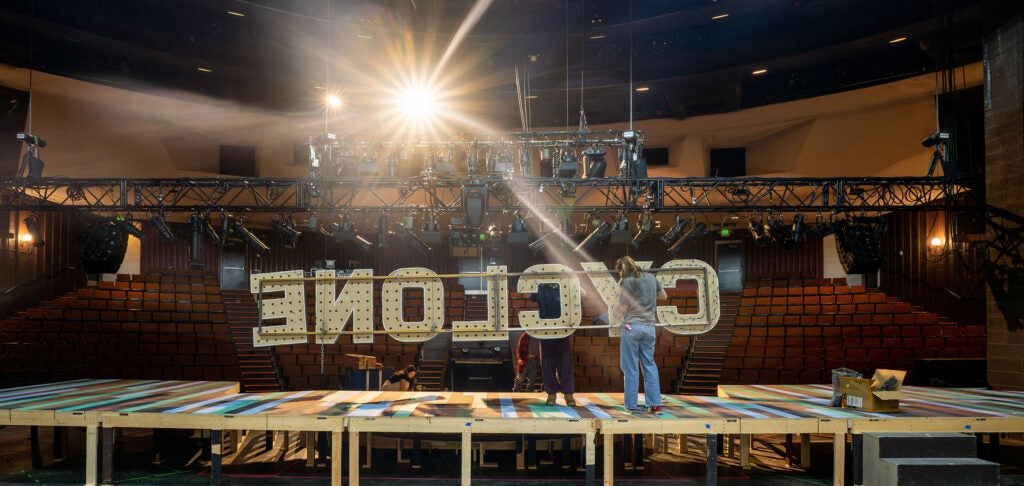
Student assistant director Parker Frenze ’27 (at right) works with carpenter Neil Santoro to construct the set for URI Theatre’s spring 2026 production of Ride the Cyclone.
Students in URI’s Theatre Department are encouraged to experience all aspects of theater production. By the time they graduate, they’ve had opportunities to star in every theater role—from delivering lines to lighting the stage.
By Paige Monopoli
Photos by Seth Jacobson
There’s a real sense of excitement and passion in the theater wing of the Fine Arts Center, no matter what time of year or what time of day. Everyone truly wants to be there. What college student would stay at rehearsal until 11 p.m. on a Friday? A theater kid. That’s because theater is a calling. It draws people in, sometimes even before they know exactly how they will fit in.
Kayla Senn ’26 was drawn to theater from a young age. She didn’t picture herself as an actor, so she gave stage management a try in high school. She enrolled at a university in Florida to study theater, but she soon realized it wasn’t the right fit. By her sophomore year, at a friend’s suggestion, she transferred to URI. She graduated in May with a B.F.A. in theater, focusing on stage management and theater design technology.
“Everyone quickly forgot I was a transfer student because of all the work I threw myself into with each production. There’s so much opportunity if you look for it,” says Senn. “There’s an ‘iron sharpens iron’ mentality that inspires us to work hard and support each other. I’ve learned so much from so many different people.”
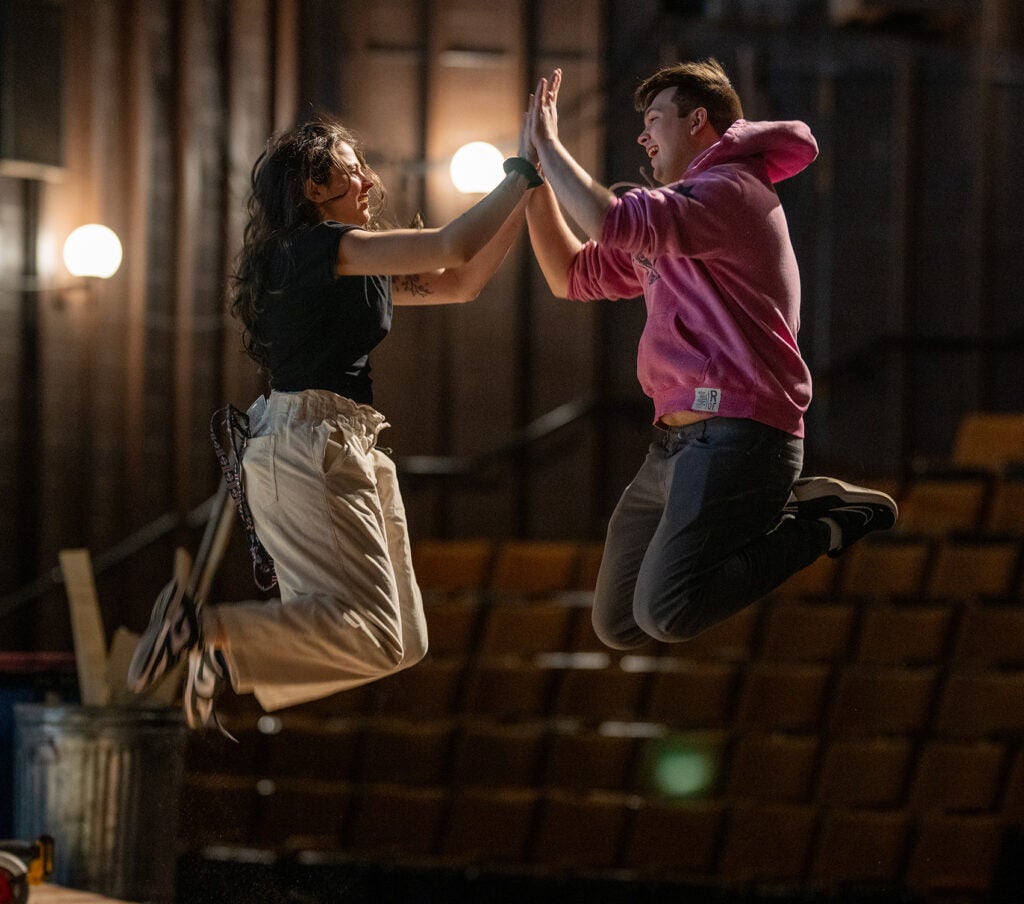
Kayla Senn ’26 and Parker Frenze ’27 during a break from backstage work on the set of Ride the Cyclone.
“There’s an ‘iron sharpens iron’ mentality that inspires us to work hard and support each other. I’ve learned so much from so many different people.”
—Kayla Senn ’26
CAMARADERIE
As students prepared for their final production of the spring semester, a musical, Ride the Cyclone, it was impossible not to feel a sense of camaraderie.
Theater major Cecelia Savage ’28 felt this, even in her first year at URI, as she played a lead role in the cast for the production and observed her older peers working.
“When there are juniors and seniors involved in the production, you learn from them, and people get so much closer. They teach each other, and they keep themselves open to their younger counterparts,” says Savage.
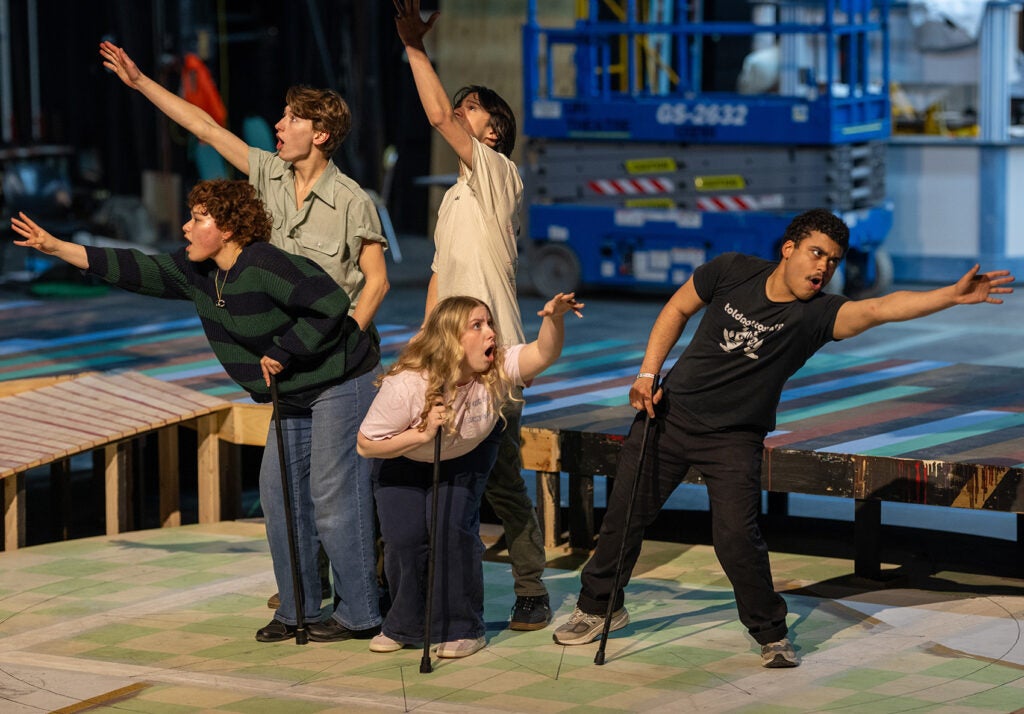
Cast members rehearse a scene from Ride the Cyclone. Clockwise from left: Cecilia Savage ’28, Ethan Clarke ’26, Calum Collard ’29, David Santana ’26, and Olivia Picard ’29.
“I was shocked by how seriously my peers took their work my first year of college. It inspired me to authentically be myself and feel even more in love with the craft.”
—Cecelia Savage ’28
Students are encouraged to work together, making art as a team, not as competitors. They cheer each other on when roles are landed, dedicate themselves to creating a world out of nothing by building and painting sets, and bring an impressive amount of professionalism to stage and production management roles. Their passion is simply contagious.
“I was shocked by how seriously my peers took their work my first year of college. It inspired me to authentically be myself and feel even more in love with the craft,” says Savage. “I thought, ‘Wow, people really care about this the way I care about it.’”
CHOOSING THE PLAY
Ride the Cyclone, written by Jacob Richmond and Brooke Maxwell, debuted in 2009, and has developed a Gen Z cult following. It first gained attention through bootleg videos on YouTube and TikTok, where it racked up millions of views. The online buzz led to a surge in productions at high schools, universities, and community theaters around the world.
URI’s production was directed by associate professor of theater Rachel Walshe, with two student assistant directors, Jay Harkness ’27 and Parker Frenze ’27. “If I am honest, the first time students pitched this play, I did not take it seriously,” says Walshe. “But this season, I was in a different headspace and really connected with the songs. It’s a viral sensation, so what do I know?!”
Walshe’s initial hesitation aside, students and their ideas are taken seriously in this department. The musical was a seemingly unusual choice because it’s a cabaret-style show with just seven actors. But at its heart, Ride the Cyclone has universal appeal, exploring existential themes such as identity, relationships, humanity, and mortality.
CREATING A UNIVERSE
Walshe describes the process of launching a new production as a big bang.
“We are generating a universe out of nowhere,” she says.
Creating the Ride the Cyclone universe began many months before it was staged. Senn, along with James Horban, URI associate professor of theater and a lighting and scenic design specialist, began working in the summer of 2025, researching and brainstorming ideas to bring to Walshe.
Alongside her academic course load, Senn juggled roles as associate scenic designer, production stage manager, assistant production manager, assistant projections designer, and student technical director for Ride the Cyclone. Horban, she says, has been integral to her growth, and his support during her time at URI prepared her to juggle these roles.
“Last summer, I was researching, writing proposals, and drafting plans. I also took a class on motion graphic design to improve my Adobe skills for the projections work on this show. I wouldn’t be in this position without James. I look up to him greatly,” says Senn.
In the weeks leading up to opening night, the production schedule ramps up. The creative team must meet tight deadlines and tackle important questions, like, “Will the actors be comfortable in their costumes for the whole show?” and “How realistic should the stage world feel to the audience?”
“We have to have a lot of bad ideas,” says Walshe.
“Bad ideas lead to good ones,” adds Horban.
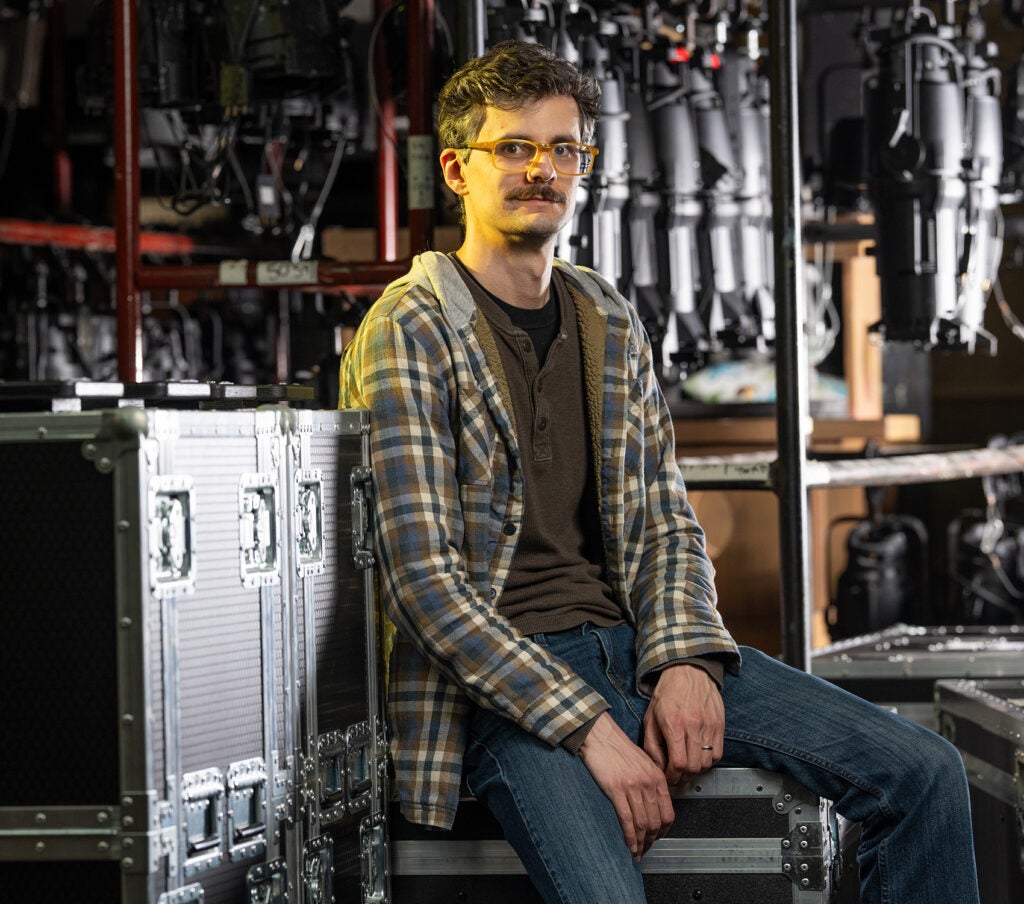
James Horban, associate professor of theater and lighting and scenic design specialist.
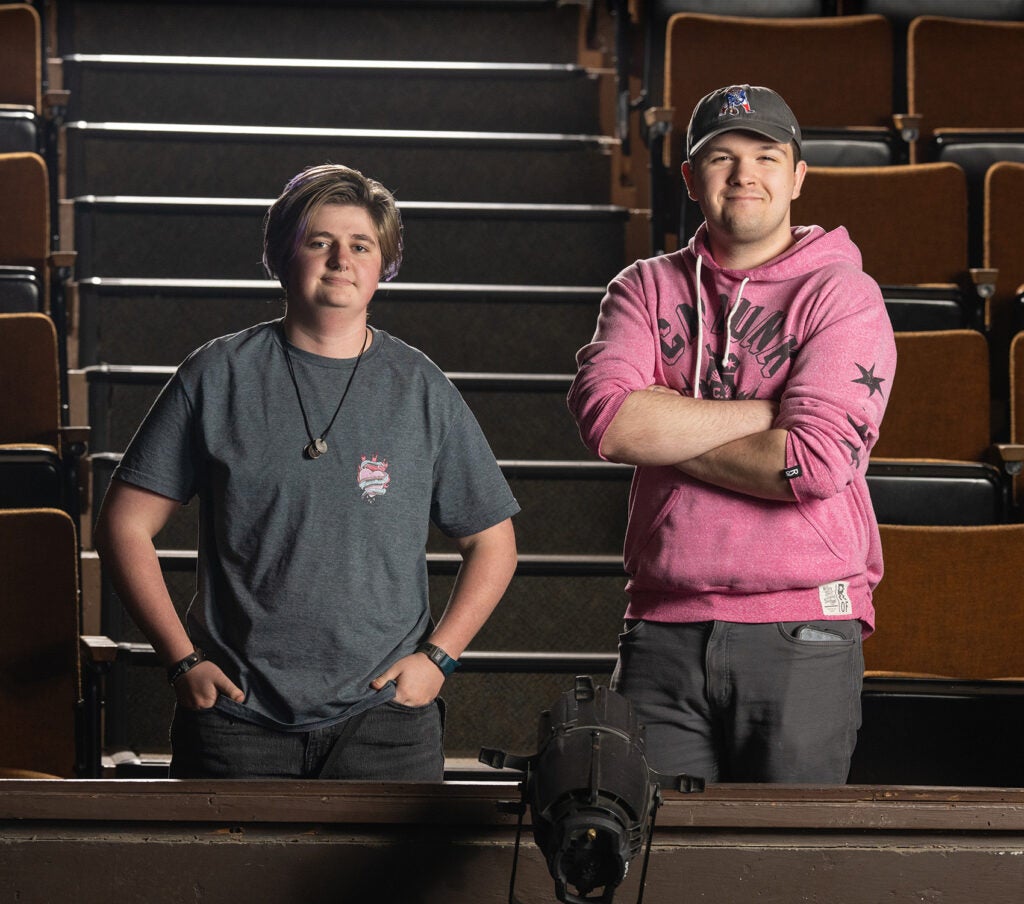
Jay Harkness ’27 and Parker Frenze ’27, student assistant directors of Ride the Cyclone.
For all URI Theatre productions—including Ride the Cyclone— student assistant directors and stage managers are encouraged to contribute and share ideas. Students in stagecraft and scenic design classes, for example, learn the how and why of scenic design, lighting, and sound, then put their new skills to use by participating in set construction.
“I joined stagecraft class and was part of the run crew (the backstage and technical team that operates and manages all physical and technical elements during a live performance) when the department produced Little Shop of Horrors my first year of college,” says Frenze. “The tech rehearsal helped me realize theater could be a viable academic path for me. As you progress through the theater curriculum, you get experience building sets, rigging lights, doing stage management, and more.”
Students usually help build scenery, work on lighting and sound, try out advanced painting techniques, or make and reuse costumes. The idea is for students to move on to new roles as they gain experience. First-year students learn the basics in the scene shop. In their second and third years, they learn to draft and paint sets and try out technical jobs like lighting and sound. By their senior year, many are ready to lead design projects.
Head electrician Julia Thelen ’26 works on set lighting for Ride the Cyclone.
With four Theatre Department mainstage productions each academic year and additional student productions, students have many opportunities to practice and show off their growing skill set.
“Collaboration isn’t always everyone making the same thing together,” says Horban. “It’s making sure what we’re creating supports the moment collectively. We’re all moving forward on the same page.”
In her senior year, Julia Thelen ’26 stepped into the role of head electrician on Ride the Cyclone.
“During my first year, I took Introduction to Stagecraft and was required to have some technical hours to put toward my grade. I went to a light-hang session and to a lighting focus session,” says Thelen. “Going to that first electric call changed my career plan and path. I just started showing up whenever they were working. I started doing small tasks but eventually began doing more.”
The workload can be intense, but the students say they stay motivated. Ride the Cyclone guest lighting designer Alex MacBeth, assistant lighting supervisor at Trinity Rep in Providence, quickly noticed a difference between professional and college theater—not in skill, but in passion.
“The kids are passionate and eager to try everything,” says MacBeth. “It was amazing to see them voice their opinions and to see their openness to hearing ideas from their peers and from me.”
FROM PAGE TO STAGE
With the key design elements in place, the characters on paper can begin to come to life, starting with auditions.
As production stage manager, Senn was responsible for organizing and coordinating the whole production. She served as the primary liaison between the director, actors, and technical crews from rehearsals through the final shows.
Among her tasks was writing audition calls with Walshe. Audition calls provide a summary of the play, a list of characters, and requirements for what actors are expected to prepare for their audition.
For Ride the Cyclone, auditions began in the first week of the spring semester with two rounds: an open call, in which anyone can audition with a song and monologue, and a second round, or callback, in which actors are selected from the first round and asked to sing, dance, and perform scenes for the production team.
“Callbacks are a joy because people show you things you didn’t know they had in them,” says Walshe. “Much of it is predicated on how actors are going to work together. Warmth, generosity, and support take priority.”
It also matters how a student shows up in class; academic work will always take priority. The schedule of any production is demanding and finding that balance is part of what’s expected of students.
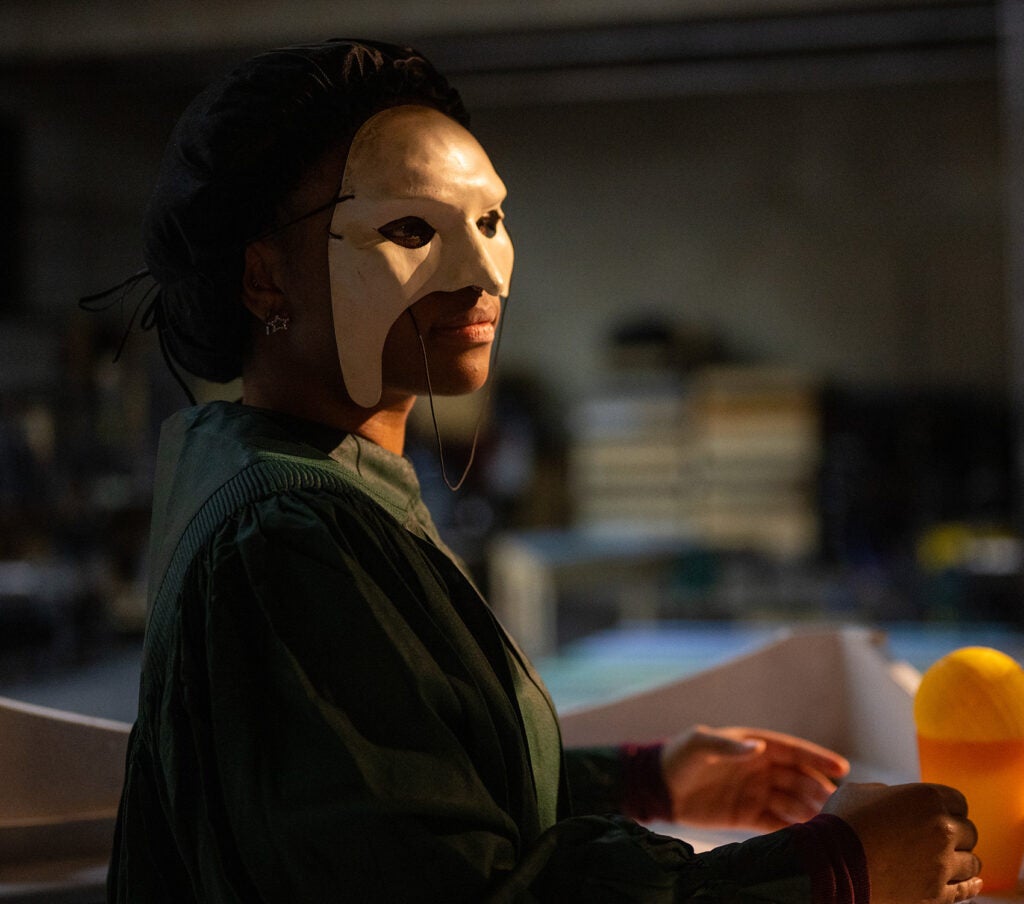
Abraphine Ngafaih ’27 played the role of mechanical fortune-teller and narrator, Karnak.
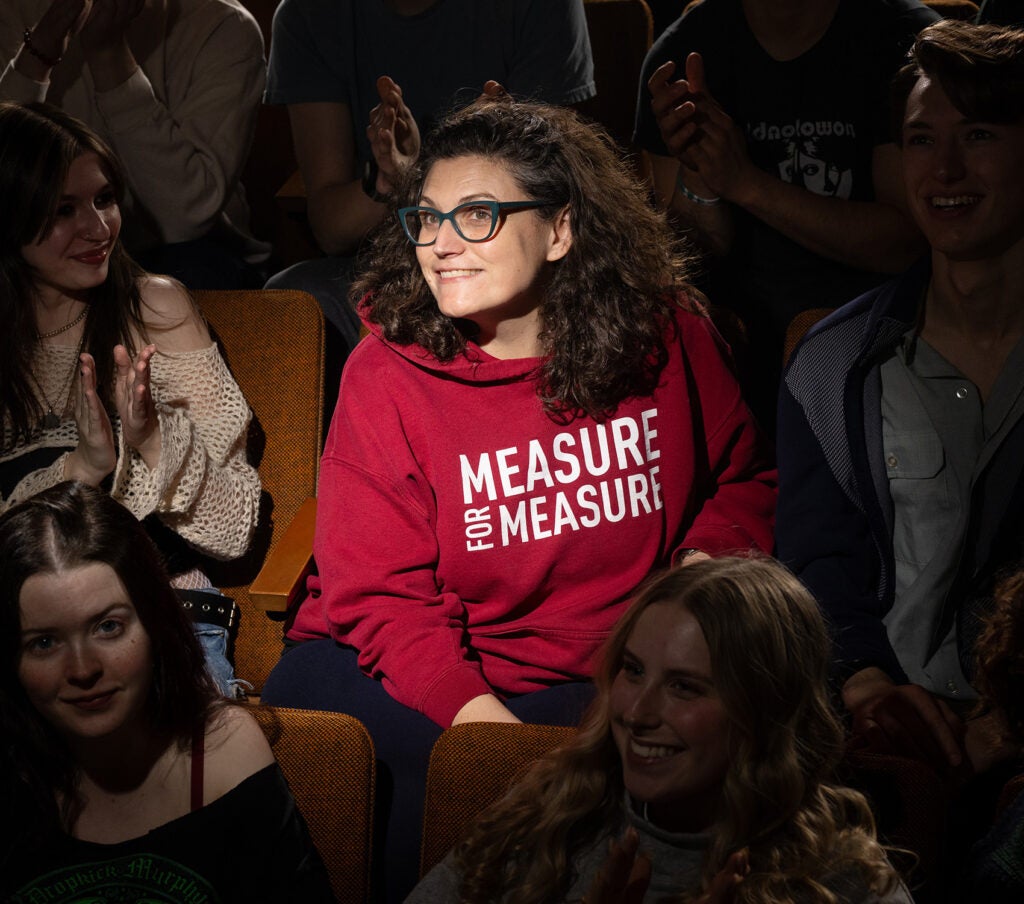
Rachel Walshe, associate professor of theater, directed the production with students Harkness and Frenze.
Abraphine Ngafaih ’27, a theater major, landed the role of the narrator, a mechanical fortune-teller named Karnak. She felt empowered to take risks during her audition and ultimately created her own version of the character.
“I remember during auditions, we all came in with animatronic body movement, because we thought that was what they wanted,” says Ngafaih. “At callbacks, Rachel told us to drop the robotics and challenged us to show how to be a fortune teller. I pretended I had a crystal ball, and I was reaching into the sky. I could tell she really wanted to experiment.”
Ngafaih started URI undecided about her major, but she knew she wanted to end up in theater. She had some experience from her small arts high school, but stepping into a larger, more talented group felt intimidating.
“I went through a lot of motions figuring myself out and figuring out what parts of the theater I wanted to be in,” says Ngafaih. “In addition to acting, I participated in a lot of backstage work over the last four years.”
First-year theater major Calum Collard ’29, who landed one of the seven primary roles in the production, was already learning a lot in his acting courses with Walshe and found ways to apply those lessons during rehearsals. He emphasized that working with the assistant director, Frenze, a third-year theater student trying his hand at directing, had a major impact.
“Parker [Frenze] is very much the kind of person who will pull you aside and tell you exactly what you need to hear. It was inspirational,” Collard says. “He’d give me a random playlist he made, or a song, or even a movie to help make his notes clear and leave me space to make my own choices as an actor.”
Between December and mid-March, the cast studied the script, learned the songs, and worked on their characters to get ready for the first rehearsal. By the time they walked into the rehearsal room, everyone had a good idea of the world they were about to create together.
“With absolutely zero exceptions, they all came in with professionalism and were highly prepared. They’re very nimble,” says Walshe.
THE REHEARSAL ROOM
Ride the Cyclone is unique—for both the cast and the audience. Each character and song adds perspective, but all contribute to the show’s messages: Appreciate the life you are given, look for meaning, and face the idea of mortality.
The primary characters are students from a fictional Canadian high school chamber choir who die in a freak roller-coaster accident. The play finds them in a kind of limbo where they meet a mechanical fortune teller, the Amazing Karnak, and compete through song for a second chance at life.
“Young adults can easily relate to these characters; the challenges of being a teenager. Several archetypes in the play are equal parts audacious and campy, and really moving,” says Walshe.
“When we play a character, we’re asked to dig deeper in ourselves to find the messy and raw things.”
—Ethan Clarke ’26
Theater majors who focus on acting spend a lot of time growing personally. They keep practicing technical skills with each show, but the rehearsal room is where they really learn about themselves and each other.
Ethan Clarke ’26 reflected on how much he had grown as he prepared for his last performance at URI.
“I feel like I’ve gotten all of the technical skills, and I’ve also gone far in soul-searching,” says Clarke. “Because that’s what’s really so important for actors, and that’s what’s so different about acting from any other major on campus. What’s asked of us is not asked of other majors. When we play a character, we’re asked to dig deeper in ourselves to find the messy and raw things.”
Amelia Connor-McCoy ’27 says it took her some time to feel confident on stage.
“For the first two years, I felt like I didn’t know what I was doing at all,” she says. “And now, it feels like I’m doing it! I still have so much to learn, but it’s so motivating.”
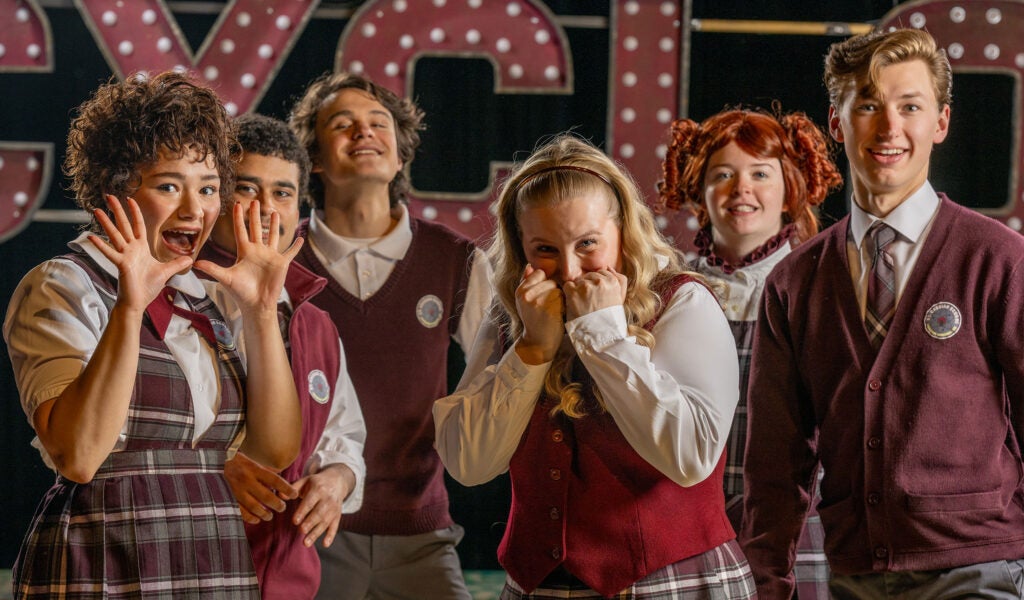
Student cast members pose for a publicity photo for Ride the Cyclone. From left, Cecelia Savage ’28, David Santana ’26, Calum Collard ’29, Olivia Picard ’29, and Ethan Clarke ’26.
TOO MANY STARS TO COUNT
Acting is a personal, inward process and, simultaneously, is about reacting to others. Theater is a team effort, and the cast of Ride the Cyclone had to balance the development of their own roles with working together as a group.
At the end of the play, the choir members decide, collectively, to give up their own attempts to win a second chance at life, and instead give Jane Doe, the character (played by Connor-McCoy), who has no family history or self-identity, the chance to come back to life.
Ride the Cyclone, with its message about transcending individual interest, is an apt way to end a season for URI’s Theatre Department.
“I love a show that gives significant roles to several actors,” says Walshe. “And this is a play with seven leads!”
Ask anyone here, and they will tell you there are too many stars to count in every production staged.