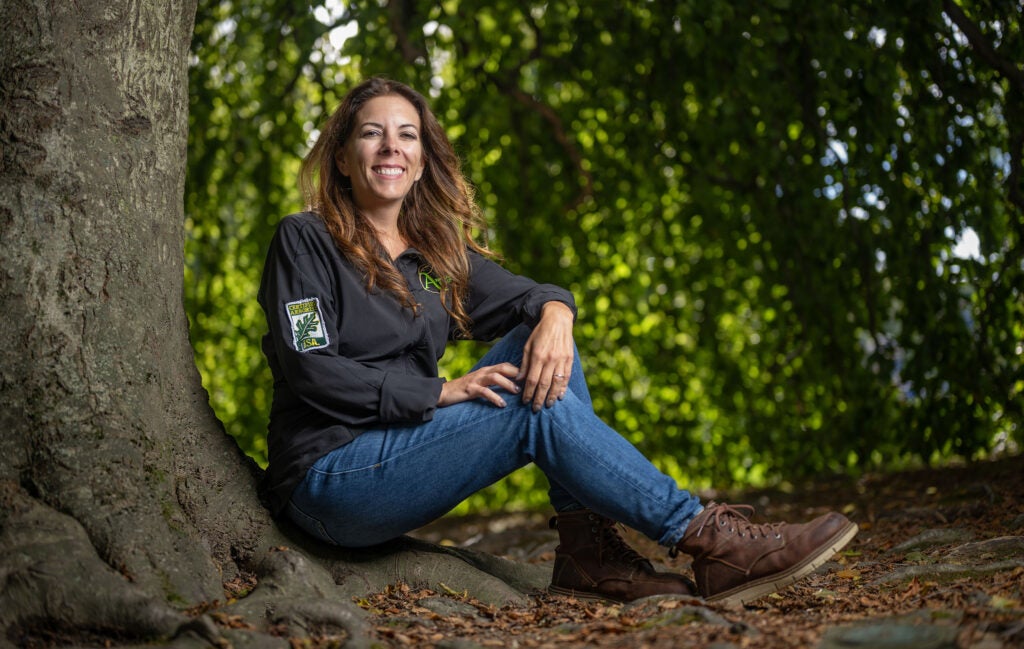
Regina Costa ’02, M.B.A. ’11, realized that her myriad interests were connected by something ordinary: trees. That realization led her on an extraordinary path to a new career in arboriculture.
Some kids like to play outside and climb trees. Regina Costa ’02, M.B.A. ’11, didn’t like to do either. She was drawn to people instead. From an early age, Costa was outgoing and conversational, with a natural curiosity about people and an ease in connecting with them. That ability would become a defining thread in her career.
Following in her father’s footsteps, Costa attended URI, earning her bachelor’s degree in mechanical engineering and later her M.B.A. Inspired by her grandfather’s legacy in the construction industry, she went on to build a 22-year career in construction, technical sales, business development, and management.
“I chose mechanical engineering as my major, but I felt a real connection to civil engineering—particularly roads, bridges, utilities, and the infrastructure we rely on every day,” she says. “I was drawn not only to technical problem-solving but also to people, relationships, and the business side of technical industries. Construction allowed me to combine those things.”
After more than two decades in construction and technical industries, Costa began thinking about what she wanted from the next stage of her career. She wanted greater flexibility for her family, more control over her professional life, and the opportunity to do meaningful work that drew on the breadth of experience she had built.
“By that point in my career, I had accumulated this unusual combination of experience—engineering, an M.B.A., sales, business development, construction, management. I realized I didn’t need to keep trying to fit those pieces into someone else’s definition of a job. Instead, I could build something that brought them together,” she says.
Entrepreneurship offered Costa the opportunity to define success on her own terms, but the decision to leave an established career and a stable income was not one she took lightly. For months, she considered what she wanted to build, how to begin, and whether she was ready to take the risk of working for herself.
She knew enough to recognize what she didn’t know, she says. So, one of her first steps was finding a mentor. She knew she’d need someone who would challenge her, ask difficult questions, and help her think like a business owner.
Through the small business mentorship organization SCORE, Costa connected with volunteer mentor Ron Caniglia, a construction and business professional with six decades of experience. The pair met weekly for a year to identify how to turn Costa’s analytical ability, curiosity, communication skills, and business training into competitive strengths.
Costa adds, “Ron and I flipped stones—exploring every idea, trying to figure out how to bring all of my experience together and build a business that would continue to challenge and interest me.”
A lifelong interest in the environment, fostered by her parents, and a previous job working in the arboriculture industry began to connect with what Costa had learned years earlier in one of her URI engineering classes—a composite materials course with Professor Hamouda Ghonem. “I loved the study of material properties, and when I remembered that class, I began thinking about the material properties of trees and how different woods respond to environmental factors like wind,” she says.
It was an “Aha!” moment. Costa realized that trees were a nexus, connecting her myriad interests: science, engineering, problem-solving, the environment, construction, risk, business, and working with people. She began to research trees and arboriculture, and the more she learned, the more fascinated she became.
“I realized I didn’t need to keep trying to fit those pieces into someone else’s definition of a job. Instead, I could build something that brought them together.”
—Regina Costa ’02, M.B.A. ’11
“My job wasn’t to teach Regina how to become somebody else,” Caniglia says. “It was to help her recognize that much of what she needed to become was already there. We began asking how her assets could be redirected into arboriculture. Instead of competing metal-to-metal in an equipment-driven industry, why not compete knowledge-to-knowledge? Two and a half years later, we’re watching that idea work.”
That idea—a different kind of tree-service model, one in which she doesn’t own or manage the equipment or the labor, but instead serves clients using her knowledge of trees and the industry itself—took root. Costa leaned on her networking skills, business experience, and determination, immersed herself in the field, built relationships within the industry, developed a client base, earned her arborist license, and established her company, Arboreal Solutions.
Costa’s niche is advising clients on comprehensive tree care, health, and risk assessments and long-term care and preservation plans. Costa also develops scopes of work, coordinates qualified tree-care professionals, and provides project management and oversight. Her clients include homeowners, businesses, municipalities, property managers, and organizations. She is proud to have earned her TRAQ (Tree Risk Assessment Qualification) credential from the International Society of Arboriculture, a distinction held by just a small percentage of certified arborists, reflecting her knowledge of tree risk assessment and her commitment to tree care and maintenance.
To pay forward the mentorship that she is so grateful for, Costa joined the URI Women’s Leadership Council last year and co-leads its engagement committee. She helps the council plan career-focused programming and create networking and professional development opportunities, and she is spearheading a new student-alumni mentorship program.
“Regina is very passionate and engaged. She really fits in with this council to make sure we have a full range of members with different backgrounds who can help bring mentorship or guidance,” says council chair Paula Testa, M.B.A. ’94. “She actively participates and comes with ideas for how to improve the council. Her enthusiasm and passion are contagious, and she always has a positive outlook.”
While changing her career trajectory was challenging, Costa believes staying true to her strengths and interests was an effective strategy. The professional threads of connection, relationship-building, determination, and finding her own path have woven through her career and will help her move forward, she says. She recently joined Leadership Rhode Island to further nurture her leadership and development skills.
“Every job I ever had was very different, but I can see how each one helped shape who I am and the business I have built,” says Costa. “I’ve taken something from every experience and brought those pieces together to build this company. My engineering background, my business experience, and the way my mind works allow me to approach arboriculture differently—and that has become one of my greatest strengths.”
—Annie Sherman
Photo: Seth Jacobson