
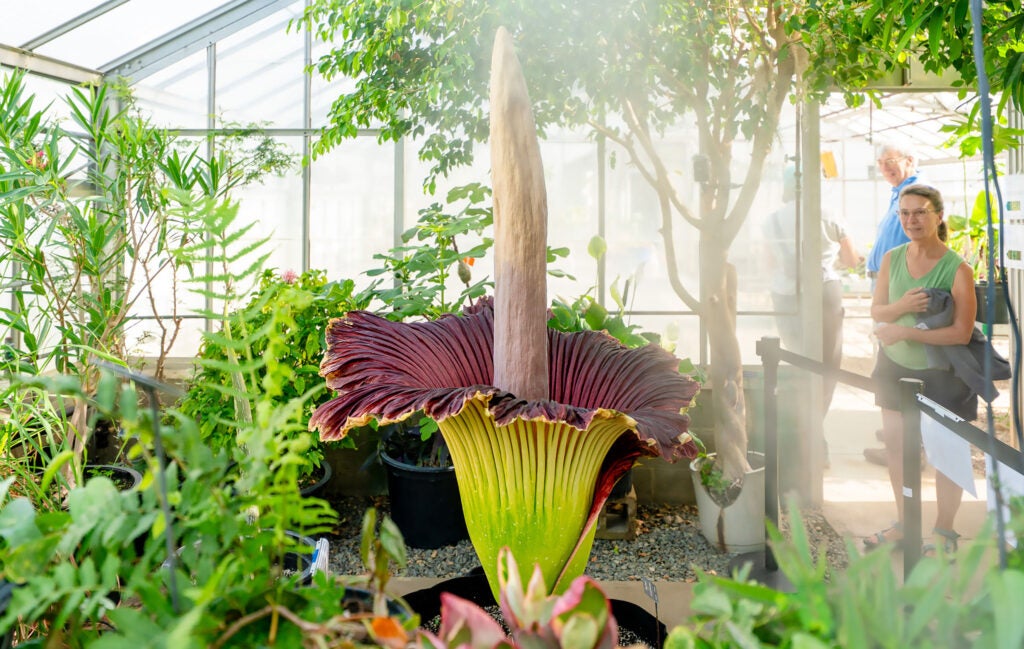
Anna Gray reflects on the remarkable collective experience of anticipating and watching a corpse flower bloom in URI’s Horridge Conservatory.
By Anna Gray ’12, M.S. ’16
For 10 days, thousands of people waited for something that could not be rushed, planned, or scheduled. We waited for a plant.
Across the country, people checked their phones and refreshed the livestream from URI’s Horridge Conservatory, waiting for a corpse flower to bloom.
The corpse flower, Amorphophallus titanum (or titan arum), is very rare. Native to the Sumatran rainforests, it produces the largest inflorescence, or cluster of flowers, in the world. It’s also notorious for smelling like a corpse.
As an employee of URI’s College of the Environment and Life Sciences, I had a front-row seat, watching the anticipation unfold from the first hints of a bloom in early June to the day more than 4,000 visitors lined up outside the greenhouse on Wednesday, June 17.
Ten days before the bloom, URI staff set up a YouTube livestream—one that would draw hundreds of thousands of views from across the country and around the world, a university record. We checked in from our homes, offices, and phones, watching the plant we had affectionately named Morticia inch closer to its moment. One night before the bloom, my sister and I were at a concert. We pulled out our phones and showed the livestream to everyone around us. “It’s our corpse flower,” we shouted to strangers, as proudly as someone showing off photos of a new baby.
It was extraordinary: A flower that smells like decay and blooms for just a few hours somehow generated the kind of enthusiasm usually reserved for a beloved sports team or family pet.
The sidewalks outside the greenhouse are usually full of faculty, students, and staff bustling across campus. On June 17, they were full of community members of all ages waiting to see the plant that captured the attention of an entire state—and beyond. It was a hot day, but people waited in line for hours.

It was extraordinary: A flower that smells like decay and blooms for just a few hours somehow generated the kind of enthusiasm usually reserved for a beloved sports team or family pet.
Strangers struck up conversations with each other and with URI Master Gardeners and greenhouse staff while they waited. Kids played games and covered the sidewalks with chalk drawings. “We were in it for the long haul,” someone wrote on social media, “so there was a sense of camaraderie.”
Greenhouse staff stayed until 2 a.m. so everyone who had waited in line would have the chance to see the bloom. Their generosity became part of the story, too.
Part of what made it so exciting was the uncertainty. The last corpse flower bloom at URI was more than a decade ago. Greenhouse staff provided expert care and knew the signs that signaled a bloom, but nature ultimately decided the timing. There was no way to predict the exact moment. All we could do was watch and wait—a reminder that we can create the conditions for something extraordinary, but we are not always in control.
The corpse flower is fleeting, remaining in full bloom for only about 12 hours. That rarity is part of its appeal. But it also serves as a reminder to pause, step away from our routines, and appreciate something remarkable—precisely because we know it will not last.
Equally remarkable, for me, was watching the public gain new appreciation for the URI faculty, staff, and students who make moments like this possible by caring for the university’s greenhouses. For visitors, Morticia was an introduction not just to a rare bloom but to the broader world of URI’s botanical collections—and to the dedication, expertise, and daily work required to help more than 1,200 unique specimens thrive.
At a time when the world can often feel divided, disconnected, and exhausting, it was a giant, stinky, short-lived flower that reminded us how much joy there is in a collective experience of awe.
Anna Gray ’12, M.S. ’16, is the communications coordinator for URI’s College of the Environment and Life Sciences. In her role, she helped share the news of the corpse flower bloom and had an up close view of how the college, the university, and the community came together to experience this rare phenomenon.
Photos: Catherine Scott