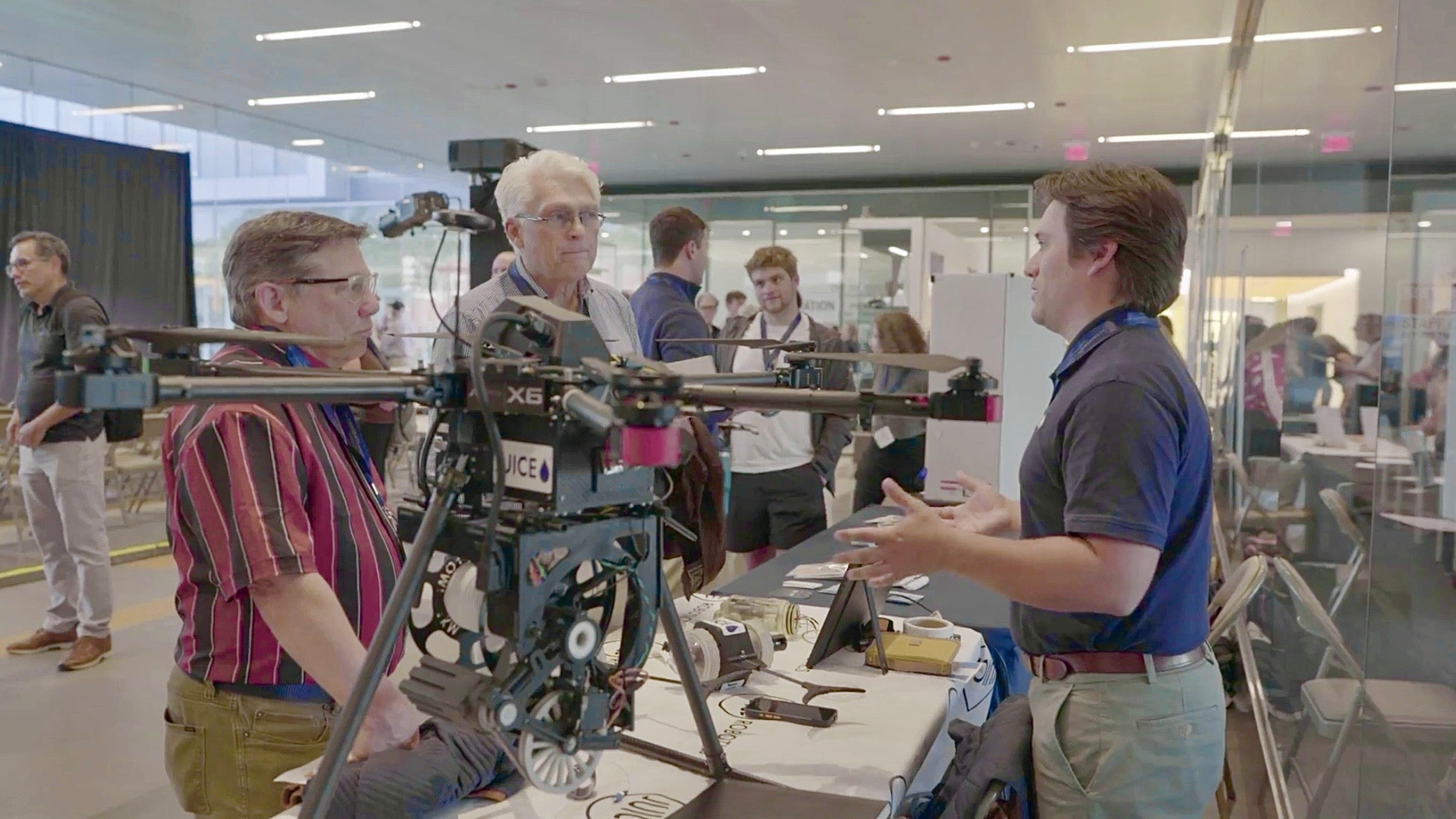
KINGSTON, R.I. – Nov. 9, 2026 – URI Innovations brought ten research-driven technologies and ventures together for the second annual URI Tech Showcase, part of Rhode Island Startup Week, powered by RIHub. The work presented on stage ranged from early university research seeking its first commercial partners to URI spinouts already raising capital, licensing technology, and generating revenue.
The Showcase gave researchers and founders a place to show what they have built, explain the problem it addresses, and make clear what they need to move it forward. It also brought them face-to-face with investors, industry partners, and advisors potentially able to help with that next step.

For several of the innovators on stage, their work began with a problem they had experienced themselves.
Chelsie Santos, co-founder and chief technology officer of FinSight Intelligence, built the foundation of FinSight while studying finance at URI.
Working full-time and living off campus made it difficult for her to regularly access necessary financial data tools. What began as a way to solve her own problem became an AI-powered, financial research and learning platform now being piloted at URI.
“I started FinSight because I needed access to financial data outside of school and off campus,” Santos said. “And now I want more students to have that opportunity.”
Registered Nurse Sarah Waimon’s idea started with a moment she would rather not repeat.
During a shift on a colorectal unit, she used a hospital bedpan washer and got what she described as a “splash right to the face.”
“After some four-letter words, a few tears and, of course, a really good face scrub,” Waimon told the audience, “I started thinking about how to make sure another caregiver would not have the same experience.”
That idea became Looey®, a clear splash guard that connects directly to existing bedpan-washing equipment. Tooling is complete, and Waimon said Looey will be manufactured in Rhode Island in partnership with Mars Plastics.
Other discoveries started in URI laboratories.
Professor Daniel Roxbury’s lab is working to make a bandage do more than cover a wound.
His team has developed a textile embedded with optical nanosensors that can detect hydrogen peroxide, a biomarker associated with wound infection. They have secured a patent for the sensing textile and are also developing a portable reader for eventual use in hospitals and clinics.
“The support that we’ve received through URI Innovations has been instrumental in advancing Smart Bandage to the next stage in its development,” Roxbury said. “I was happy to be part of and present our team’s work at the URI Tech Showcase. The year-over-year growth of the event was impressive, and I am excited to see the pitches in years to come.”
Professor Joe Goodwill presented a water-treatment problem faced by private well owners and other small systems. Traditional manganese treatment can work well at utility scale but often depends on chemical-feeding equipment that is impractical for a home, church, hotel, or small community.
His lab is developing a self-regenerating treatment system that uses electricity to regenerate the filtration media instead. The technology is patent pending, and his team is now building a larger prototype as they work toward commercialization.
Each presenter who took to the stage had only five minutes to summarize years of research, testing, and development.
Professor Rainer Lohmann used his time to present his team’s integrative sampler, which stays in the field for several weeks to give decisionmakers a longer-term picture of PFAS contamination.
CHAMP, led by Austin Becker, professor and chair of URI’s Department of Marine Affairs, combines hyperlocal storm predictions with consequence thresholds tied to vulnerable infrastructure. Already in use at the Rhode Island Emergency Management Agency, the team has also worked with U.S. Navy and Coast Guard installations.
Riccardo Sirtori, founder and scientific lead of NanoGlyph, presented a platform designed to reduce the time and cost required to analyze experiments in biotechnology labs. The platform uses URI-patented nanosensor technology and is moving toward validation with potential customers.
Professor Haibo He, founder of Schedatrix, Inc., presented software designed to make AI inference more efficient by better matching computing resources to individual workloads. The team has tested an early system on GPU hardware.
Several pitches ended with a request aimed directly at the people in the room. Some teams needed pilot partners or industry expertise. Others were looking for customers, advisors, or capital.
Those requests echoed a central point made by keynote speaker Jon Soderstrom, founder of Yale Ventures.
He spoke about passion and perseverance as essential qualities for entrepreneurs but argued that neither is enough on its own. “You need a team,” he said. No founder, researcher, or company builds something significant entirely alone.
By the time he took the stage, the room had already begun demonstrating that idea. URI President Marc Parlange opened the event by pointing to the “good noise and the good discussions” happening around him. Soderstrom later returned to the same observation, saying the network of people willing to help founders, researchers, and companies move forward was beginning to take shape.
“Success builds success,” he said. “It just does.”
Following the milestones from some of last year’s ventures, the event is no longer only about what URI research could become. Some of those trajectories were already visible.
Pete Rumsey, URI associate vice president for economic development, innovation and entrepreneurship and operations director for URI Innovations,pointed to three in particular: Juice Robotics, Trace Sensing Technologies, and FastFlowLM.
“The goal isn’t just to celebrate those three successes,” Rumsey explained. “The larger challenge is creating the conditions for the next 10 — and eventually the next 100”
A video recap of the 2026 URI Tech Showcase is available at URI Innovations’ YouTube page.
About URI Innovations
URI Innovations is the University of Rhode Island’s hub for innovation, entrepreneurship, technology commercialization, and strategic partnerships. Through startup support, intellectual property management, industry engagement, and venture development programs, URI Innovations helps move URI discoveries from the lab to the marketplace—creating real-world impact, advancing economic development, and supporting the next generation of innovators. URI Innovations is operated by the University of Rhode Island Research Foundation. Learn more at uriinnovations.org.
Additional Media Contacts:
Allison Markova
URI Innovations
allison_nangle@uri.edu
401-451-8578